- Space station
- ISS
- NORAD 25544
- 1998-067-A
- Low Earth orbit
- Naked-eye
Current orbit
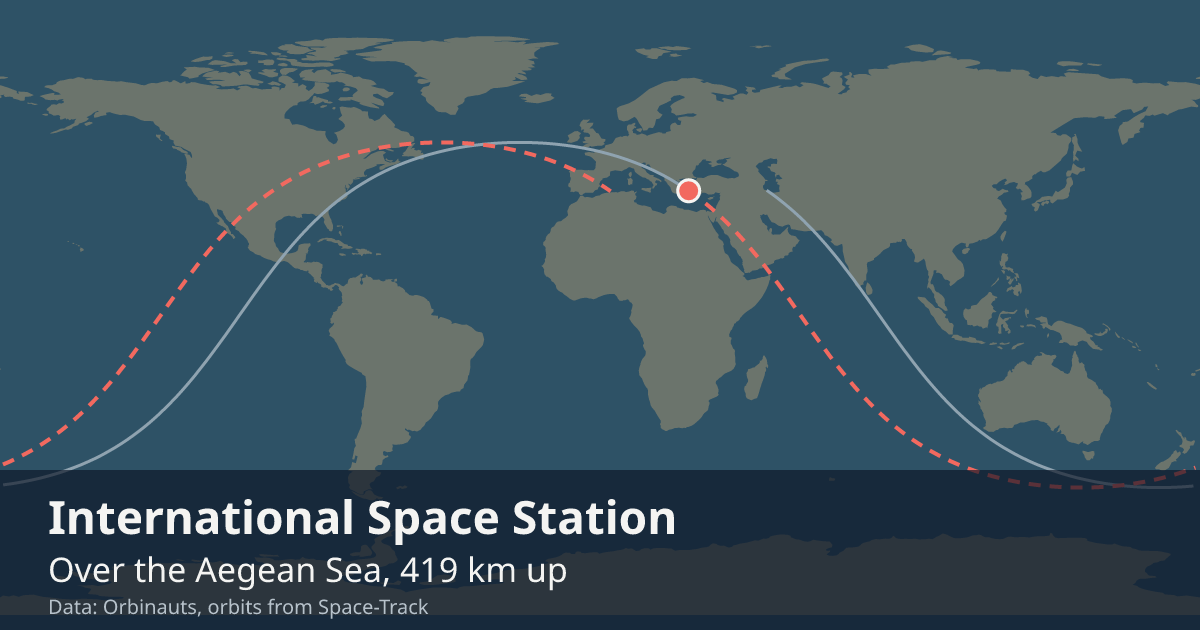 View on live map
Orbit began over the Arabian Sea
Orbit ends over Saudi Arabia
Sunlit since
Enters the Earth’s shadow
Passes over you
Say where you are and your own next passes appear here, the first drawn across your sky.
Your position is rounded to about a kilometre and sent only to the Orbinauts API, to find the pass.
Meanwhile, the next visible pass over three cities:
How to see it
It crosses the sky as a steady point of light, as bright as Venus, moving far faster than an aircraft and never blinking. A pass lasts up to about six minutes from one horizon to the other, and the best ones come in the hour or two after sunset or before sunrise, while the sky is dark and the station overhead is still in sunlight. It can be seen as far north and south as about 64°, with no telescope and no binoculars.
Passes over: London, New York City, Madrid, Mexico City, Delhi, Tokyo, São Paulo, Sydney, every city
Altitude
One reading a day, worked out from the elements Space-Track publishes.
Timeline
- Launch
Launched on Proton from Baikonur. Source
- Milestone
The first crew, Expedition 1, arrived and moved in. Source
- Milestone
The station as it was first designed was finished, with the last of the Space Shuttle flights that built it. Source
- MilestoneStill to come
NASA and its partners plan to bring the station down into a remote part of the ocean at the end of its useful life. Source
Size
- ISS
- Football pitch, 105 by 68 m
Summary
Over the Pacific Ocean LIVE
Where is the ISS?
At 8:06:11 PM UTC the ISS was over the Pacific Ocean (51.1° S, 179.6° E), 438 km up, moving at 7.65 km/s and in sunlight.
What is the ISS?
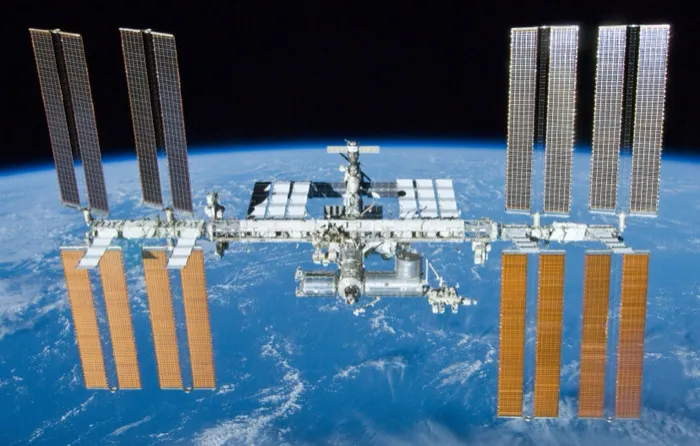
A space station in low Earth orbit, in space since Nov 20, 1998 and crewed without interruption since Nov 2, 2000.
Can I see the ISS tonight?
Yes: the ISS can be seen with the naked eye when it passes over you in a dark sky, after dusk or before dawn, as a steady light that crosses the sky in a few minutes.
General

- Launched
- Crewed without interruption since
- Size
- 109 m across the solar arrays by 73 m of modules
- Crew
- 7 people
- Air
- Oxygen is made by splitting water with electricity, and about nine tenths of the water aboard is recovered and used again.
- Power
- 75 to 90 kW from its solar arrays
- Spacecraft attached at once
- 8
- Amateur radio
- 145.8, 145.825, and 437.8 MHz, the downlinks anyone on the ground can listen to
- Mass
- about 420 t
- Typical altitude
- 400 to 420 km
- Speed
- about 7.66 km/s (27,600 km/h)
Latest orbital data
- Position received
- 8:06 PM UTC
- Station time (UTC)
- 8:06 PM UTC
- Latitude / longitude
- 51.1° S, 179.6° E
- Altitude
- 438 km
- Speed
- 7.65 km/s (27,529 km/h)
- Course
- east
- Light
- In sunlight until 8:53 PM UTC
- Inclination
- 51.6°
- Orbital period
- 93 minutes
- Orbits per day
- 15.49
- This orbit
- 416 to 423 km
- In shadow
- 36 minutes of each orbit
- In view from
- Within 1,430 km of the point below it
- Elements epoch
- Sep 18, 2026, 3:25 AM, 16 hours old
- Source
- Position from NASA’s ephemeris issued Sep 18, 2026, 3:36 PM, 4 hours old.
In orbit
- Close approaches
- Close approaches to the ISS are not available right now. Try again in a few minutes.
- Losing to drag
- the ISS is falling about 34 m a day, read from the last 21 days of samples.
Beside the others
| Satellite | Typical altitude | Orbital period | Mass | Crew | Pressurised modules | In space since |
|---|---|---|---|---|---|---|
| ISS | 400 to 420 km | 93 minutes | about 420 t | 7 | — | 1998 |
| Tiangong | 380 to 400 km | 92 minutes | about 100 t | 3 | 3 | 2021 |
Data and API
The current elements from Space-Track as an OMM object, epoch Sep 18, 2026, 3:25 AM, 16 hours old.
{
  "OBJECT_NAME": "ISS (ZARYA)",
  "OBJECT_ID": "1998-067A",
  "EPOCH": "2026-09-18T03:25:38.782272",
  "MEAN_MOTION": 15.49160218,
  "ECCENTRICITY": 0.00048228,
  "INCLINATION": 51.6307,
  "RA_OF_ASC_NODE": 200.0361,
  "ARG_OF_PERICENTER": 152.4527,
  "MEAN_ANOMALY": 207.6718,
  "EPHEMERIS_TYPE": 0,
  "CLASSIFICATION_TYPE": "U",
  "NORAD_CAT_ID": 25544,
  "ELEMENT_SET_NO": 999,
  "REV_AT_EPOCH": 58616,
  "BSTAR": 0.00011125122,
  "MEAN_MOTION_DOT": 0.00005718,
  "MEAN_MOTION_DDOT": 0
}- The same elements from the API
- Its position from the API
- Passes over a place from the API
- Embed the live map
NASA ephemeris
Issued Sep 18, 2026, 3:36 PM, 4 hours old, covering Sep 18, 2026, 12:00 PM to Oct 3, 2026, 12:00 PM.