- Earth-watching satellite
- NORAD 62261
- 2024-235A
- Low Earth orbit
Current orbit
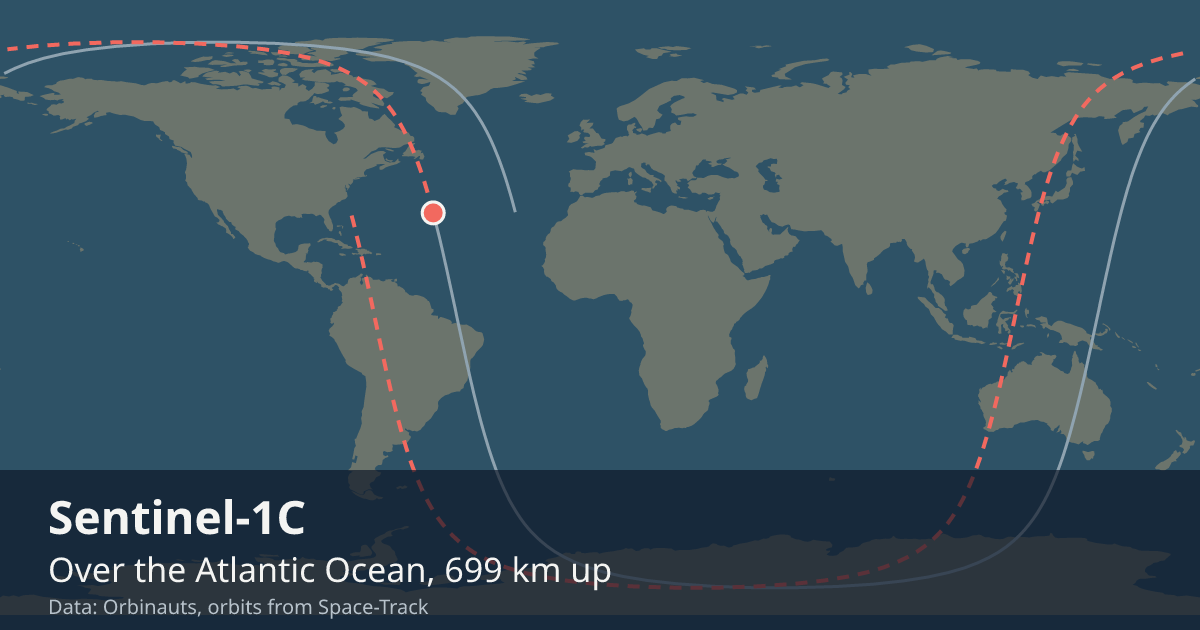 View on live map
Orbit began over the Arctic Ocean
Orbit ends over the Arctic Ocean
In view from you
Nobody watches Sentinel-1C go over, but a receiver still asks whether it is above the horizon. Say where you are and this card answers.
Your position is rounded to about a kilometre and sent only to the Orbinauts API, to find the pass.
No brightness has been published for Sentinel-1C, so it is not a naked-eye satellite and no city page carries pass times for it. Nothing here estimates one.
Seeing it
There is nothing to go outside for: it is too faint for the naked eye. What it is up there for reaches the ground as pictures and measurements, not as a light in the sky.
Altitude
One reading a day, worked out from the elements Space-Track publishes.
Timeline
- Launch
Launched on Vega-C from Kourou. Source
Summary
Over the Coral Sea LIVE
Where is Sentinel-1C?
At 8:07:03 PM UTC Sentinel-1C was over the Coral Sea (14.7° S, 146.2° E), 702 km up, moving at 7.5 km/s and in sunlight.
What is Sentinel-1C?
A satellite that watches the Earth in low Earth orbit, in space since Dec 5, 2024.
Can I see Sentinel-1C?
No, not with the naked eye: no brightness has been published for Sentinel-1C, and nothing here estimates one; what people use is its pictures and measurements of the Earth.
General
- Launched
- Watches
- The Earth’s surface by radar, day and night and through cloud: sea ice, oil spills, floods and the slow movements of the ground
- Full picture of the Earth
- Every 12 days on its own, or every 6 together with Sentinel-1D
- Operator
- ESA, which flies it for the European Union’s Copernicus programme
- Mass
- about 2.2 t
- Typical altitude
- 695 to 697 km
- Speed
- about 7.51 km/s (27,000 km/h)
Latest orbital data
- Position received
- 8:07 PM UTC
- Station time (UTC)
- 8:07 PM UTC
- Latitude / longitude
- 14.7° S, 146.2° E
- Altitude
- 702 km
- Speed
- 7.5 km/s (27,014 km/h)
- Course
- south
- Light
- In sunlight
- Inclination
- 98.2°
- Orbital period
- 98.7 minutes
- Orbits per day
- 14.59
- This orbit
- 692 to 694 km
- In shadow
- None of this orbit
- In view from
- Within 1,950 km of the point below it
- Elements epoch
- Sep 18, 2026, 7:42 AM, 12 hours old
- Source
- Position from Space-Track orbital elements of Sep 18, 2026, 7:42 AM, 12 hours old.
No operator publishes an ephemeris for Sentinel-1C, so every position here comes from its orbital elements.
In orbit
- Close approaches
- Close approaches to Sentinel-1C are not available right now. Try again in a few minutes.
- Losing to drag
- Sentinel-1C is falling less than a metre a day, read from the last 2 days of samples.
The Copernicus Sentinel-1 programme
Orbinauts also tracks:
Data and API
The current elements from Space-Track as an OMM object, epoch Sep 18, 2026, 7:42 AM, 12 hours old.
{
  "OBJECT_NAME": "SENTINEL 1C",
  "OBJECT_ID": "2024-235A",
  "EPOCH": "2026-09-18T07:42:31.401792",
  "MEAN_MOTION": 14.59199713,
  "ECCENTRICITY": 0.00013622,
  "INCLINATION": 98.1823,
  "RA_OF_ASC_NODE": 267.3093,
  "ARG_OF_PERICENTER": 89.9594,
  "MEAN_ANOMALY": 270.1762,
  "EPHEMERIS_TYPE": 0,
  "CLASSIFICATION_TYPE": "U",
  "NORAD_CAT_ID": 62261,
  "ELEMENT_SET_NO": 999,
  "REV_AT_EPOCH": 9499,
  "BSTAR": 0.000027670554,
  "MEAN_MOTION_DOT": 8.5e-7,
  "MEAN_MOTION_DDOT": 0
}