- Space telescope
- Hubble
- NORAD 20580
- 1990-037B
- Low Earth orbit
- Naked-eye
Current orbit
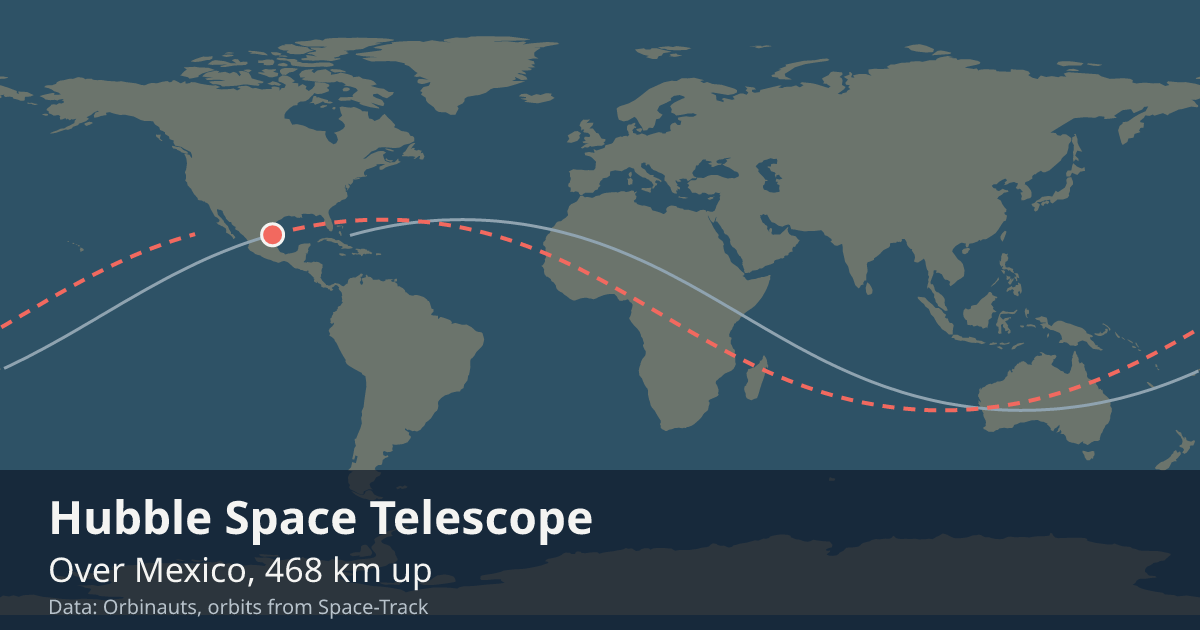 View on live map
Orbit began over the Atlantic Ocean
Orbit ends over the Atlantic Ocean
In the Earth’s shadow since
Back in sunlight
Passes over you
Say where you are and your own next passes appear here, the first drawn across your sky.
Your position is rounded to about a kilometre and sent only to the Orbinauts API, to find the pass.
Meanwhile, the next visible pass over three cities:
- LondonNo visible pass in the next 10 days
- New York CityNo visible pass in the next 10 days
- Sydney
How to see it
It crosses the sky as a steady point of light, as bright as the brightest stars, taking a few minutes from one horizon to the other and never blinking. Look in the dark hour after sunset or before sunrise, when the sky is dark and it is still in sunlight, and away from street lights if you can. It can be seen as far north and south as about 42°.
Passes over: New York City, Los Angeles, Mexico City, Madrid, Cairo, Delhi, Tokyo, São Paulo, every city
Altitude
- 1 The main mirror was found to be the wrong shape by a hair, which blurred every picture it took.
- 2 First servicing mission, STS-61: the COSTAR corrective optics went in and Wide Field and Planetary Camera 2 replaced the first camera.
- 3 Second servicing mission, STS-82: the Space Telescope Imaging Spectrograph and NICMOS replaced the two spectrographs before them.
- 4 Third servicing mission, STS-103: the units holding the gyroscopes were replaced, and the computer with them.
- 5 Fourth servicing mission, STS-109: the Advanced Camera for Surveys and a new cooling system went in, with new solar arrays.
- 6 Last servicing mission, STS-125: Wide Field Camera 3 and the Cosmic Origins Spectrograph went in, every gyroscope and battery was replaced, and two instruments were repaired in orbit.
- 7 Hubble went back to observing after weeks offline, pointing itself with one gyroscope instead of three.
One reading a day, worked out from the elements Space-Track publishes.
Timeline
- Launch
Launched on Space Shuttle Discovery from Kennedy Space Center. Source
- Milestone
The main mirror was found to be the wrong shape by a hair, which blurred every picture it took. Source
- Milestone
First servicing mission, STS-61: the COSTAR corrective optics went in and Wide Field and Planetary Camera 2 replaced the first camera. Source
- Milestone
Second servicing mission, STS-82: the Space Telescope Imaging Spectrograph and NICMOS replaced the two spectrographs before them. Source
- Milestone
Third servicing mission, STS-103: the units holding the gyroscopes were replaced, and the computer with them. Source
- Milestone
Fourth servicing mission, STS-109: the Advanced Camera for Surveys and a new cooling system went in, with new solar arrays. Source
- Milestone
Last servicing mission, STS-125: Wide Field Camera 3 and the Cosmic Origins Spectrograph went in, every gyroscope and battery was replaced, and two instruments were repaired in orbit. Source
- Milestone
Hubble went back to observing after weeks offline, pointing itself with one gyroscope instead of three. Source
Size
- Hubble
- City bus, 12 by 3 m
Summary
Over the Indian Ocean LIVE
Where is Hubble?
At 8:06:04 PM UTC Hubble was over the Indian Ocean (13.1° S, 66° E), 472 km up, moving at 7.63 km/s and in the Earth’s shadow.
What is Hubble?
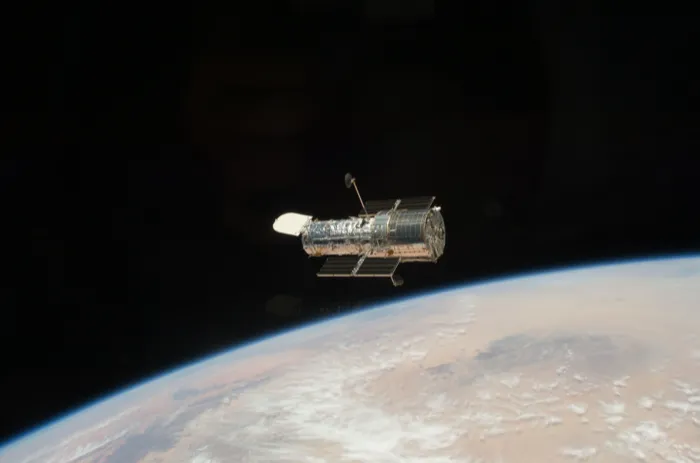
A space telescope in low Earth orbit, in space since Apr 24, 1990.
Can I see Hubble tonight?
Yes: Hubble can be seen with the naked eye when it passes over you in a dark sky, after dusk or before dawn, as a steady light that crosses the sky in a few minutes.
General

- Launched
- Main mirror
- 2.4 m across
- Size
- 13.2 m long by 4.3 m across
- Light it sees
- Ultraviolet, visible and infrared light
- Wavelengths
- 115 to 2,500 nm
- Instruments
- WFC3, ACS, COS, STIS, and FGS
- Operator
- NASA and ESA, with the science run from the Space Telescope Science Institute
- Mass
- about 12.2 t
- Typical altitude
- 465 to 480 km
- Speed
- about 7.63 km/s (27,500 km/h)
Latest orbital data
- Position received
- 8:06 PM UTC
- Station time (UTC)
- 8:06 PM UTC
- Latitude / longitude
- 13.1° S, 66° E
- Altitude
- 472 km
- Speed
- 7.63 km/s (27,475 km/h)
- Course
- south-east
- Light
- In the Earth’s shadow until 8:20 PM UTC
- Inclination
- 28.5°
- Orbital period
- 94 minutes
- Orbits per day
- 15.32
- This orbit
- 474 to 476 km
- In shadow
- 36 minutes of each orbit
- In view from
- Within 1,500 km of the point below it
- Elements epoch
- Sep 18, 2026, 12:25 AM, 19 hours old
- Source
- Position from Space-Track orbital elements of Sep 18, 2026, 12:25 AM, 19 hours old.
No operator publishes an ephemeris for Hubble, so every position here comes from its orbital elements.
In orbit
- Close approaches
- Close approaches to Hubble are not available right now. Try again in a few minutes.
- Losing to drag
- Hubble is falling about 9 m a day, read from the last 8,939 days of samples.
Beside the others
| Satellite | Light it sees | Typical altitude | Main mirror | Mass | In space since |
|---|---|---|---|---|---|
| Hubble | Ultraviolet, visible and infrared light | 465 to 480 km | 2.4 m | about 12.2 t | 1990 |
| Fermi | Gamma rays, from 8 keV to more than 300 GeV | 488 to 498 km | — | about 4.3 t | 2008 |
| Cheops | Visible and near-infrared light, from 0.33 to 1.1 µm | 679 to 694 km | 0.3 m | 280 kg | 2019 |
| XMM-Newton | X-rays, from 0.15 to 12 keV, and visible and ultraviolet light | 29,443 to 91,682 km | 0.7 m | about 3.8 t | 1999 |
| Chandra | X-rays, from 0.1 to 10 keV | 12,186 to 136,630 km | 1.2 m | about 4.8 t | 1999 |
Data and API
The current elements from Space-Track as an OMM object, epoch Sep 18, 2026, 12:25 AM, 19 hours old.
{
  "OBJECT_NAME": "HST",
  "OBJECT_ID": "1990-037B",
  "EPOCH": "2026-09-18T00:25:58.587744",
  "MEAN_MOTION": 15.31682701,
  "ECCENTRICITY": 0.00019535,
  "INCLINATION": 28.4729,
  "RA_OF_ASC_NODE": 165.6473,
  "ARG_OF_PERICENTER": 95.0051,
  "MEAN_ANOMALY": 265.0768,
  "EPHEMERIS_TYPE": 0,
  "CLASSIFICATION_TYPE": "U",
  "NORAD_CAT_ID": 20580,
  "ELEMENT_SET_NO": 999,
  "REV_AT_EPOCH": 80281,
  "BSTAR": 0.00017792507,
  "MEAN_MOTION_DOT": 0.00005838,
  "MEAN_MOTION_DDOT": 0
}