- Earth-watching satellite
- NORAD 54743
- 2022-170C
- Geostationary
Current orbit
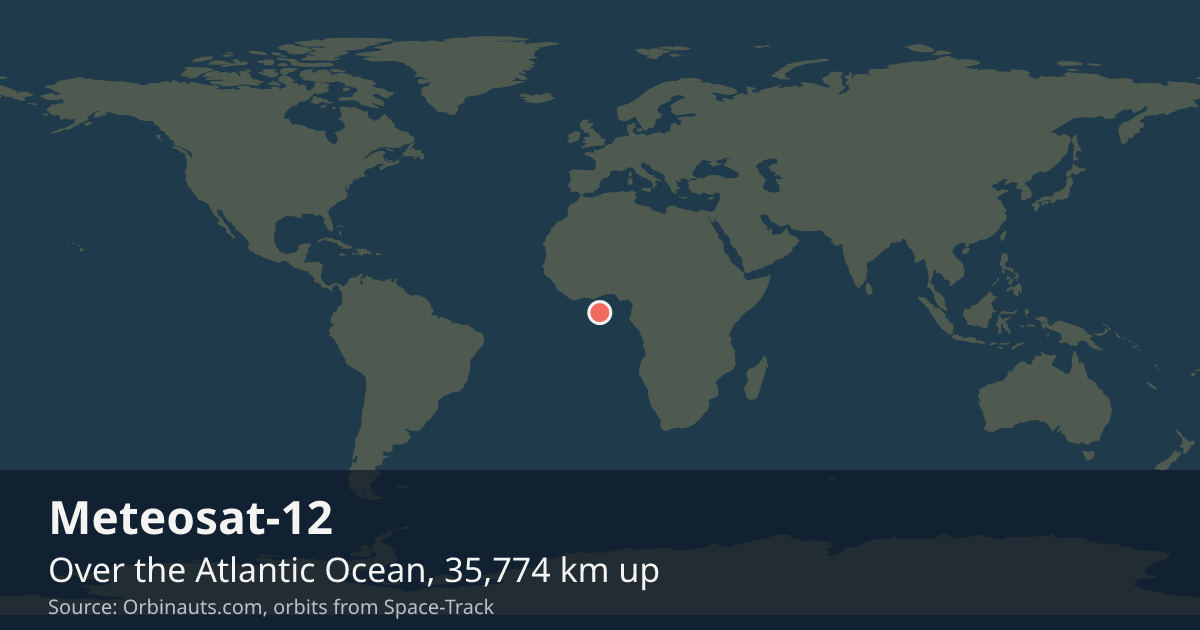 View on live map
One orbit takes a day, as long as the Earth takes to turn, so Meteosat-12 keeps above 0.1° W of the equator and never crosses the sky.
It never rises or sets
Meteosat-12 turns with the Earth, standing over one longitude of the equator. From anywhere it can be seen at all it is up day and night, in the same direction, so there is no pass to wait for.
No brightness has been published for Meteosat-12, so it is not a naked-eye satellite and no city page carries pass times for it. Nothing here estimates one.
Seeing it
There is nothing to wait for: it never crosses the sky. From the half of the Earth it stands over it keeps the same point day and night, and from the other half it never rises at all.
Timeline
- Launch
Launched on Ariane 5 from Kourou. Source
Summary
Over the Atlantic Ocean LIVE
Where is Meteosat-12?
At 3:04:24 AM UTC Meteosat-12 was over the Atlantic Ocean (0.7° N, 0.1° W), 35,775 km up, standing over one longitude of the equator and in sunlight.
What is Meteosat-12?
A satellite that watches the Earth in geostationary orbit, in space since Dec 13, 2022.
Can I see Meteosat-12?
No, not with the naked eye, and it never crosses the sky: Meteosat-12 stands over 0.1° W of the equator; what people use is its pictures and measurements of the Earth.
General
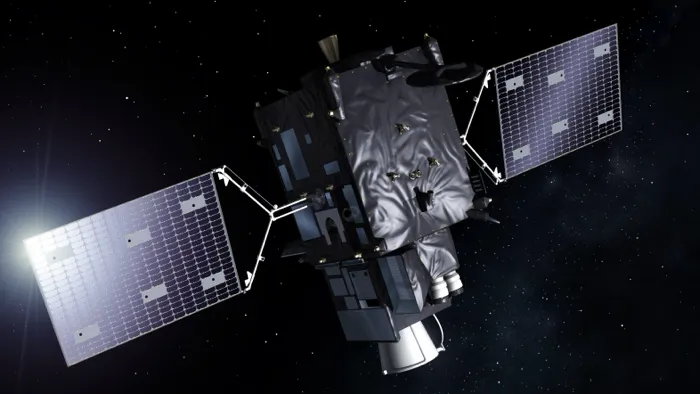
- Launched
- Rocket
- Ariane 5
- Watches
- Europe, Africa and the oceans around them: their clouds, storms and lightning, day and night
- Full picture of the Earth
- Every 10 minutes
- Operator
- EUMETSAT, Europe’s meteorological satellite agency, for its 30 member states
- Took over from
- Meteosat-10, as Europe’s prime geostationary service, on Jun 16, 2025
- Mass
- about 3.8 t
- Typical altitude
- 35,786 to 35,786 km
- Speed
- about 3.07 km/s (11,100 km/h)
Latest orbital data
- Position received
- 3:04 AM UTC
- Station time (UTC)
- 3:04 AM UTC
- Latitude / longitude
- 0.7° N, 0.1° W
- Altitude
- 35,775 km
- Speed
- 3.08 km/s (11,074 km/h)
- Course
- Stands over 0.1° W
- Light
- In sunlight
- Inclination
- 0.7°
- Orbital period
- 1,436.2 minutes
- Orbits per day
- 1
- This orbit
- 35,776 to 35,803 km
- In view from
- Within 7,940 km of the point below it
- Elements epoch
- Nov 2, 2026, 7:51 AM, 16 hours old
- Source
- Position from Space-Track orbital elements of Nov 2, 2026, 7:51 AM, 19 hours old.
No operator publishes an ephemeris for Meteosat-12, so every position here comes from its orbital elements.
In orbit
- Close approaches
- No close approach to Meteosat-12 has been reported publicly in the past thirty days.
From Space-Track’s public conjunction messages; the latest report was issued Nov 2, 2026, 1:53 PM, 10 hours old. Only approaches serious enough to be reported publicly are listed: within three days and, for two bodies near the Earth, closer than a kilometre with a chance of a collision above 1 in 10,000, the level at which NASA moves the ISS.
The Meteosat programme
Orbinauts also tracks:
Data and API
The current elements from Space-Track as an OMM object, epoch Nov 2, 2026, 7:51 AM, 16 hours old.
{
  "OBJECT_NAME": "METEOSAT 12 (MTG I1)",
  "OBJECT_ID": "2022-170C",
  "EPOCH": "2026-11-02T07:51:34.094880",
  "MEAN_MOTION": 1.00265369,
  "ECCENTRICITY": 0.0003237,
  "INCLINATION": 0.7491,
  "RA_OF_ASC_NODE": 21.5062,
  "ARG_OF_PERICENTER": 86.847,
  "MEAN_ANOMALY": 51.1348,
  "EPHEMERIS_TYPE": 0,
  "CLASSIFICATION_TYPE": "U",
  "NORAD_CAT_ID": 54743,
  "ELEMENT_SET_NO": 999,
  "REV_AT_EPOCH": 1435,
  "BSTAR": 0,
  "MEAN_MOTION_DOT": -1.4e-7,
  "MEAN_MOTION_DDOT": 0
}