- Space telescope
- NORAD 25989
- 1999-066A
- Highly elliptical orbit
Current orbit
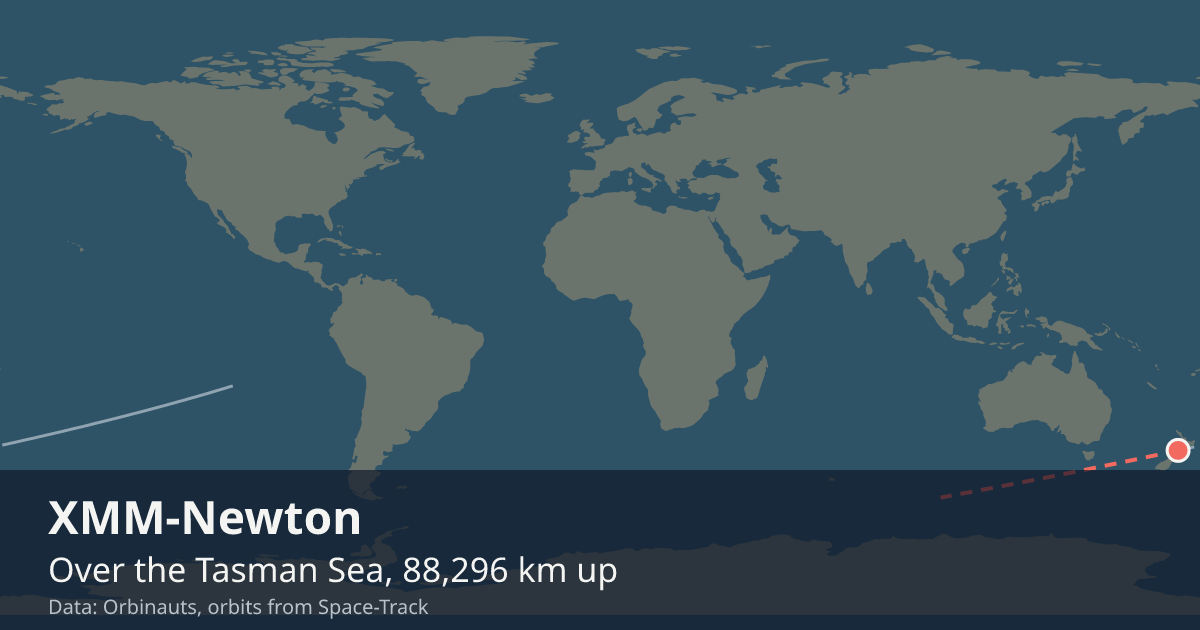 View on live map
Orbit began over Canada
Orbit ends over Canada
In view from you
Nobody watches XMM-Newton go over, but a receiver still asks whether it is above the horizon. Say where you are and this card answers.
Your position is rounded to about a kilometre and sent only to the Orbinauts API, to find the pass.
Even at its closest, XMM-Newton is too faint to see with the naked eye from anywhere on Earth, so no city page carries pass times for it.
Seeing it
There is nothing to go outside for. It is far too faint for the naked eye, and catching it would take a telescope driven to follow a point crossing the sky in minutes. What is worth looking at is what it sends back.
Timeline
- Launch
Launched on Ariane-5 from Kourou. Source
Summary
Over the Pacific Ocean LIVE
Where is XMM-Newton?
At 8:07:30 PM UTC XMM-Newton was over the Pacific Ocean (38.1° S, 175.2° W), 86,984 km up, moving at 1.61 km/s and in sunlight.
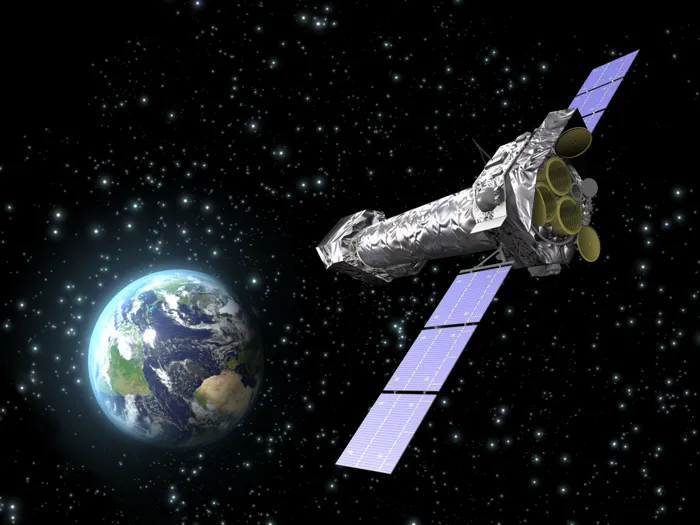
What is XMM-Newton?
A space telescope in a highly elliptical orbit, in space since Dec 10, 1999.
Can I see XMM-Newton?
No, not with the naked eye: even at its closest, XMM-Newton is too faint to see from anywhere on Earth; what people use is what it sees, which its operator publishes.
General
- Launched
- Main mirror
- 0.7 m across
- Light it sees
- X-rays, from 0.15 to 12 keV, and visible and ultraviolet light
- Operator
- ESA, flown from its operations centre in Darmstadt, with the science run from ESAC near Madrid
- Mass
- about 3.8 t
- Typical altitude
- 29,443 to 91,682 km
- Speed
- about 1.47 to 4.04 km/s (5,300 to 14,500 km/h)
Latest orbital data
- Position received
- 8:07 PM UTC
- Station time (UTC)
- 8:07 PM UTC
- Latitude / longitude
- 38.1° S, 175.2° W
- Altitude
- 86,984 km
- Speed
- 1.61 km/s (5,789 km/h)
- Course
- west
- Light
- In sunlight
- Inclination
- 64°
- Orbital period
- 2,872.8 minutes
- Orbits per day
- 0.5
- This orbit
- 29,445 to 91,680 km
- In view from
- Within 8,470 km of the point below it
- Elements epoch
- Sep 20, 2026, 2:15 AM, 0 seconds old
- Source
- Position from Space-Track orbital elements of Sep 20, 2026, 2:15 AM, 0 seconds old.
No operator publishes an ephemeris for XMM-Newton, so every position here comes from its orbital elements.
In orbit
- Close approaches
- Close approaches to XMM-Newton are not available right now. Try again in a few minutes.
Beside the others
| Satellite | Light it sees | Typical altitude | Main mirror | Mass | In space since |
|---|---|---|---|---|---|
| XMM-Newton | X-rays, from 0.15 to 12 keV, and visible and ultraviolet light | 29,443 to 91,682 km | 0.7 m | about 3.8 t | 1999 |
| Chandra | X-rays, from 0.1 to 10 keV | 12,186 to 136,630 km | 1.2 m | about 4.8 t | 1999 |
| Cheops | Visible and near-infrared light, from 0.33 to 1.1 µm | 679 to 694 km | 0.3 m | 280 kg | 2019 |
| Fermi | Gamma rays, from 8 keV to more than 300 GeV | 488 to 498 km | — | about 4.3 t | 2008 |
| Hubble | Ultraviolet, visible and infrared light | 465 to 480 km | 2.4 m | about 12.2 t | 1990 |
Data and API
The current elements from Space-Track as an OMM object, epoch Sep 20, 2026, 2:15 AM, 0 seconds old.
{
  "OBJECT_NAME": "XMM",
  "OBJECT_ID": "1999-066A",
  "EPOCH": "2026-09-20T02:15:28.951776",
  "MEAN_MOTION": 0.50125912,
  "ECCENTRICITY": 0.46485054,
  "INCLINATION": 63.989,
  "RA_OF_ASC_NODE": 281.7554,
  "ARG_OF_PERICENTER": 63.192,
  "MEAN_ANOMALY": 0.128,
  "EPHEMERIS_TYPE": 0,
  "CLASSIFICATION_TYPE": "U",
  "NORAD_CAT_ID": 25989,
  "ELEMENT_SET_NO": 999,
  "REV_AT_EPOCH": 2348,
  "BSTAR": 0,
  "MEAN_MOTION_DOT": 0.00000133,
  "MEAN_MOTION_DDOT": 0
}