- Communications satellite
- NORAD 53807
- 2022-111AL
- Low Earth orbit
- Naked-eye
Current orbit
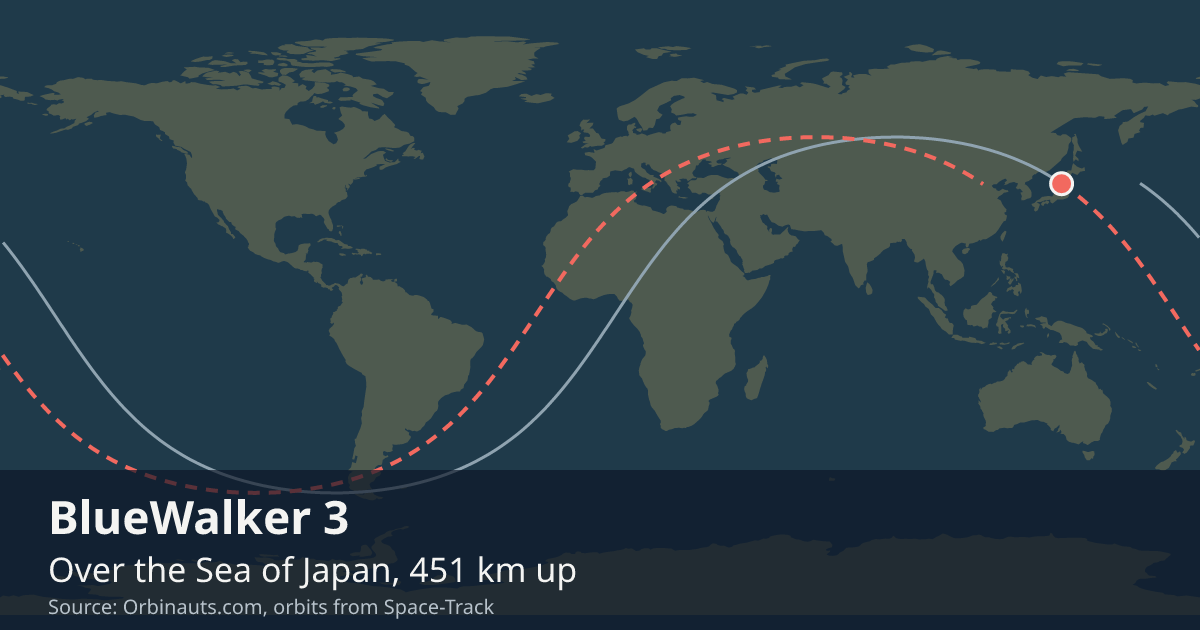 View on live map
Orbit began over the Pacific Ocean
Orbit ends over the Pacific Ocean
Sunlit since
Enters the Earth’s shadow
Passes over you
Say where you are and your own next passes appear here, the first drawn across your sky.
Your position is rounded to about a kilometre and sent only to the Orbinauts API, to find the pass.
Meanwhile, the next visible pass over three cities:
- London
- New York City
- SydneyNo visible pass in the next 10 days
How to see it
It crosses the sky as a steady point of light, no brighter than a faint star, taking a few minutes from horizon to horizon and never blinking. Look in the hour or two after sunset or before sunrise, while the sky is dark and it is still in sunlight. It can be seen as far north and south as about 66°.
Passes over: London, Berlin, New York City, Mexico City, Delhi, Tokyo, Buenos Aires, Auckland, every city
Altitude
One reading a day, worked out from the elements Space-Track publishes.
Timeline
- Launch
Launched on Falcon 9 from Cape Canaveral. Source
Summary
Over the Pacific Ocean LIVE
Where is BlueWalker 3?
At 3:03:01 AM UTC BlueWalker 3 was over the Pacific Ocean (41.1° S, 126.8° W), 457 km up, moving at 7.64 km/s and in sunlight.
What is BlueWalker 3?
A communications satellite in low Earth orbit, in space since Sep 11, 2022.
Can I see BlueWalker 3 tonight?
Yes: BlueWalker 3 can be seen with the naked eye when it passes over you in a dark sky, after dusk or before dawn, as a steady light that crosses the sky in a few minutes.
General
- Launched
- Rocket
- Falcon 9
- Carries
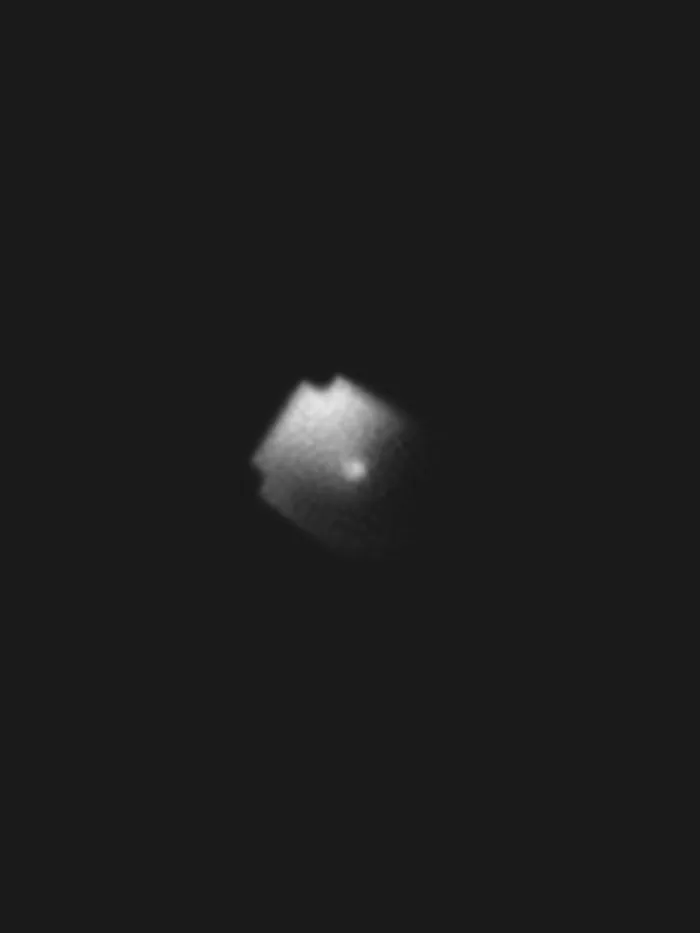
- Test calls, video and 5G broadband straight to everyday, unmodified smartphones, from a phased array of 64 m²
- Covers
- A field of view of more than 775,000 km² below it, wherever its orbit takes it
- Operator
- AST SpaceMobile, which built it as the prototype of its BlueBird satellites
- Design life
- 2 years
- Mass
- about 1.5 t
- Typical altitude
- 443 to 453 km
- Speed
- about 7.64 km/s (27,500 km/h)
Latest orbital data
- Position received
- 3:03 AM UTC
- Station time (UTC)
- 3:03 AM UTC
- Latitude / longitude
- 41.1° S, 126.8° W
- Altitude
- 457 km
- Speed
- 7.64 km/s (27,504 km/h)
- Course
- south-east
- Light
- In sunlight until 3:13 AM UTC
- Inclination
- 53.2°
- Orbital period
- 93.5 minutes
- Orbits per day
- 15.4
- This orbit
- 444 to 450 km
- In shadow
- 25 minutes of each orbit
- In view from
- Within 1,470 km of the point below it
- Elements epoch
- Nov 2, 2026, 10:27 AM, 16 hours old
- Source
- Position from Space-Track orbital elements of Nov 2, 2026, 10:27 AM, 16 hours old.
No operator publishes an ephemeris for BlueWalker 3, so every position here comes from its orbital elements.
In orbit
- Close approaches
- No close approach to BlueWalker 3 has been reported publicly in the past thirty days.
- Losing to drag
- BlueWalker 3 is falling about 33 m a day, read from the last 48 days of samples.
From Space-Track’s public conjunction messages; the latest report was issued Nov 2, 2026, 1:53 PM, 13 hours old. Only approaches serious enough to be reported publicly are listed: within three days and, for two bodies near the Earth, closer than a kilometre with a chance of a collision above 1 in 10,000, the level at which NASA moves the ISS.
Data and API
The current elements from Space-Track as an OMM object, epoch Nov 2, 2026, 10:27 AM, 16 hours old.
{
  "OBJECT_NAME": "BLUEWALKER 3",
  "OBJECT_ID": "2022-111AL",
  "EPOCH": "2026-11-02T10:27:24.156000",
  "MEAN_MOTION": 15.39778409,
  "ECCENTRICITY": 0.0004256,
  "INCLINATION": 53.227,
  "RA_OF_ASC_NODE": 104.176,
  "ARG_OF_PERICENTER": 234.6279,
  "MEAN_ANOMALY": 125.4329,
  "EPHEMERIS_TYPE": 0,
  "CLASSIFICATION_TYPE": "U",
  "NORAD_CAT_ID": 53807,
  "ELEMENT_SET_NO": 999,
  "REV_AT_EPOCH": 23149,
  "BSTAR": 0.00013476,
  "MEAN_MOTION_DOT": 0.00005021,
  "MEAN_MOTION_DDOT": 0
}