INTELSAT 805 broke up on July 30, 2026
Published by the breakups project on Jul 31, 2026, 8:00 PM UTC, confirmed on August 20, 2026 by its pieces (4).
Download the figures (PNG)Height chartOrbit at the time shownPieces’ spread
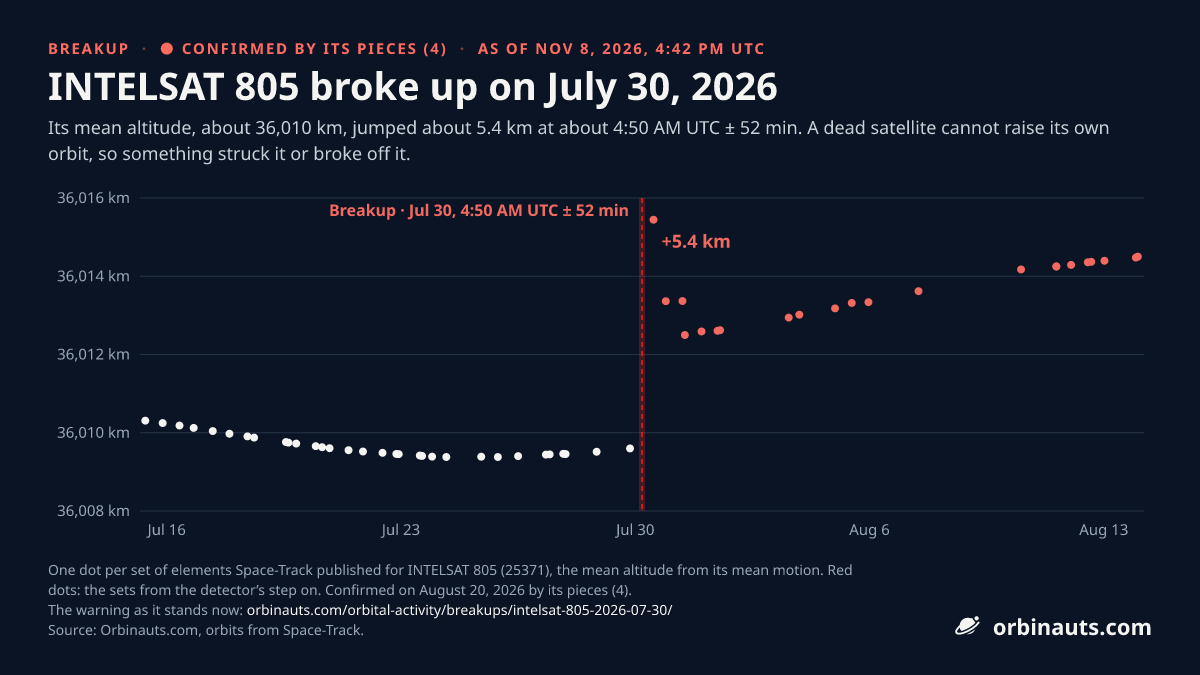
Mean altitude of every set of elements, July 15, 2026 to August 14, 2026
One dot per set · 54 setsMean altitude from the mean motion of each set of elements Space-Track published for INTELSAT 805 (25371). Dots in red are the sets from the detector’s step on; the band is the time shown.
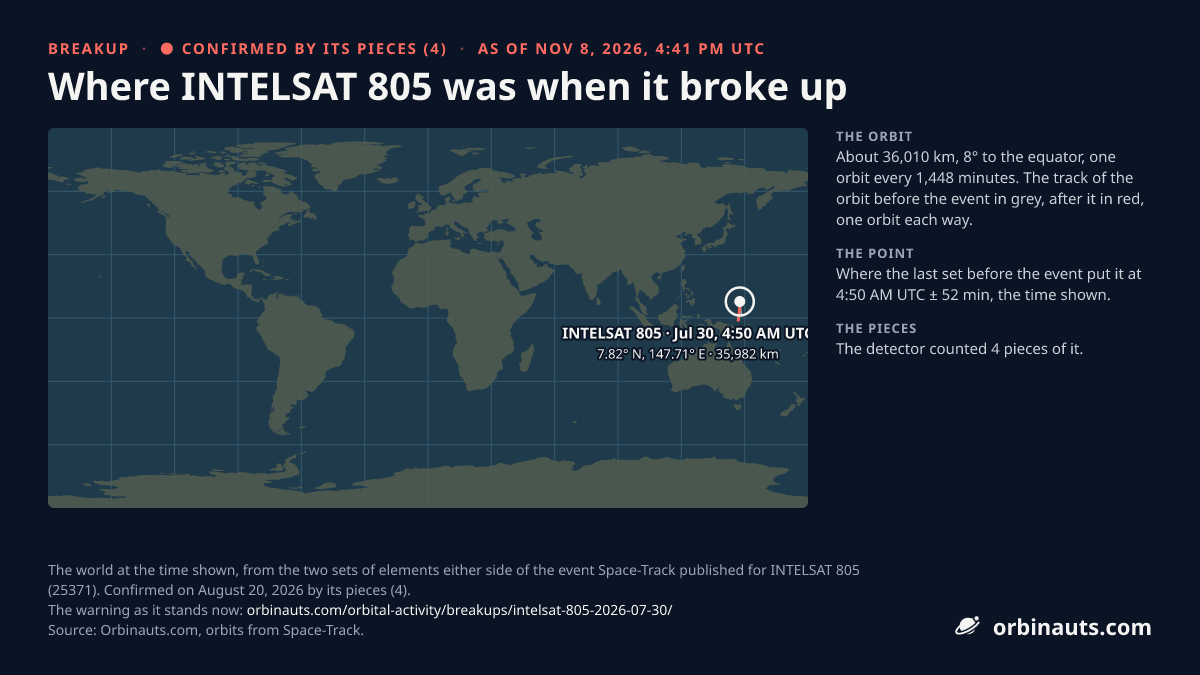
Where it was at 4:50 AM UTC
The orbit INTELSAT 805 was on at the time shown: one orbit from its last set of elements before the event (grey) and one from its first set after it (red). The point is where the set before put it then, 35,982 km up. Follow it on the live map now. The live map plays back the past 7 days, so this instant is beyond it.
The parent and its pieces
- Body
- INTELSAT 805, 25371
- International designator
- 1998-037A
- Class
- Payload
- Launched
- June 18, 1998
- Mass
- 3,524 kg
- Orbit
- 35,760 km to 36,269 km up, one orbit every 1,447.7 min
The detector counted 4 pieces of it.
See them
Masses: data from J. McDowell, planet4589.org, licensed CC BY 4.0
How far its pieces have spread
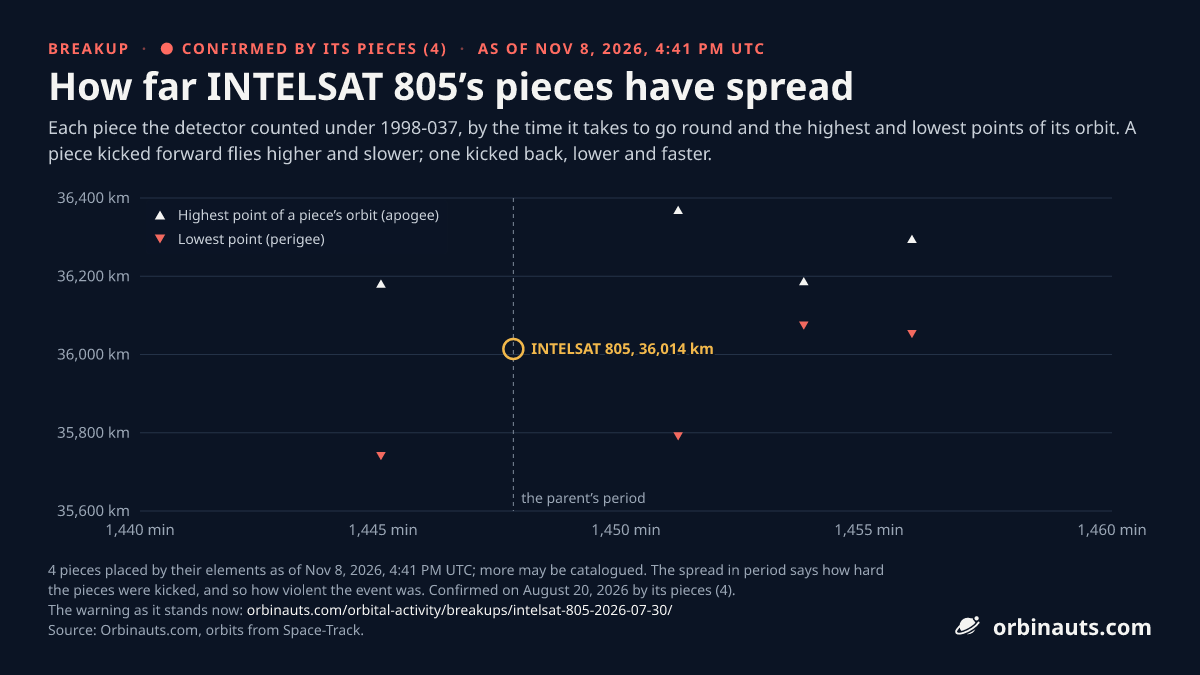
4 pieces placed by their elements- Highest point of a piece’s orbit (apogee)
- Lowest point (perigee)
Each piece the detector counted, by the time it takes to go round and the highest and lowest points of its orbit, from its latest elements on Space-Track. A piece kicked forward flies higher and slower; one kicked back, lower and faster. The ring is INTELSAT 805 and the dashed line its period: how far the pieces spread either side of it says how violent the event was.
Why it is shown
- What the detector saw: the mean altitude stepped up by about 5.4 km between the sets of Jul 29, 2026, 8:14 PM and Jul 30, 2026, 1:06 PM UTC; the perigee moved +6.3 km, the apogee +4.5 km and the inclination −0.0516°.
- The step held over the 3 sets after it, at 270.6 times the scatter of the parent’s own record.
- How it was confirmed: by 4 pieces catalogued in the parent’s orbital plane.
- The time shown: July 30, 2026, 4:50 AM UTC ± 52 min, the detector’s own estimate.
The detector’s own reasons, as it wrote them:
- 4 new bodies under launch 1998-037 (100395, 100396, 100398, 100397) numbered above the catalogue's mark at the step, first published after it, in the parent's plane (distance 0.5, 0.5, 0.4, 0.2), moving 3.3 m/s from it
- propagated back, 4 pieces converge on 25371 at 2026-07-29 19:43, sigma 405 min, missing it by 190.5 km; each piece's closest approach to 25371: 4 of 4 cross it in the window, their median at 2026-07-30 03:25, half of them within 0.5 h of it and three quarters within 3.4 h (robust spread 0.8 h), the pieces 19.9 days old at it
- 4 new bodies under 1998-037 in 14 days against a background of 0.50 (0 in the year before): Poisson tail 1.8e-3, no burst
- 4 pieces in the plane of parent 25371 (distance under 3), moving 3.3 m/s, the semi-major axes spread over 213.0 km
- confirmed 20.6 days after the step
Source: Orbinauts.com, orbits from Space-Track. Breakups and their evidence from the open-source breakups detector; each time is credited to whoever dated it.
Its pieces in the catalogue
4 pieces of 1998-037 the detector counted, as Space-Track lists them now.