- NORAD 100462
- 2026-188E
- Low Earth orbit
Current orbit
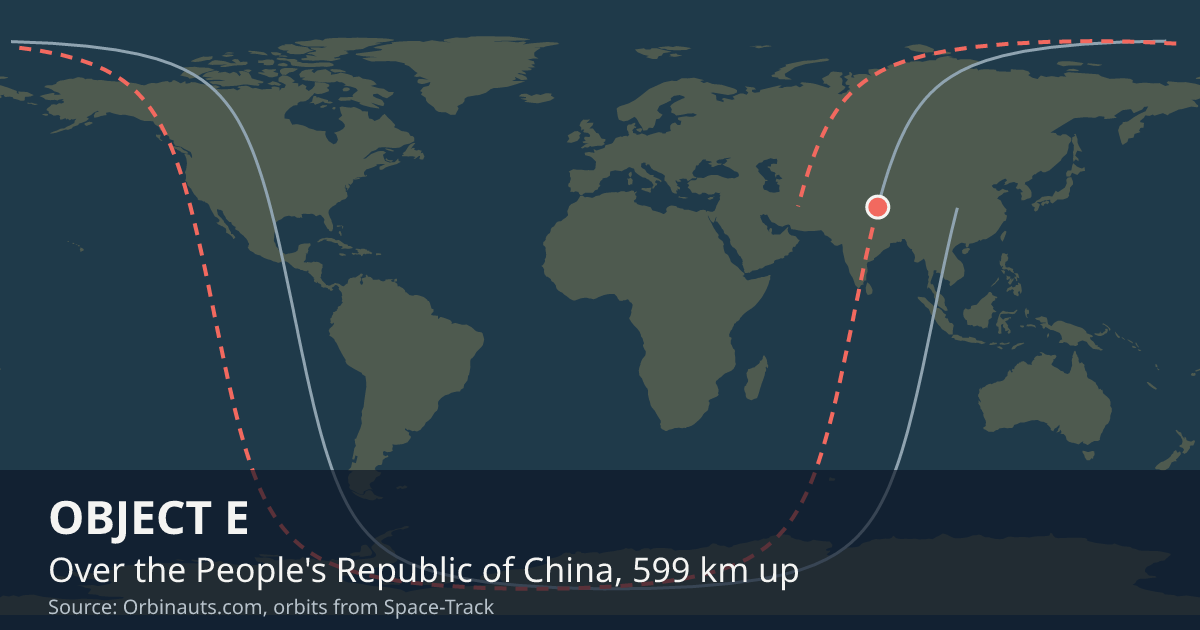 View on live map
Orbit began over Antarctica
Orbit ends over Antarctica
Sunlit since
Enters the Earth’s shadow
In view from you
Nobody watches OBJECT E go over, but a receiver still asks whether it is above the horizon. Say where you are and this card answers.
Your position is rounded to about a kilometre and sent only to the Orbinauts API, to find the pass.
No brightness has been published for OBJECT E, so it is not a naked-eye satellite and no city page carries pass times for it. Nothing here estimates one.
Seeing it
There is nothing to go outside for: it is too faint to see with the naked eye from anywhere on Earth.
Timeline
- Launch
Launched, on the day GCAT records. Source
Summary
Over the Pacific Ocean LIVE
Where is OBJECT E?
At 4:55:20 PM UTC OBJECT E was over the Pacific Ocean (44.1° S, 106.3° W), 534 km up, moving at 7.61 km/s and in sunlight.
What is OBJECT E?
A satellite in low Earth orbit, in space since Aug 17, 2026.
Can I see OBJECT E?
No, not with the naked eye: no brightness has been published for OBJECT E, and nothing here estimates one.
General
- Launched
- Mass
- 1 kg
- Orbit class
- Low Earth orbit
From GCAT, Jonathan McDowell’s general catalogue, licensed CC BY 4.0: the launch day and the mass. The orbit class is read from its current elements.
Latest orbital data
- Position received
- 4:55 PM UTC
- Station time (UTC)
- 4:55 PM UTC
- Latitude / longitude
- 44.1° S, 106.3° W
- Altitude
- 534 km
- Speed
- 7.61 km/s (27,410 km/h)
- Course
- south
- Light
- In sunlight until 5:17 PM UTC
- Inclination
- 97.9°
- Orbital period
- 95.7 minutes
- Orbits per day
- 15.04
- This orbit
- 474 to 627 km
- In shadow
- 35 minutes of each orbit
- In view from
- Within 1,630 km of the point below it
- Elements epoch
- Nov 8, 2026, 3:08 AM, 13 hours old
- Source
- Position from Space-Track orbital elements of Nov 8, 2026, 3:08 AM, 13 hours old.
No operator publishes an ephemeris for OBJECT E, so every position here comes from its orbital elements.
In orbit
- Close approaches
- No close approach to OBJECT E has been reported publicly in the past thirty days.
From Space-Track’s public conjunction messages; the latest report was issued Nov 8, 2026, 1:11 PM, 3 hours old. Only approaches serious enough to be reported publicly are listed: within three days and, for two bodies near the Earth, closer than a kilometre with a chance of a collision above 1 in 10,000, the level at which NASA moves the ISS.
Launched with
OBJECT E shares its launch, 2026-188, with 6 other bodies the catalogue lists in orbit.
| Body | What it is |
|---|---|
| OBJECT A | Earth-watching satellite |
| OBJECT B | Satellite |
| OBJECT C | Satellite |
| OBJECT D | Satellite |
| OBJECT F | Satellite |
| OBJECT G | Satellite |
Read from the international designators of the US catalogue: the year and the launch number every piece of one launch shares. A body that has come down is no longer listed.
Data and API
The current elements from Space-Track as an OMM object, epoch Nov 8, 2026, 3:08 AM, 13 hours old.
{
  "OBJECT_NAME": "OBJECT E",
  "OBJECT_ID": "2026-188E",
  "EPOCH": "2026-11-08T03:08:44.605248",
  "MEAN_MOTION": 15.04225078,
  "ECCENTRICITY": 0.01105239,
  "INCLINATION": 97.8697,
  "RA_OF_ASC_NODE": 22.4761,
  "ARG_OF_PERICENTER": 288.4067,
  "MEAN_ANOMALY": 70.5167,
  "EPHEMERIS_TYPE": 0,
  "CLASSIFICATION_TYPE": "U",
  "NORAD_CAT_ID": 100462,
  "ELEMENT_SET_NO": 999,
  "REV_AT_EPOCH": 1244,
  "BSTAR": 0.001855822,
  "MEAN_MOTION_DOT": 0.00029564,
  "MEAN_MOTION_DDOT": 0
}