- Navigation satellite
- Military
- NORAD 54031
- 2022-130A
- Medium Earth orbit
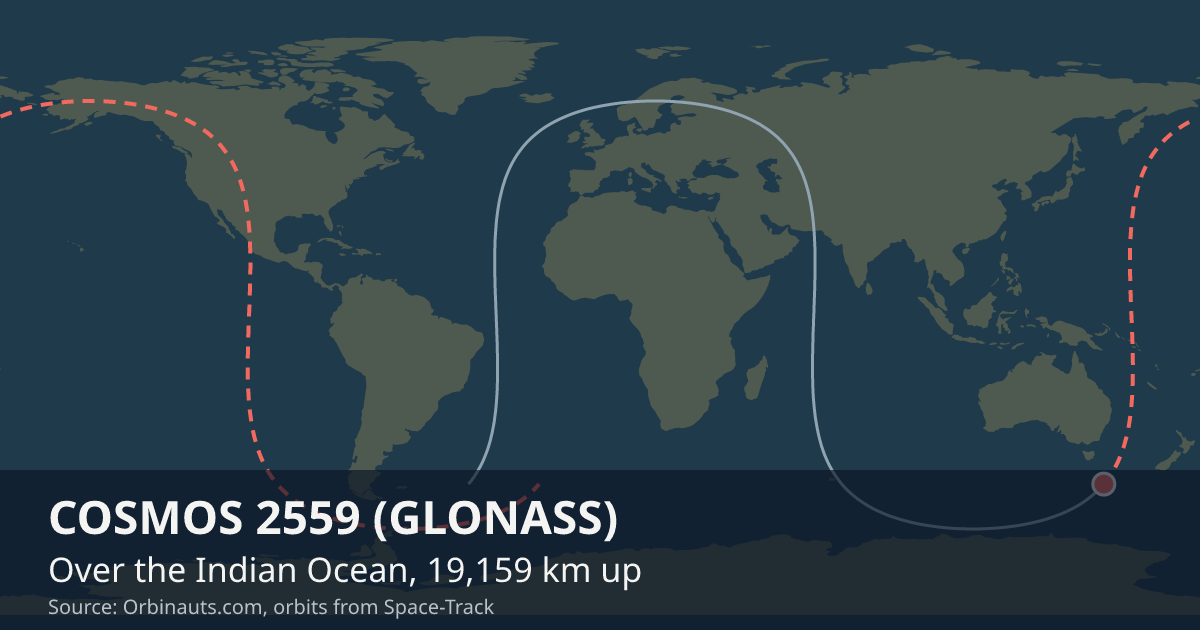
Current orbit
 View on live map
Orbit began over the Indian Ocean
Orbit ends over the Pacific Ocean
In view from you
Nobody watches COSMOS 2559 (GLONASS) go over, but a receiver still asks whether it is above the horizon. Say where you are and this card answers.
Your position is rounded to about a kilometre and sent only to the Orbinauts API, to find the pass.
No brightness has been published for COSMOS 2559 (GLONASS), so it is not a naked-eye satellite and no city page carries pass times for it. Nothing here estimates one.
Seeing it
There is nothing to go outside for: it is far too high and too faint for the naked eye. What you notice of it is a position fix, and the card above says whether it is above your horizon to give you one.
Summary
Over the Southern Ocean LIVE
Where is COSMOS 2559 (GLONASS)?
At 4:10:00 AM UTC COSMOS 2559 (GLONASS) was over the Southern Ocean (63.5° S, 100.9° E), 19,143 km up, moving at 3.95 km/s and in sunlight.
What is COSMOS 2559 (GLONASS)?
A GLONASS navigation satellite in medium Earth orbit, in space since Oct 10, 2022.
Can I see COSMOS 2559 (GLONASS)?
No, not with the naked eye: no brightness has been published for COSMOS 2559 (GLONASS), and nothing here estimates one; receivers on the ground use its signals instead, whenever it is above their horizon.
General
COSMOS 2559 (GLONASS) is one of the 24 navigation satellites of the GLONASS constellation. See every GLONASS satellite and how many are above you right now.
- Launched
- Known to its operator as
- GC 707
- Typical altitude
- 19,050 to 19,200 km
Latest orbital data
- Position received
- 4:10 AM UTC
- Station time (UTC)
- 4:10 AM UTC
- Latitude / longitude
- 63.5° S, 100.9° E
- Altitude
- 19,143 km
- Speed
- 3.95 km/s (14,231 km/h)
- Course
- east
- Light
- In sunlight
- Inclination
- 64.2°
- Orbital period
- 675.7 minutes
- Orbits per day
- 2.13
- This orbit
- 19,097 to 19,163 km
- In shadow
- None of this orbit
- In view from
- Within 7,310 km of the point below it
- Elements epoch
- Nov 1, 2026, 9:23 PM, 1 day old
- Source
- Position from Space-Track orbital elements of Nov 1, 2026, 9:23 PM, 1 day old.
No operator publishes an ephemeris for COSMOS 2559 (GLONASS), so every position here comes from its orbital elements.
In orbit
- Close approaches
- No close approach to COSMOS 2559 (GLONASS) has been reported publicly in the past thirty days.
From Space-Track’s public conjunction messages; the latest report was issued Nov 2, 2026, 1:53 PM, 11 hours old. Only approaches serious enough to be reported publicly are listed: within three days and, for two bodies near the Earth, closer than a kilometre with a chance of a collision above 1 in 10,000, the level at which NASA moves the ISS.
Beside the others
| Constellation | Satellites | Typical altitude | Orbital period | Planes | Operator |
|---|---|---|---|---|---|
| GLONASS | 24 | 19,050 to 19,200 km | 676 minutes | — | Roscosmos, the Russian State Space Corporation |
| GPS | 32 | 20,000 to 20,400 km | 718 minutes | 6 | The United States Space Force |
| Galileo | 28 | 23,100 to 23,300 km | 845 minutes | — | EUSPA, the European Union Agency for the Space Programme |
| BeiDou | 37 | 21,450 to 21,600 km | 773 minutes | — | The China Satellite Navigation Office |
Data and API
The current elements from Space-Track as an OMM object, epoch Nov 1, 2026, 9:23 PM, 1 day old.
{
  "OBJECT_NAME": "COSMOS 2559 (GLONASS)",
  "OBJECT_ID": "2022-130A",
  "EPOCH": "2026-11-01T21:23:26.778624",
  "MEAN_MOTION": 2.13101439,
  "ECCENTRICITY": 0.0012926,
  "INCLINATION": 64.1852,
  "RA_OF_ASC_NODE": 309.7009,
  "ARG_OF_PERICENTER": 191.7229,
  "MEAN_ANOMALY": 168.2737,
  "EPHEMERIS_TYPE": 0,
  "CLASSIFICATION_TYPE": "U",
  "NORAD_CAT_ID": 54031,
  "ELEMENT_SET_NO": 999,
  "REV_AT_EPOCH": 3162,
  "BSTAR": 0,
  "MEAN_MOTION_DOT": -1.3e-7,
  "MEAN_MOTION_DDOT": 0
}