Breakups
A satellite that no longer works, a rocket body or a piece of debris cannot change its own orbit, and drag only ever lowers it. When its mean altitude steps up between two consecutive sets of its elements, something struck it or broke off it. Each is a suspected breakup until the catalogue lists new pieces under its international designator or Space-Track publishes its notice.
Latest warnings
| Event time (UTC) | Parent | Class | Jump | Status |
|---|---|---|---|---|
| Oct 10, 2026, 7:51 PM± 1 min | DMSP 5D-2 F14 DEB62941 · 1997-012M | Debris | −130 mdrop, more than drag explains | Suspected0 days, no notice, no new piece |
| Oct 8, 2026, 8:36 AM± 30 min | HAIYANG 2A37781 · 2011-043A | Payload, ended per GCAT | +210 mrise, which drag cannot cause | Suspected3 days, no notice, no new piece |
| Oct 5, 2026 | METEOR 2-712456 · 1981-043AIn the news: Meteor 2-7, a Soviet weather satellite dead since 1984, may have broken up | Payload, ended per GCAT | +230 mrise, which drag cannot cause | Suspected5 days, no notice, no new piece |
| Sep 13, 2026, 9:12 PM± 8 min | USA 3219460 · 1988-078AIn the news: A 38-year-old US spy satellite breaks apart in orbit | Payload, ended per GCAT | −470 mdrop, more than drag explains | ConfirmedSpace-Track notice, Sep 13 |
Not watched, as their elements scatter too widely or too few were measured to hold the false alarms to about one a month: ended payloads below 700 km and from 1,800 km up; rocket bodies below 600 km, from 1,200 km to 1,300 km, and from 1,600 km up; debris below 600 km and from 1,900 km up; unknown objects below 600 km, from 700 km to 1,000 km, and from 1,200 km up.
Source: Orbinauts (orbinauts.com), orbits from Space-Track. Event times are estimated from the elements either side of the jump, never from a notice.
DMSP 5D-2 F14 DEB may have broken up on October 10, 2026
Suspected since Oct 11, 2026, 4:18 AM UTC, the refresh that read it. Not confirmed: no notice from Space-Track and no new piece under 1997-012 as of Oct 11, 2026, 7:42 AM UTC.
Download the figures (PNG)Height chartOrbit at the event time
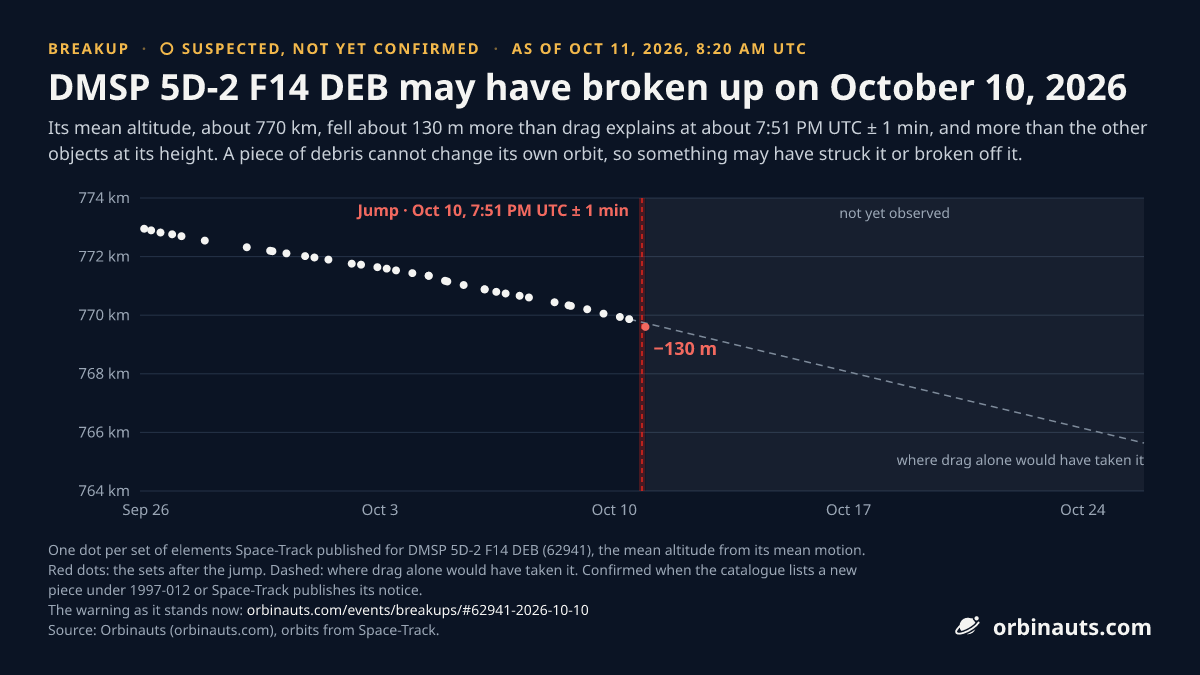
Mean altitude of every set of elements, September 25, 2026 to October 10, 2026
One dot per set · 38 setsMean altitude from the mean motion of each set of elements Space-Track published for DMSP 5D-2 F14 DEB (62941). Dots in red are the sets after the jump. The dashed grey line is where the last set before the jump, carried at its own drag rate, would have put the orbit.
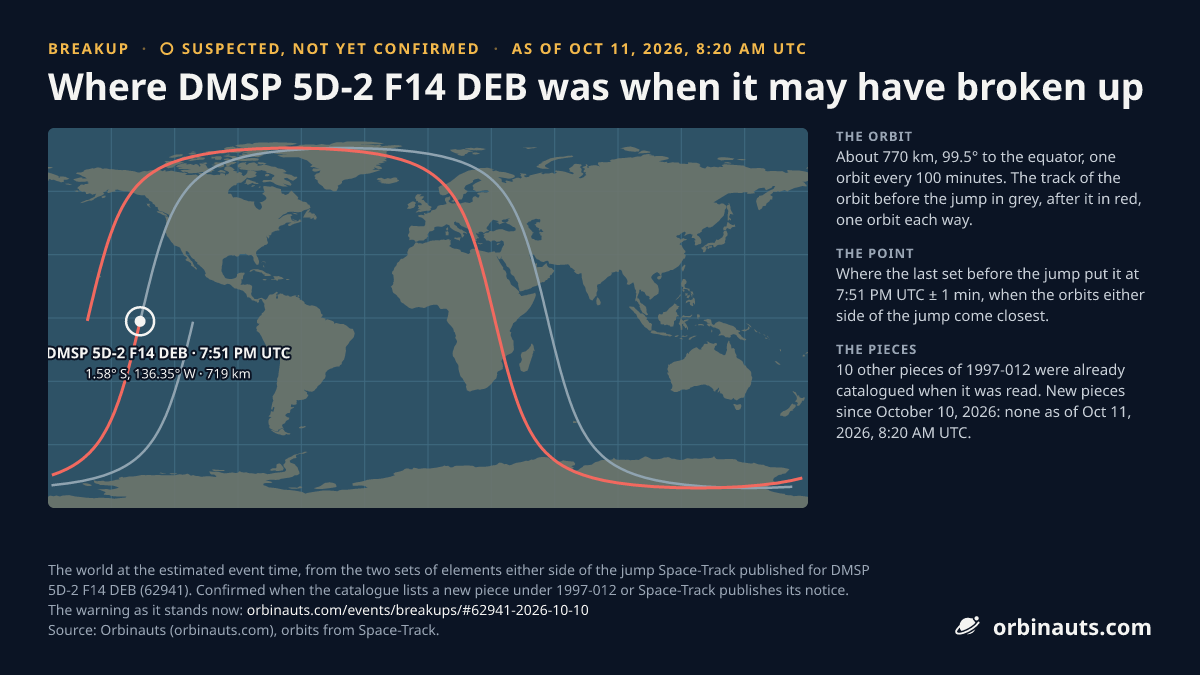
Where it was at 7:51 PM UTC
The orbit DMSP 5D-2 F14 DEB was on at the estimated event time: one orbit before it from the last set before the jump (grey) and one after it from the first set after the jump (red). The point is where the last set before the jump put it then, 719 km up. Follow it on the live map at that instant.
The parent and its pieces
- Body
- DMSP 5D-2 F14 DEB, 62941
- International designator
- 1997-012M
- Class
- Debris
- Launched
- 1997
- Mass
- not given
- Orbit
- about 770 km, 99.5° to the equator
10 other pieces of 1997-012 were already catalogued when it was read.
See them
- 1997-012A, DMSP 5D-2 F14 (USA 131) (24753)
- 1997-012H, DMSP 5D-2 F14 DEB (62937)
- 1997-012J, DMSP 5D-2 F14 DEB (62938)
- 1997-012K, DMSP 5D-2 F14 DEB (62939)
- 1997-012N, DMSP 5D-2 F14 DEB (62942)
- 1997-012P, DMSP 5D-2 F14 DEB (62943)
- 1997-012Q, DMSP 5D-2 F14 DEB (62944)
- 1997-012R, DMSP 5D-2 F14 DEB (62945)
- 1997-012U, DMSP 5D-2 F14 DEB (63154)
- 1997-012V, DMSP 5D-2 F14 DEB (63155)
New pieces since October 10, 2026: none. When one is catalogued under 1997-012, this warning is confirmed and the count is kept here.
Why it was raised
| Set of elements | Epoch (UTC) | Mean altitude |
|---|---|---|
| Last before the jump | Oct 10, 2026, 10:39 AM | 769.866 km |
| Where drag alone would have taken it | Oct 10, 2026, 10:21 PM | 769.732 km |
| First after the jump | Oct 10, 2026, 10:21 PM | 769.600 km |
- The jump: about 130 m below where drag alone would have taken it, more than drag explains, and a drop the other objects at its height did not share.
- The threshold for debris between 700 km and 800 km: 90 m, set from the set-to-set scatter of that class and band, 1.15 m.
- Its own sets: over the 30 days before, 67 comparisons from one set to the next scattered by 9.01 m, and the jump is 14 times that; it had to be 10.
- The event time: the orbits of the last set before the jump and the first after it, propagated, come closest at Oct 10, 2026, 7:51 PM UTC; the spread of ± 1 min is where they stay within twice that distance.
- What would confirm it: a new piece under 1997-012 in the catalogue, or Space-Track’s notice. Checked at every refresh.
Source: Orbinauts (orbinauts.com), orbits from Space-Track. Event times are estimated from the elements either side of the jump, never from a notice.
HAIYANG 2A may have broken up on October 8, 2026
Suspected since Oct 8, 2026, 8:17 PM UTC, the refresh that read it. Not confirmed: no notice from Space-Track and no new piece under 2011-043 as of Oct 11, 2026, 7:42 AM UTC.
Download the figures (PNG)Height chartOrbit at the event time
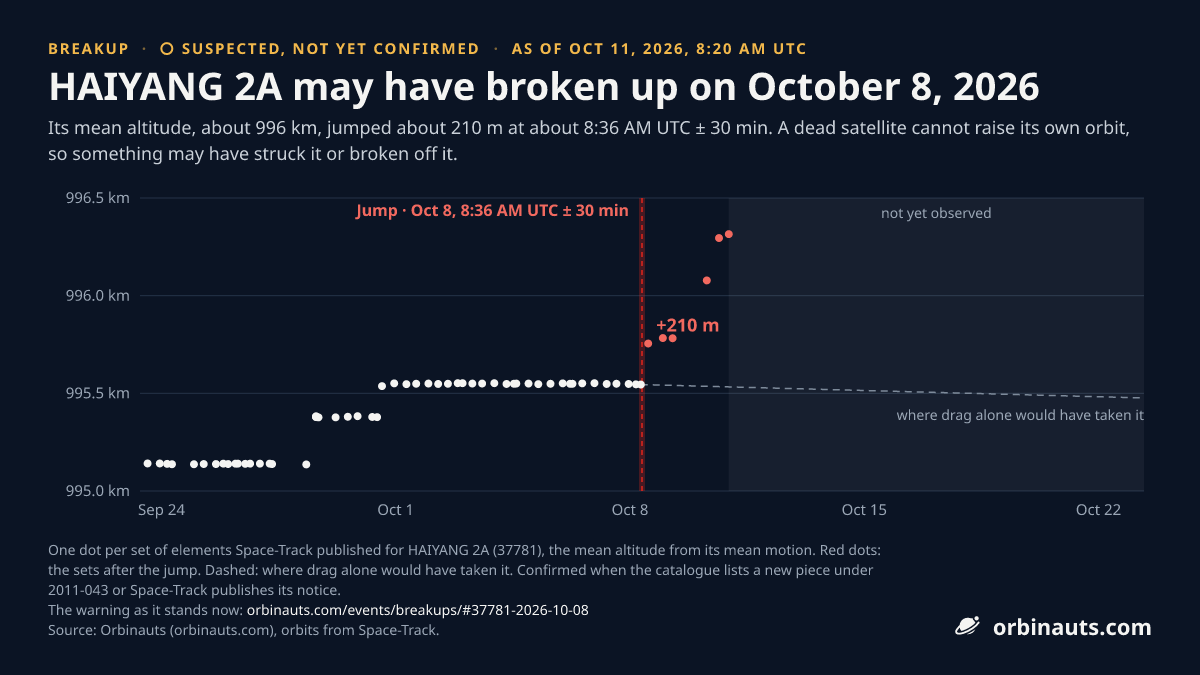
Mean altitude of every set of elements, September 23, 2026 to October 10, 2026
One dot per set · 60 setsMean altitude from the mean motion of each set of elements Space-Track published for HAIYANG 2A (37781). Dots in red are the sets after the jump. The dashed grey line is where the last set before the jump, carried at its own drag rate, would have put the orbit.
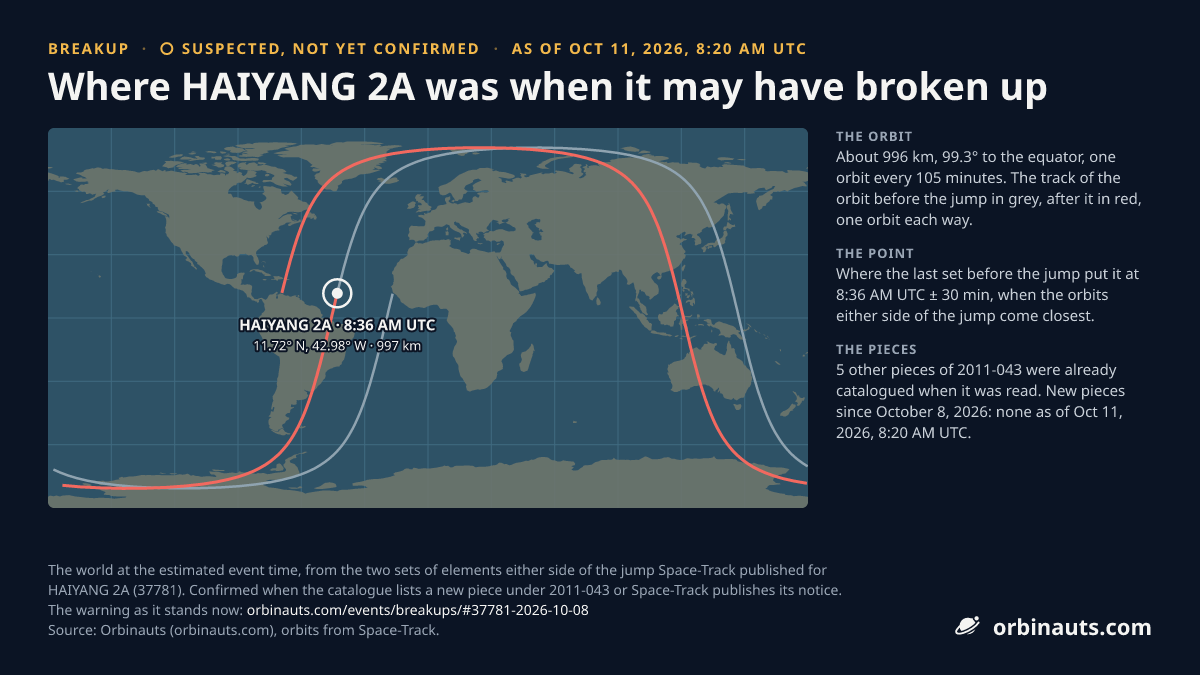
Where it was at 8:36 AM UTC
The orbit HAIYANG 2A was on at the estimated event time: one orbit before it from the last set before the jump (grey) and one after it from the first set after the jump (red). The point is where the last set before the jump put it then, 997 km up. Follow it on the live map at that instant.
The parent and its pieces
- Body
- HAIYANG 2A, 37781
- International designator
- 2011-043A
- Class
- Payload, ended per GCAT
- Launched
- 2011
- Ended
- November 2020
- Mass
- 1,500 kg
- Orbit
- about 996 km, 99.3° to the equator
5 other pieces of 2011-043 were already catalogued when it was read.
See them
New pieces since October 8, 2026: none. When one is catalogued under 2011-043, this warning is confirmed and the count is kept here.
Masses: data from J. McDowell, planet4589.org, licensed CC BY 4.0
Ends of operations: data from J. McDowell, planet4589.org, licensed CC BY 4.0
Why it was raised
| Set of elements | Epoch (UTC) | Mean altitude |
|---|---|---|
| Last before the jump | Oct 8, 2026, 7:47 AM | 995.545 km |
| Where drag alone would have taken it | Oct 8, 2026, 1:02 PM | 995.544 km |
| First after the jump | Oct 8, 2026, 1:02 PM | 995.755 km |
- The jump: about 210 m above where drag alone would have taken it. Drag only ever lowers an orbit, so it cannot cause a rise.
- The threshold for ended payloads between 900 km and 1,000 km: 20 m, set from the set-to-set scatter of that class and band, 0.1 m.
- Its own sets: over the 30 days before, 119 comparisons from one set to the next scattered by 1.93 m, and the jump is 109 times that; it had to be 10.
- The event time: the orbits of the last set before the jump and the first after it, propagated, come closest at Oct 8, 2026, 8:36 AM UTC; the spread of ± 30 min is where they stay within twice that distance.
- What would confirm it: a new piece under 2011-043 in the catalogue, or Space-Track’s notice. Checked at every refresh.
Source: Orbinauts (orbinauts.com), orbits from Space-Track. Event times are estimated from the elements either side of the jump, never from a notice.
METEOR 2-7 may have broken up on October 5, 2026
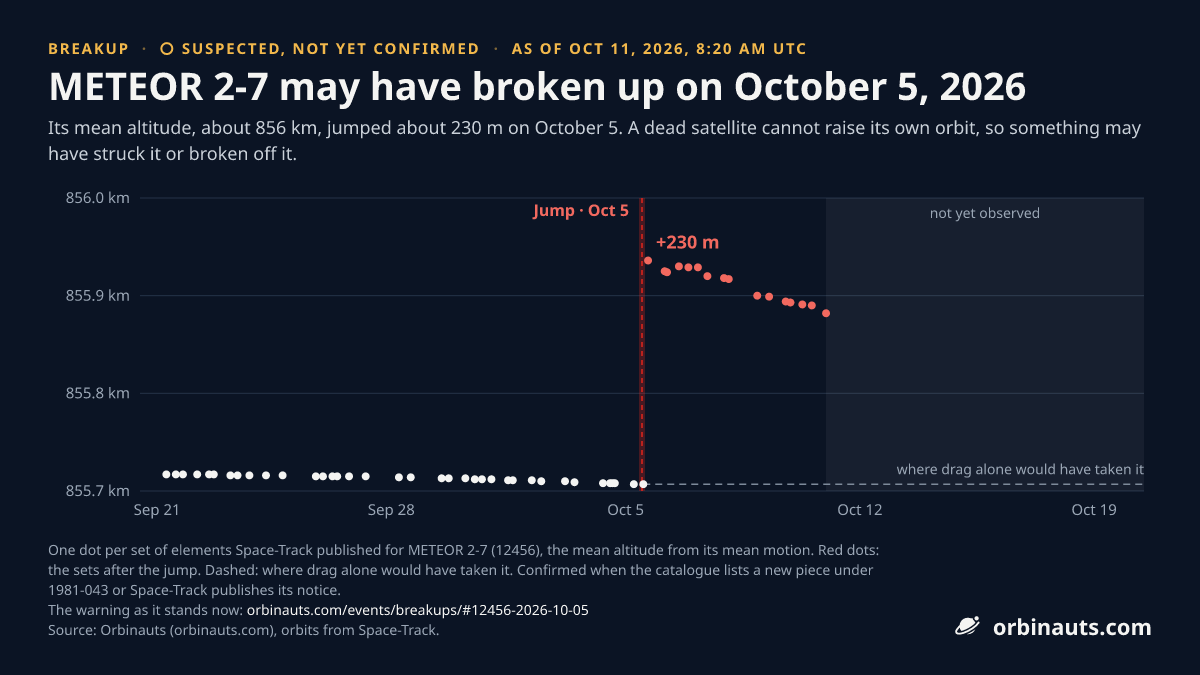
Suspected since Oct 6, 2026, 4:17 AM UTC, the refresh that read it. Not confirmed: no notice from Space-Track and no new piece under 1981-043 as of Oct 11, 2026, 7:42 AM UTC.
Download the figures (PNG)Height chartOrbit at the event time
In the news: Meteor 2-7, a Soviet weather satellite dead since 1984, may have broken up
Mean altitude of every set of elements, September 21, 2026 to October 10, 2026
One dot per set · 53 setsMean altitude from the mean motion of each set of elements Space-Track published for METEOR 2-7 (12456). Dots in red are the sets after the jump. The dashed grey line is where the last set before the jump, carried at its own drag rate, would have put the orbit.
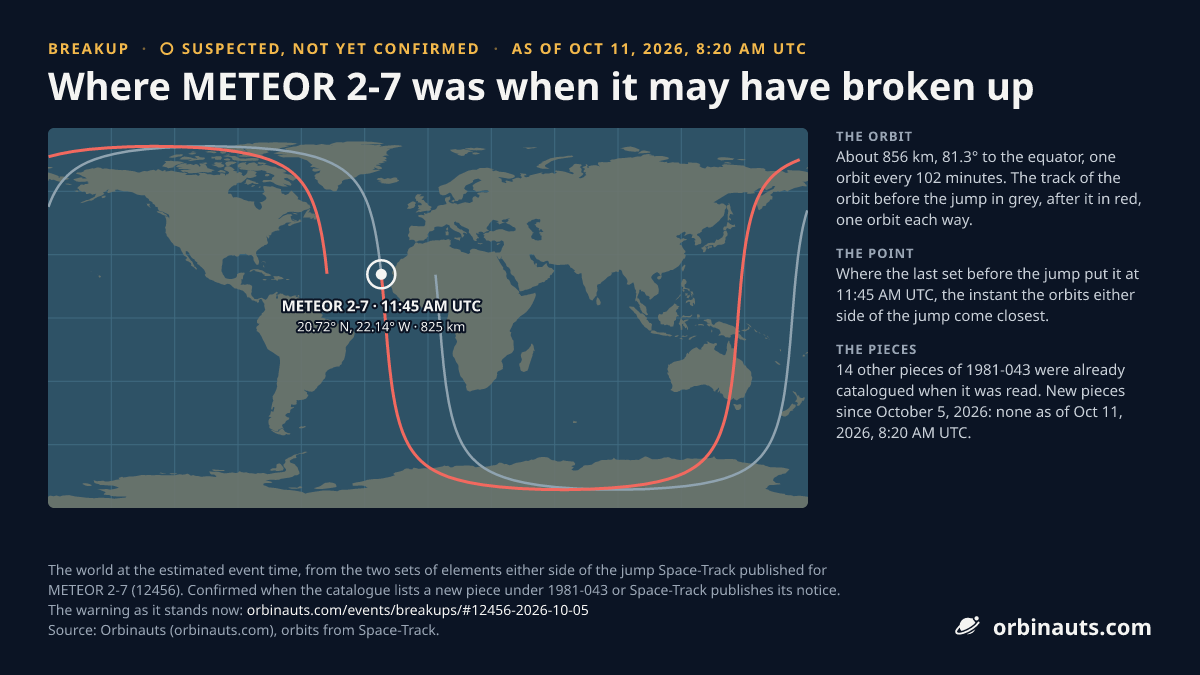
Where it was at 11:45 AM UTC
The orbit METEOR 2-7 was on at the estimated event time: one orbit before it from the last set before the jump (grey) and one after it from the first set after the jump (red). The point is where the last set before the jump put it then, 825 km up. Follow it on the live map at that instant.
The parent and its pieces
- Body
- METEOR 2-7, 12456
- International designator
- 1981-043A
- Class
- Payload, ended per GCAT
- Launched
- 1981
- Ended
- August 28, 1984
- Mass
- 1,500 kg
- Orbit
- about 856 km, 81.3° to the equator
14 other pieces of 1981-043 were already catalogued when it was read.
See them
- 1981-043B, SL-3 R/B (12457)
- 1981-043C, SL-3 DEB (15769)
- 1981-043D, SL-3 DEB (25255)
- 1981-043E, METEOR 2-7 DEB (28388)
- 1981-043F, METEOR 2-7 DEB (28389)
- 1981-043M, METEOR 2-7 DEB (35424)
- 1981-043R, METEOR 2-7 DEB (36878)
- 1981-043S, METEOR 2-7 DEB (36879)
- 1981-043W, METEOR 2-7 DEB (38288)
- 1981-043X, METEOR 2-7 DEB (43300)
- 1981-043Y, METEOR 2-7 DEB (43301)
- 1981-043Z, METEOR 2-7 DEB (43302)
- 1981-043AA, METEOR 2-7 DEB (45515)
- 1981-043AB, METEOR 2-7 DEB (59993)
New pieces since October 5, 2026: none. When one is catalogued under 1981-043, this warning is confirmed and the count is kept here.
Masses: data from J. McDowell, planet4589.org, licensed CC BY 4.0
Ends of operations: data from J. McDowell, planet4589.org, licensed CC BY 4.0
Why it was raised
| Set of elements | Epoch (UTC) | Mean altitude |
|---|---|---|
| Last before the jump | Oct 5, 2026, 12:42 PM | 855.707 km |
| Where drag alone would have taken it | Oct 5, 2026, 4:07 PM | 855.707 km |
| First after the jump | Oct 5, 2026, 4:07 PM | 855.936 km |
- The jump: about 230 m above where drag alone would have taken it. Drag only ever lowers an orbit, so it cannot cause a rise.
- The threshold for ended payloads between 800 km and 900 km: 10 m, set from the set-to-set scatter of that class and band, 0.15 m.
- Its own sets: over the 30 days before, 73 comparisons from one set to the next scattered by 0.11 m, and the jump is 2,081 times that; it had to be 10.
- The event time: the orbits of the last set before the jump and the first after it, propagated, come closest at 11:45 AM UTC on October 5. Their distance gives no margin about that instant, so it is an estimate to the day, not to the minute.
- What would confirm it: a new piece under 1981-043 in the catalogue, or Space-Track’s notice. Checked at every refresh.
Source: Orbinauts (orbinauts.com), orbits from Space-Track. Event times are estimated from the elements either side of the jump, never from a notice.
USA 32 broke up on September 13, 2026
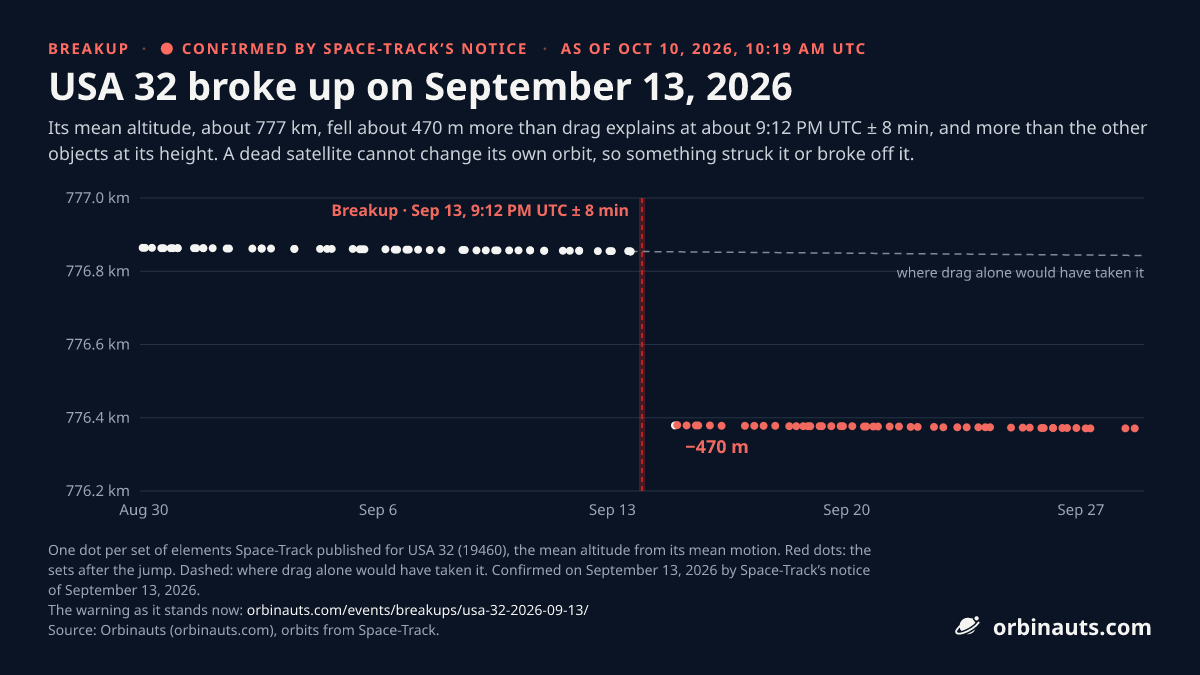
Suspected from Sep 15, 2026, 4:17 AM UTC, confirmed on September 13, 2026 by Space-Track’s notice of September 13, 2026.
Download the figures (PNG)Height chartOrbit at the event time
In the news: A 38-year-old US spy satellite breaks apart in orbit
Mean altitude of every set of elements, August 29, 2026 to September 28, 2026
One dot per set · 110 setsMean altitude from the mean motion of each set of elements Space-Track published for USA 32 (19460). Dots in red are the sets after the jump. The dashed grey line is where the last set before the jump, carried at its own drag rate, would have put the orbit.
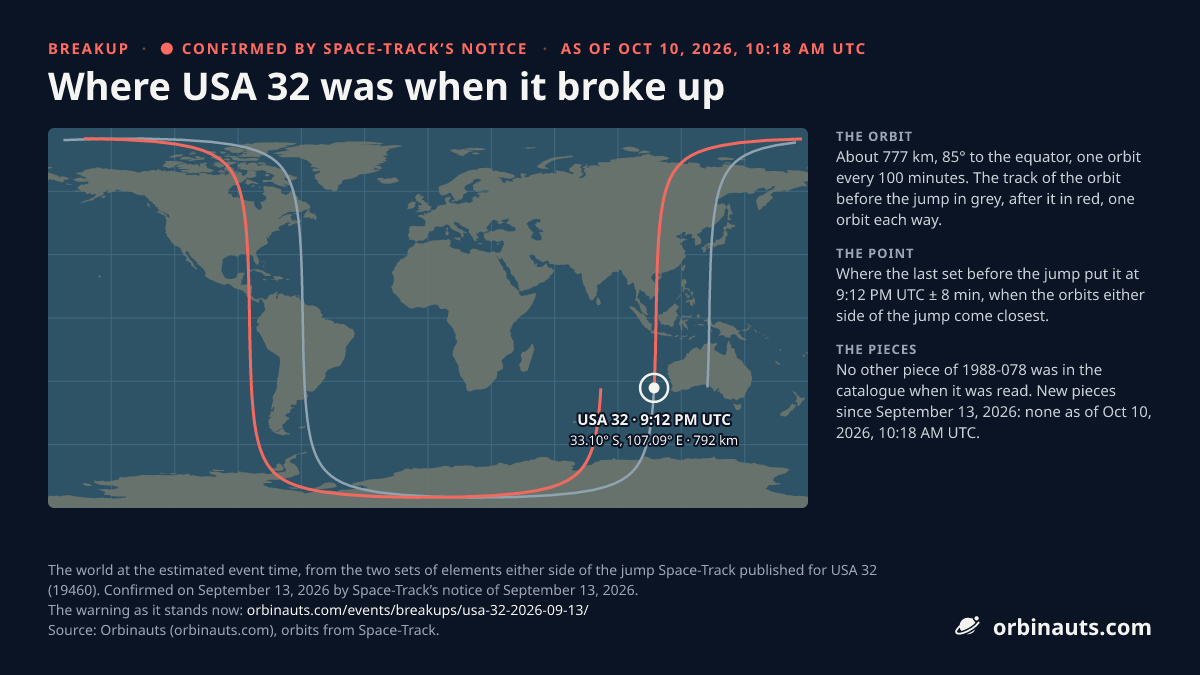
Where it was at 9:12 PM UTC
The orbit USA 32 was on at the estimated event time: one orbit before it from the last set before the jump (grey) and one after it from the first set after the jump (red). The point is where the last set before the jump put it then, 792 km up. Follow it on the live map now. The live map plays back the past 7 days, so this instant is beyond it.
The parent and its pieces
- Body
- USA 32, 19460
- International designator
- 1988-078A
- Class
- Payload, ended per GCAT
- Launched
- 1988
- Ended
- 1998
- Mass
- 1,450 kg
- Orbit
- about 777 km, 85° to the equator
No other piece of 1988-078 was in the catalogue when it was read.
New pieces since September 13, 2026: none. When one is catalogued under 1988-078, this warning is confirmed and the count is kept here.
Masses: data from J. McDowell, planet4589.org, licensed CC BY 4.0
Ends of operations: data from J. McDowell, planet4589.org, licensed CC BY 4.0
Why it was raised
| Set of elements | Epoch (UTC) | Mean altitude |
|---|---|---|
| Last before the jump | Sep 13, 2026, 12:59 PM | 776.854 km |
| Where drag alone would have taken it | Sep 14, 2026, 10:28 PM | 776.853 km |
| First after the jump | Sep 14, 2026, 10:28 PM | 776.380 km |
- The jump: about 470 m below where drag alone would have taken it, more than drag explains, and a drop the other objects at its height did not share.
- The threshold for ended payloads between 700 km and 800 km: 20 m, set from the set-to-set scatter of that class and band, 0.2 m.
- Its own sets: over the 31 days before, 88 comparisons from one set to the next scattered by 0.11 m, and the jump is 4,309 times that; it had to be 10.
- The event time: the orbits of the last set before the jump and the first after it, propagated, come closest at Sep 13, 2026, 9:12 PM UTC; the spread of ± 8 min is where they stay within twice that distance.
- What confirmed it: Space-Track’s notice of September 13, 2026.
Source: Orbinauts (orbinauts.com), orbits from Space-Track. Event times are estimated from the elements either side of the jump, never from a notice.