A 38-year-old US spy satellite breaks apart in orbit
USA 32, a US spy satellite from 1988, broke up on 13 September at about 775 km, near Iridium's altitude; China's Yaogan-50 02 has shed 43 pieces too.
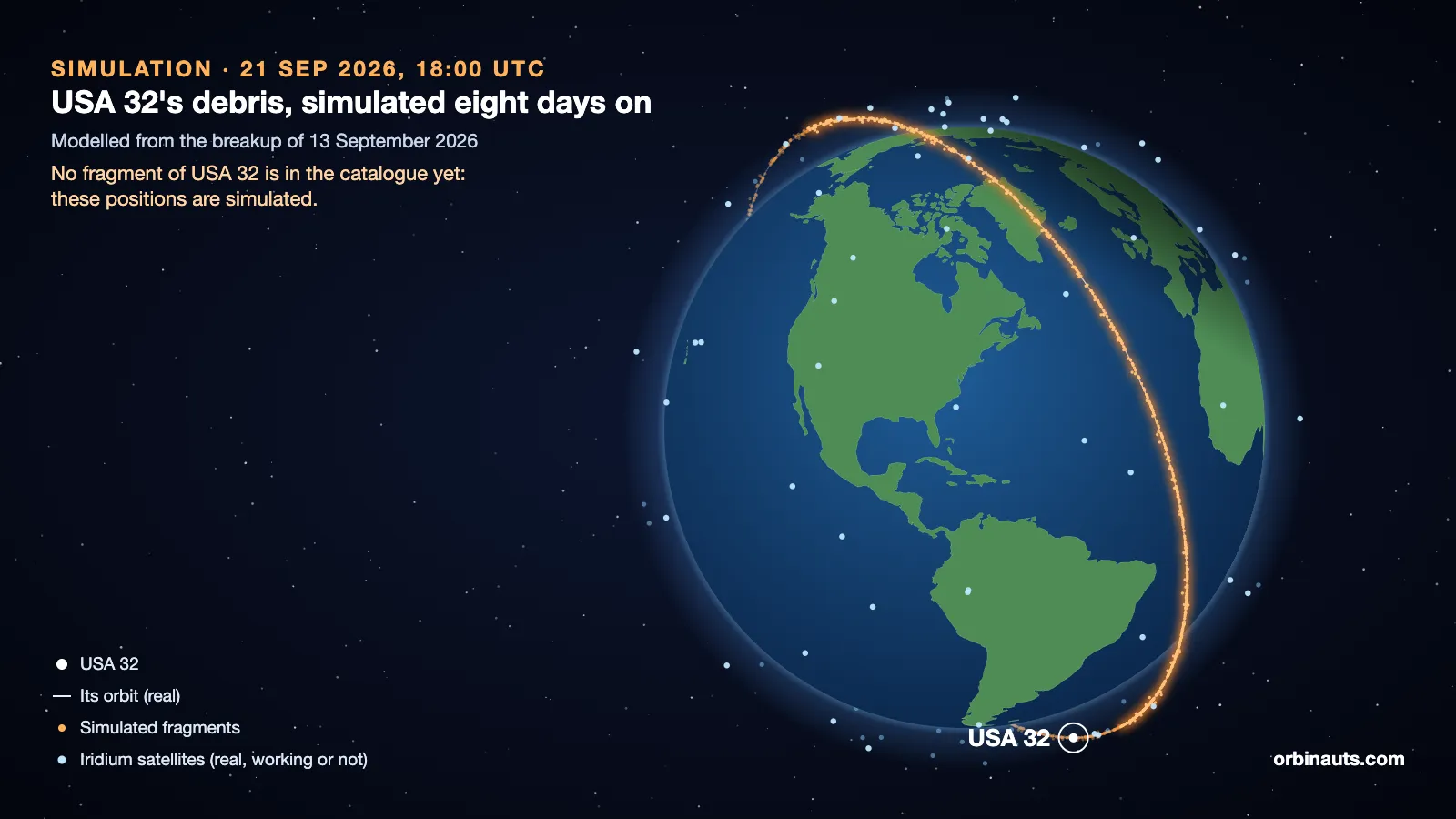
USA 32, a US satellite launched in 1988, broke apart in low Earth orbit on Sunday 13 September at about 21:13 UTC, U.S. Space Forces–Space (S4S) said on Space-Track. The notice gives no cause. It says every tracked piece is being added to the routine screening for close approaches, that no immediate threat has been identified, and that further analysis is ongoing.
What broke up
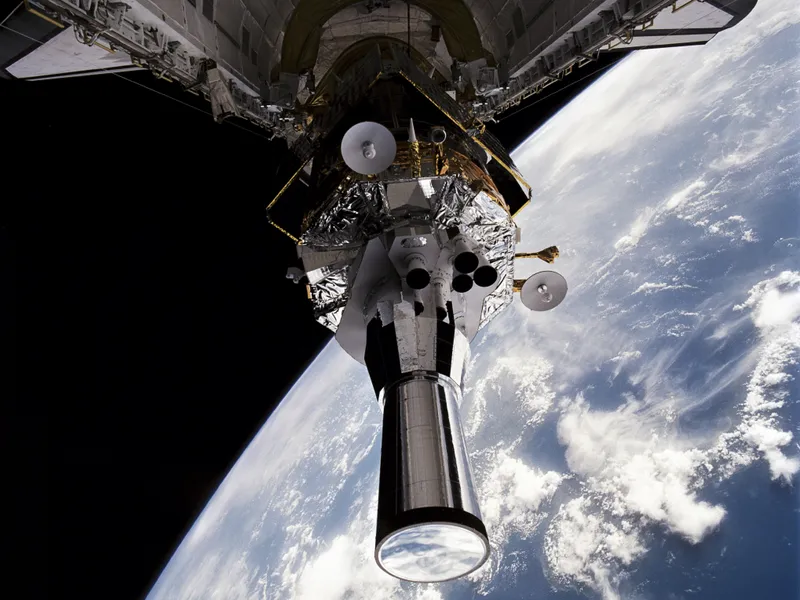
USA 32 went up on 5 September 1988 on a Titan II from Vandenberg, and is still listed under its own Catalogue number, 19460, in the US catalogue as CelesTrak publishes it. Jonathan McDowell’s GCAT lists its owner as the National Reconnaissance Office and names it NRO Mission 7348, FARRAH III, a cylinder with antennas, and gives its purpose as signals intelligence.
GCAT dates the end of its regular operations to about 1998, a date it marks as uncertain, and flags it as a zombie: a satellite no longer controlled that still emits a beacon signal. The last time GCAT knew it to be active was 21 December 2019.
Where it broke up
USA 32 circles Earth between 773 and 780 km, in an orbit tilted 85° to the equator that takes it close to both poles, according to the Elements we hold. The band is a busy one. The 105 Iridium satellites in the catalogue, 25 of them launched before 2017, fly at a median altitude of 778 km, and 455 satellites, working and dead, have orbits that cross the band between 765 and 790 km.
S4S says it is tracking the debris, but on 21 September, eight days after the breakup, the US catalogue as we carry it listed no fragment of USA 32. USA 32 itself can be followed on the live map.
Another satellite’s pieces
USA 32 is not the only satellite to have shed pieces this year. China’s Yaogan-50 02 went up only on 15 March 2026, from Taiyuan, and circles at about 952 km, according to CelesTrak, which still marks it as operational; GCAT lists it as a radar imaging satellite. The US catalogue now lists 43 pieces of it, the oldest with Elements dated 3 September. They keep the satellite’s tilt of 142° to the equator, so they too travel against the Earth’s rotation, but have spread out in height, from 593 to 1,083 km. None of the sources we link says when or why it shed them. Yaogan-50 02 can be followed on the live map.
Sources
- Space-Track, U.S. Space Forces–Space notice on the fragmentation of USA 32 (#19460), 13 September 2026
- CelesTrak, SATCAT records for international designator 1988-078
- CelesTrak, SATCAT records for international designator 2026-051
- Jonathan McDowell, GCAT object catalogue
- Jonathan McDowell, GCAT payload catalogue
- Jonathan McDowell, GCAT payload catalogue columns
- Orbinauts, the Elements of USA 32
- Orbinauts, the Catalogue
- Orbinauts, the Census
Cite this
Copy either form. The date is the date of the figures above, so it stays true even if you are reading a saved copy.
- In a sentence
- On 21 September 2026, eight days after USA 32 broke up, the US catalogue listed none of its fragments, according to Orbinauts.
- As a footnote
- Orbinauts, A 38-year-old US spy satellite breaks apart in orbit, orbinauts.com/news/a-38-year-old-us-spy-satellite-breaks-apart-in-orbit, orbits from Space-Track, retrieved September 21, 2026.
- Under a chart or a table
- Source: Orbinauts (orbinauts.com), orbits from Space-Track