Meteor 2-7, a Soviet weather satellite dead since 1984, may have broken up
LeoLabs' radar confirmed a debris-generating event with an estimated tens of fragments; on 5 October the dead satellite's orbit rose about 230 m.
Meteor 2-7, a Soviet-era weather satellite launched in 1981, may have broken up in orbit on Monday 5 October. That day, by the account of LeoLabs, which tracks objects in orbit by radar, LeoLabs Delta alerted the company’s team to multiple objects near the satellite after a pass over its radar site in Western Australia. Further observations across LeoLabs’ network confirmed a debris-generating event, the company said on X on 7 October, with what it estimated at tens of fragments that may pose a threat to spacecraft around it.
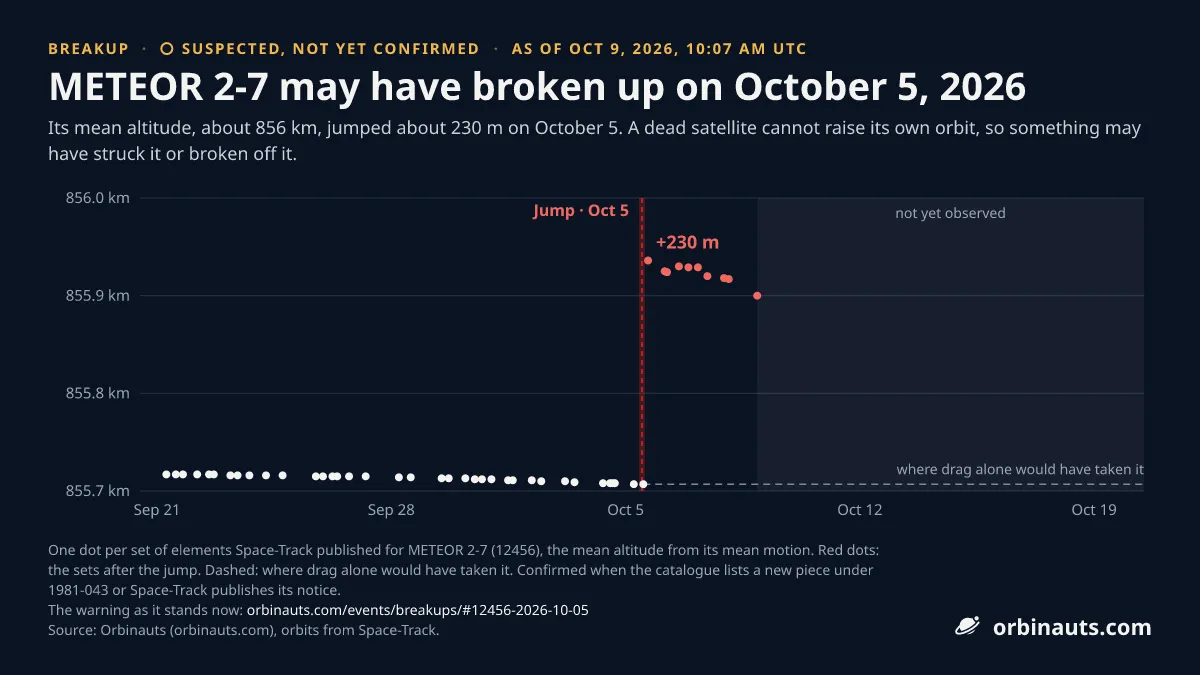
The public orbit data points the same way. Between two consecutive sets of Meteor 2-7’s elements published for 5 October, its mean altitude rose by about 230 metres. Drag only ever lowers an orbit, and a satellite that has been silent for four decades cannot raise its own: something struck it or broke off it. When this was written, neither a notice from Space-Track nor a new piece in the catalogue had confirmed it, so the breakup is still a suspected one.
What LeoLabs saw
LeoLabs called it the latest in a series of debris-generating events it has seen over the last six months. It also posted a plot of Doppler measurements from a follow-up pass of Meteor 2-7 over Western Australia, in which orange dots mark fragments and blue dots the satellite’s main body. The thread dates its alert to 5 October and gives no time, and no cause.
What the orbit shows
Orbinauts’ Breakups page watches the public orbit data for jumps like this one, and marks this breakup as suspected: a new piece from its launch, 1981-043, in the catalogue or a notice from Space-Track would confirm it.
Meteor 2-7 circles at about 856 km, in an orbit tilted 81.3° to the equator. Over the thirty days before the jump, its mean altitude had scattered by just 0.11 m from one set to the next; the rise of 5 October is more than 2,000 times that, and far beyond the 10 m threshold set for dead satellites between 800 and 900 km. The page raised it as suspected at 04:17 UTC on 6 October, at the refresh that read the jump. Our method puts the instant at 11:45 UTC, an estimate which for a jump this small can be a revolution or two off (about 100 minutes each), so the sets date the event only to 5 October.
What broke up
Meteor 2-7 went up on 14 May 1981 and is listed under Catalogue number 12456. Jonathan McDowell’s GCAT gives its purpose as meteorology and dates the end of its transmissions to 28 August 1984: the date after which, as GCAT defines it, a satellite becomes completely silent and unresponsive, or its owners make no further contact with it. GCAT lists it as Meteor-2, with the name Meteor-2 No. 8, and puts its mass at launch at 1,500 kg, which it marks as an estimate, “hopefully good to about 20 percent”.
Pieces have come off it before. Under its launch’s designator, 1981-043, the US catalogue as CelesTrak publishes it lists 22 pieces of debris named after Meteor 2-7, 11 of which have since re-entered, beside the rocket body from its launch and two pieces named after that rocket. GCAT dates when those 22 separated from it, each date marked uncertain: July 2004 (six pieces), December 2004 (one), June 2009 (one), August 2010 (twelve), March 2020 (one) and 2024 (one). No new piece has been catalogued since 5 October. Meteor 2-7 itself can be seen on the live map.
Sources
- LeoLabs on X, "LeoLabs has detected another debris-generating event in orbit", 7 October 2026
- LeoLabs on X, 1/5: objects near Meteor 2-7 after a pass over Western Australia, 7 October 2026
- LeoLabs on X, 2/5: a debris-generating event confirmed, tens of fragments, 7 October 2026
- LeoLabs on X, 5/5: Doppler measurements from a follow-up pass of Meteor 2-7, 7 October 2026
- Orbinauts, Breakups: Meteor 2-7, 5 October 2026
- Orbinauts, the Breakups of the API
- Orbinauts, API reference: Breakups
- CelesTrak, SATCAT records for international designator 1981-043
- Jonathan McDowell, GCAT payload catalogue
- Jonathan McDowell, GCAT payload catalogue columns
- Jonathan McDowell, GCAT object catalogue
- Jonathan McDowell, GCAT object catalogue columns
- Jonathan McDowell, GCAT time representations and Vague Date format
Cite this
Copy either form. The date is the date of the figures above, so it stays true even if you are reading a saved copy.
- In a sentence
- On 5 October 2026 the mean altitude of Meteor 2-7, a Soviet weather satellite silent since 1984, rose by about 230 metres between two consecutive sets of its elements, according to Orbinauts.
- As a footnote
- Orbinauts, Meteor 2-7, a Soviet weather satellite dead since 1984, may have broken up, orbinauts.com/news/meteor-2-7-soviet-weather-satellite-may-have-broken-up, orbits from Space-Track, retrieved October 9, 2026.
- Under a chart or a table
- Source: Orbinauts (orbinauts.com), orbits from Space-Track