Smile is cleared for science while its X-ray camera fights stray light
ESA and China's Smile was cleared for science on 23 September: its aurora camera is filming, but its X-ray camera sees too much stray light facing Earth.
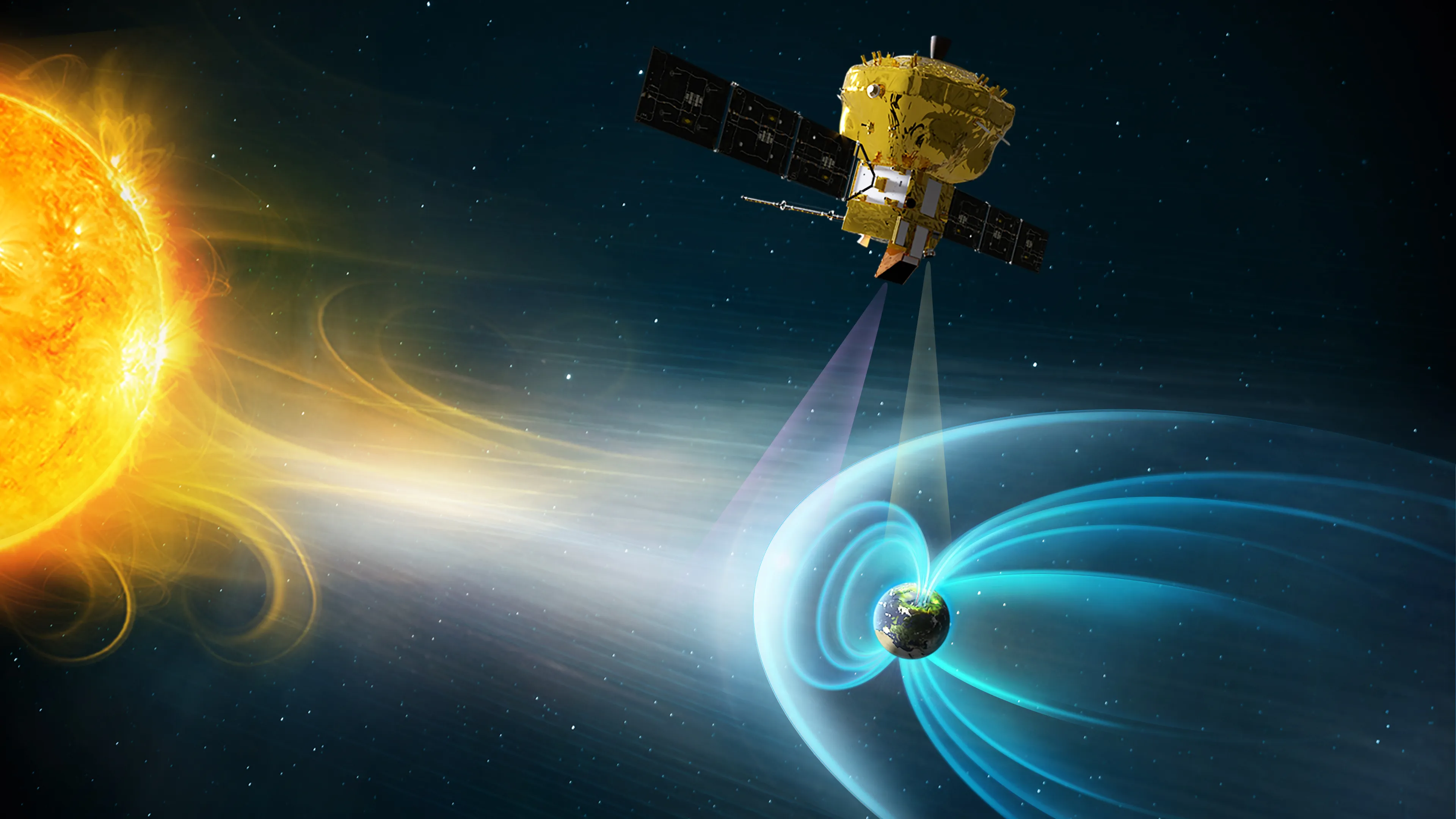
Smile, the spacecraft the European Space Agency (ESA) and the Chinese Academy of Sciences (CAS) built to watch how Earth’s magnetic field takes the solar wind, was declared ready to begin science operations on Wednesday 23 September, ESA said on 30 September. The approval closes the commissioning that followed Smile’s launch on 19 May and its arrival in its science orbit on 20 June: deploying mechanisms, switching units on, checking every link between the spacecraft and the ground, and fixing what came up. It took longer than first planned: at launch ESA expected data collection to begin in earnest in July, and on reaching the orbit it said commissioning would last until the end of August, with the real science beginning in September.
“Smile is now approved to begin science operations,” said Carole Mundell, ESA’s Director of Science.
The announcement carries a caveat of ESA’s own. It shows first data from all four of Smile’s instruments, but the X-ray camera, the instrument ESA calls a key European contribution to the mission, picks up too much stray light when it is pointed towards Earth, which is where it is meant to look.
The whole ring of the northern lights
The first footage released from the ultraviolet camera, UVI, covers 00:00 to 00:58 UTC on 24 July, during commissioning. It shows the ring of northern lights rippling around the North Pole in a substorm: a brief disturbance that starts when the solar wind squashes Earth’s magnetic field lines until they pinch together and send a burst of energetic particles towards the poles. The image below was taken by the same camera on 4 August; UVI had been switched on in July.
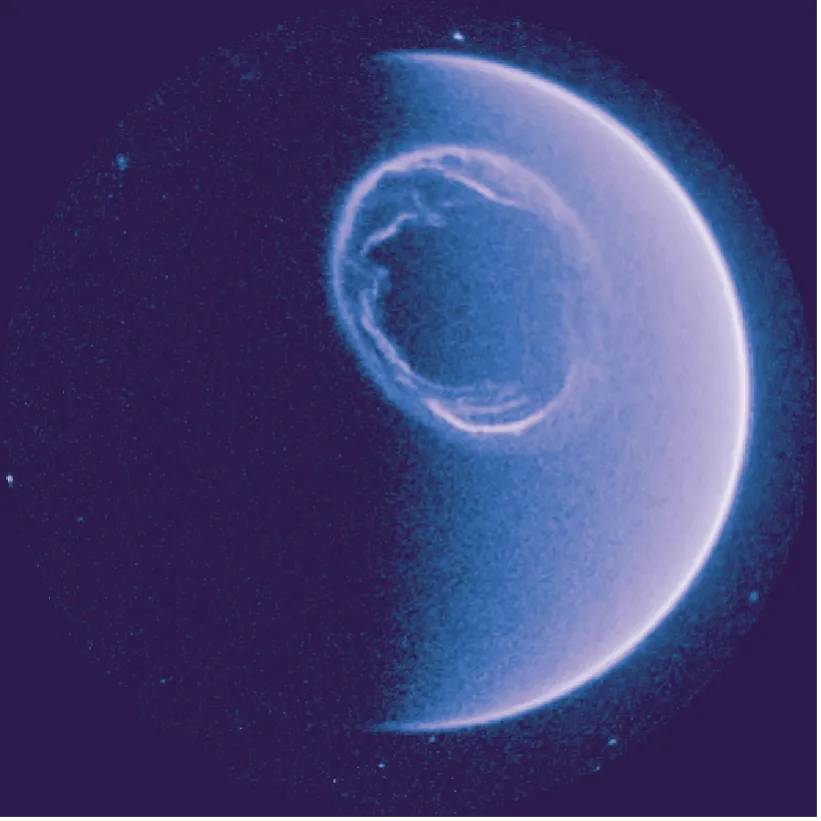
With UVI, ESA says, Smile is the first spacecraft since 2008 to capture the full ring of northern lights in ultraviolet light, and it is recording that ring for 45 hours at a time, which the agency calls a record. It will have plenty to film. ESA expects about 300 substorms in the three years Smile is expected to operate, and they are more common than normal at present, with the Sun at the most active point of its 11-year cycle.
An X-ray camera that works, and cannot yet look at Earth
The soft X-ray imager, SXI, has also been switched on and has taken its first images. Both are of exploded stars: N132D, in the Large Magellanic Cloud, around 160,000 light-years away, and Cassiopeia A, about 11,000 light-years away. Such remnants glow bright in X-rays, which makes them good test subjects, and the two images were taken to check that the camera works as expected. ESA says the camera itself is working very well.
Its real subject is much closer. SXI is there to image the X-rays released at the edge of Earth’s magnetosphere when charged particles from the Sun hit it, and Smile is to be the first mission to look at Earth’s magnetic shield in X-rays. Pointed that way, the camera currently detects too much unwanted light. To cut it down, settings are being changed and software updates put in place on board, a job shared by ESA, the consortium of universities and companies behind the instrument, and the Chinese team that leads the spacecraft’s operations. It helps, ESA says, that the instrument’s design can be adjusted remotely.
The season is helping as well. Smile is pointing steadily farther from Earth, and the North Pole gives off less light as the northern winter approaches, so the unwanted light is falling by itself and is due to reach a minimum in mid-October. “At that point, SXI would take its first good image of the magnetopause”, the boundary where the solar wind meets Earth’s magnetic field, or of the northern polar cusp, the hole in the magnetosphere over the North Pole through which solar wind particles are funnelled towards the surface, ESA says. Its account gives no date for the on-board changes, and does not say how the camera will cope once that minimum has passed.
Smile’s method needs both cameras. Comparing the X-ray and the ultraviolet images is how Smile is meant to read, in real time, how Earth responds to the solar wind.
The two instruments that measure on the spot
The other two instruments, both led by CAS, sample what passes the spacecraft itself. The magnetometer, MAG, was switched on on 27 June; its sensors sit at the end of a three-metre boom, away from the disturbance of the spacecraft, and the graph ESA published shows the field they measured before and after that boom was deployed. The light ion analyser, LIA, was switched on on 30 June and collects solar wind particles with two sensors; the data ESA shows are from 11 August.
Where Smile flies
Smile reached its orbit by firing its main engine 12 times, ESA said on 25 June: an orbit that took it 120,920 km over the North Pole and down to 5,027 km over the South Pole. The engine did better than expected, and around 164 kg of propellant was left to hold the orbit over what ESA called the next three-plus years.
The Elements that Space-Track published for 25 September give an orbit inclined 70° to the equator, as Orbinauts carries them. Worked forward from them, Smile passed its low point on 29 September at about 6,470 km above the Southern Ocean, and the lap that began there takes it to a high point of about 119,530 km above Norway, at latitude 65° north, on the evening of 30 September. One lap lasts 50 hours 31 minutes, according to Orbinauts. ESA’s figures are from June; ours rest on Elements from late September.
That long, high lap is what lets the ultraviolet camera watch the northern lights for 45 hours at a time. On the low side, over the south, Smile delivers its data, mainly to the O’Higgins station in Antarctica, operated by the German Aerospace Center, and the Sanya station in China. Smile can be followed on the live map.
The film
With the announcement ESA released Let’s Smile (the full story), a documentary of nearly 45 minutes that follows the spacecraft from June 2024 to May 2026: its parts arriving at ESA’s technical centre in the Netherlands, being joined, tested and shipped to French Guiana. It is the last instalment of a series, and gathers and adds to the four shorter episodes before it.
It also shows how late the launch delay came. Smile was first due to lift off on 9 April; that date was postponed as a precaution after a technical issue was found on the production line of a Vega-C component. In the film, 41 minutes in, a member of the launch campaign team says the news reached them “literally one or two working days before the launch”.
Sources
- ESA, "Science begins for Smile", 30 September 2026
- ESA, "Smile's first ultraviolet footage shows auroral substorm", 30 September 2026
- ESA, "Smile's first ultraviolet image shows auroral substorm", 30 September 2026
- ESA, "Smile's first test X-ray image shows supernova remnant in Large Magellanic Cloud", 30 September 2026
- ESA, "Smile's first test X-ray image shows Cassiopeia A", 30 September 2026
- ESA, "Smile's magnetometer working well in space", 30 September 2026
- ESA, "Smile's light ion analyser working well in space", 30 September 2026
- ESA, "Smile reaches science orbit", 25 June 2026
- ESA, "Smile lifts off on quest to reveal Earth's invisible shield against the solar wind", 19 May 2026
- ESA, "Smile set to launch on 19 May", 23 April 2026
- ESA, Smile factsheet
- ESA, "Let's Smile (the full story)", video, 30 September 2026
- Orbinauts, the Elements of Smile
- ESA, "T-20 days: Smile to launch on 9 April", 20 March 2026
- Orbinauts, the Position of Smile at its low point on 29 September 2026
- Orbinauts, the Position of Smile at its high point on 30 September 2026
Cite this
Copy either form. The date is the date of the figures above, so it stays true even if you are reading a saved copy.
- In a sentence
- On 30 September 2026 Smile was on an orbit running from about 6,470 km to about 119,530 km above Earth, one lap every 50 hours 31 minutes, according to Orbinauts.
- As a footnote
- Orbinauts, Smile is cleared for science while its X-ray camera fights stray light, orbinauts.com/news/smile-is-cleared-for-science-while-its-x-ray-camera-fights-stray-light, orbits from Space-Track, retrieved September 30, 2026.
- Under a chart or a table
- Source: Orbinauts (orbinauts.com), orbits from Space-Track