Starship is cleared for its first attempt at orbit on 28 September
Flight 14 aims for orbit on 28 September with 26 Starlink V3 satellites, now licensed by the FAA. The route, the plan and the fallbacks.
SpaceX is getting ready to put Starship into orbit for the first time. Flight 14 is set to lift off from Starbase, Texas, on Monday 28 September, in a 75-minute window that opens at 7:15 a.m. Central time, 12:15 UTC. The FAA cleared it on 26 September: revision 9.0 of SpaceX’s Starship licence adds its first order for a Starship reentry from Earth orbit, to an ocean landing in the Pacific, for this one flight.
All 13 flights so far were planned to stop just short of orbit. This one is planned to fly about six orbits at about 275 km over nearly 10 hours, release the first 26 Starlink V3 satellites, a mission Launch Library lists as Starlink Group 31-1, and come down in the Pacific west of Chile.
The flight at a glance
| Vehicle | Super Heavy Booster 21 and Starship Ship 41 |
| Pad | Starbase, Texas |
| Licence | FAA VOL 23-129 Rev 9.0, issued 26 September |
| Window | 28 September, 12:15 to 13:30 UTC (7:15 to 8:30 a.m. CDT) |
| Backup days | 29 September to 4 October, 12:15 to 14:14 UTC |
| Orbit | about 275 km, about six orbits |
| Payload | 26 Starlink V3 satellites |
| Booster | boostback and landing burn, splashdown in the Gulf of Mexico |
| Ship | deorbit burn at T+8 h 52 min, splashdown west of Chile at T+9 h 50 min |
The backup days are the ones the FAA’s Space Operations office gave air traffic controllers for the flight on 24 September.
What the flight is meant to prove
The ship. Ship 41’s primary objectives are the first orbital insertion burn, the deployment of the 26 satellites, a deorbit burn on a single Raptor engine in space, and a controlled reentry, descent and splashdown. Going to orbit is what SpaceX says opens the next phase: a Starship that is fully and rapidly reusable, and later tests such as the first orbital propellant transfer.
The satellites. Each Starlink V3 satellite adds 1 Tbps of capacity, 26 Tbps for the flight, which SpaceX puts at about ten times one Falcon 9 launch of V2 Mini satellites. Once released they unfold their antennas and solar arrays, make contact with the ground and the rest of the constellation over radio and laser links, and raise their own orbits with their thrusters; they could serve customers as soon as a few weeks after launch. Three carry cameras to photograph Starship’s heatshield and send the pictures down, practice for the day a ship has to be cleared to fly back to its launch site.
The heatshield. Ship 41 flies tiles with extra retention where they are most likely to fall off during ascent, fixes for gaps where plasma could flow behind the tiles, and several areas of curved tiles. Two tiles recovered from Ship 40, the Flight 13 ship, fly again: the first reuse of a Starship tile.
The booster. Booster 21’s task is a launch, ascent, stage separation, boostback burn and landing burn over the Gulf of Mexico. On Flight 13 its predecessor fired all 33 engines on the boostback for the first time, but signs of ice clogging in the three centre engines cut the burn short, and only 8 of the 13 planned engines relit for the landing burn before a hard splashdown. This booster has better filtering to the engines and software changes to relight more reliably.
The route
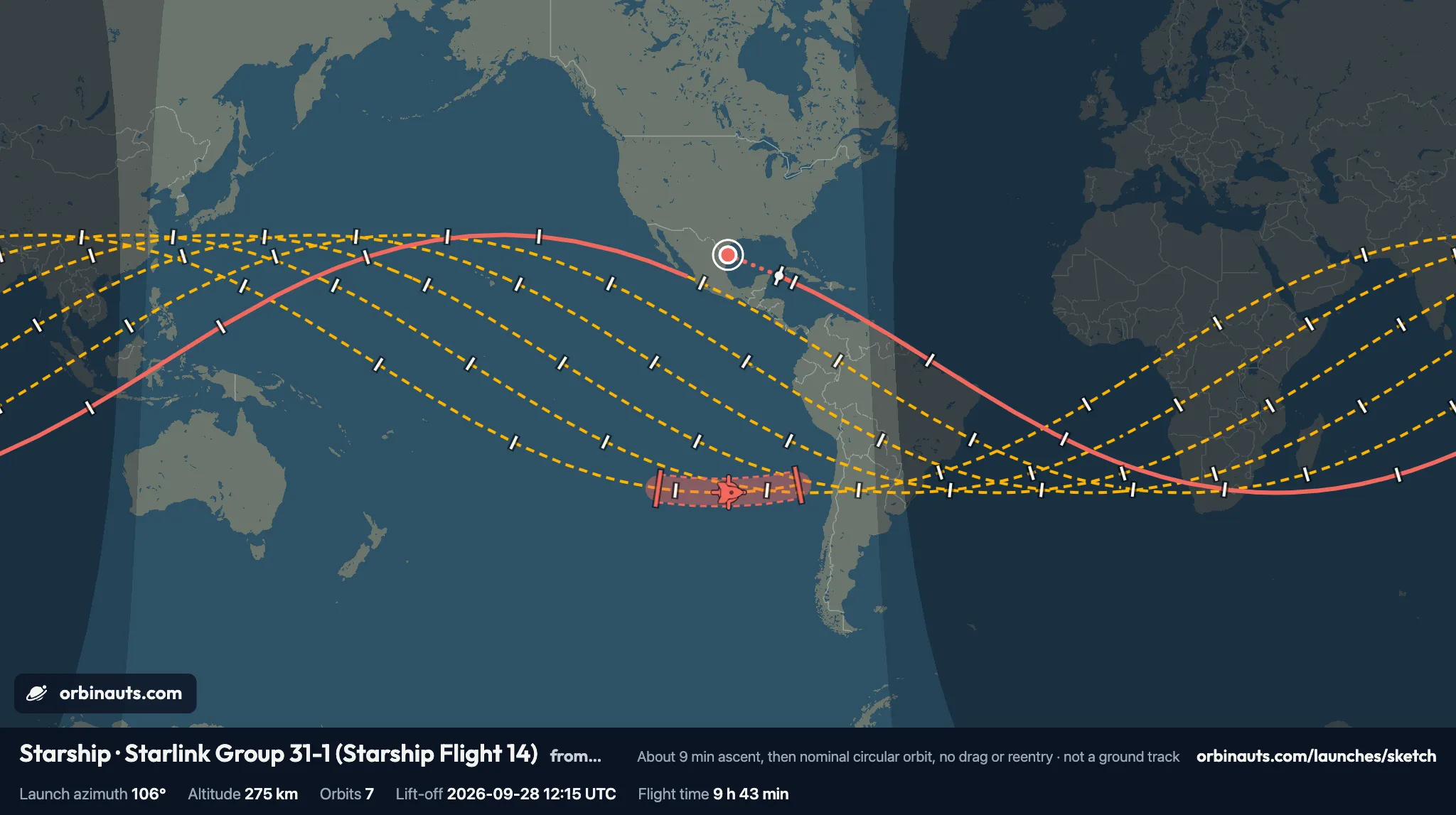
SpaceX has not published the direction Starship will fly. The FAA’s hazard areas for the ascent show it: they run from Starbase across the Gulf, through the Yucatán Channel and along the south coast of Cuba, and end south of Haiti at 17°44′ N, 74°06′ W. A line from the pad to that point leaves Starbase on a Launch azimuth of about 106°, which gives an orbit inclined about 30° to the equator. That is our reading of the FAA’s coordinates, not a figure SpaceX has given, and it is what the map at the top of this page is drawn with: 275 km from 12:15 UTC, an ascent of about 9 minutes assumed, then nominal circles with no drag and no deorbit burn. SpaceX’s timeline puts splashdown at T+9 h 50 min, but the sketch leaves out the deorbit burn and the reentry that slow the real ship, so at that time its nominal orbit is already over northern Chile and Argentina. We end the drawn flight at 9 h 43 min instead, which puts the red Landing zone in the South Pacific, about 2,300 km west of Chile, on the side where SpaceX targets its splashdown.
On that orbit the ship would cross the Caribbean and northern South America, then the South Atlantic to southern Africa on its first lap, with each orbit about 90 minutes long and shifted about 22.6° west of the one before. Open the Orbit sketch to play the flight minute by minute, or type your town to see when it passes over. It is a sketch, not a prediction: once the ship is tracked in orbit, the real path replaces it.
Closed skies and seas
Around the pad, the FAA has closed the airspace from the surface upwards to all aircraft from 12:00 to 14:08 UTC on 28 September, with the same closure on 29 September and 30 September. No FAA closure for 1 to 4 October had been published by 26 September.
Further out, six Aircraft Hazard Areas follow the climb, two off Texas, two in Mexico’s airspace over the Gulf, one off the south coast of Cuba and one in Jamaica’s airspace. The countries under the path have issued their own notices. Cuba has published a danger zone along its south coast (A3414/26), active 12:15 to 14:14 UTC each day from 28 September to 4 October, and a notice (A3420/26) that stops accepting flights bound through the area from between 10:00 and 12:05 UTC, depending on their route. Jamaica has activated a restricted area for falling debris (A0368/26) west of the island, over the Cayman Islands, up to 24,500 ft, every day from 12:00 to 14:30 UTC. Trinidad and Tobago’s Piarco centre has declared a danger area east of Trinidad and debris response areas around Barbados and the Windward Islands (A1483/26, A1485/26 and A1487/26 to A1489/26), where flights may be held or rerouted if the vehicle fails.
The timeline
All times are SpaceX’s approximate flight timeline; the UTC column gives when each event starts, to the nearest minute, for a lift-off at 12:15 UTC on 28 September.
| Event | T+ | UTC |
|---|---|---|
| Lift-off | 0:00:00 | 12:15 |
| Max Q | 0:00:58 | 12:16 |
| Hot staging | 0:02:22 | 12:17 |
| Boostback burn | 0:02:27 to 0:03:07 | 12:17 |
| Booster landing burn | 0:06:36 to 0:07:01 | 12:22 |
| Ship engine cutoff | 0:08:11 | 12:23 |
| Orbital insertion burn | 0:25:17 to 0:25:36 | 12:40 |
| Starlink deployment | 0:34:07 to 1:04:39 | 12:49 |
| Deorbit burn | 8:52:37 to 8:52:48 | 21:08 |
| Entry | 9:28:56 | 21:44 |
| Landing burn and splashdown | 9:50:11 to 9:50:30 | 22:05 |
A live webcast starts about 30 minutes before lift-off, and SpaceX plans to stay on through splashdown, with the potential for hours of views from orbit.
If it does not reach orbit
The insertion burn is a choice, not a given. After its ascent burn, Ship 41 will be on the same passively safe suborbital path to the Indian Ocean as the flights before it: even with all control lost, it would re-enter and come down in a known area. During the 17 minutes between engine cutoff and the insertion burn, flight controllers check the ship’s health and decide whether to go to orbit or let it splash down in the Indian Ocean. SpaceX will only fire the insertion burn once the team is sure there is enough redundancy in the hardware needed for the deorbit burn at the end.
Once in orbit, the team watches for reasons to stop early. SpaceX describes its first abort criteria as intentionally conservative: Raptor health, loss of power or communications, flight computers and navigation sensors, the propellant tanks and feedlines, tank pressure and attitude control, read from more than 500 sensors. Any of them can bring the ship down early in one of several areas set in advance over the ocean.
The licence writes these branches down. Its launch order allows the ship’s suborbital flights to “the Indian Ocean location”; its new reentry order allows a single reentry from orbit, the one that ends Flight 14, to an ocean landing in the Pacific, with the analysis keeping the risk contours more than 50 nautical miles from populated land. SpaceX must carry $500 million of liability insurance for that reentry, and if an abort leaves the ship in orbit, the cover stays in place for 18 months or until it comes down.
The FAA’s hazard areas show three places the ship can come down, each with its own window on launch day:
| Option | Where | Window on 28 September (UTC) |
|---|---|---|
| No orbit (“skip-orbit”) | southern Indian Ocean | 12:23 to 14:47 |
| Early end | North Pacific, from east of Japan to Hawaii | 14:27 to 18:33 |
| Planned end | South Pacific, from French Polynesia to off northern Chile | 21:07 to 01:08 (29 September) |
The planned end’s window opens at 21:07 UTC, less than a minute before the deorbit burn starts on SpaceX’s timeline.
Still to come
With the licence issued, SpaceX still warns that the schedule of a development test is dynamic and likely to change. The FAA’s planning slides already list two more Starship missions among the upcoming high-profile ones: Flight 15 on 19 October and a Starlink mission, 30-1, on 30 October.
Until it flies, Flight 14 is on our next launches, with its countdown and its window.
Sources
- SpaceX, "Starship Flight 14"
- SpaceX, "Starship to Orbit", 15 September 2026
- FAA, Commercial Space Transportation License VOL 23-129 Rev 9.0, SpaceX Starship-Super Heavy, 26 September 2026
- Launch Library 2, Starship | Starlink Group 31-1 (Starship Flight 14)
- FAA, temporary flight restriction FDC 6/5573, Starbase, 28 September 2026
- FAA, temporary flight restriction FDC 6/5574, Starbase, 29 September 2026
- FAA, temporary flight restriction FDC 6/5575, Starbase, 30 September 2026
- FAA Space Operations (AJR-1800) and Piarco ACC, slides for the CADENA planning web conference, 24 September 2026
- CADENA COMPASS, launch advisories and NOTAMs of Cuba (A3414/26, A3420/26) and Jamaica (A0368/26)
- Orbinauts, Orbit sketch of Starship Flight 14 on a Launch azimuth of 106°, coming back down after 9 h 43 min
Cite this
Copy either form. The date is the date of the figures above, so it stays true even if you are reading a saved copy.
- In a sentence
- The FAA's hazard areas for Starship Flight 14 point to a Launch azimuth of about 106° and an orbit inclined about 30°, according to Orbinauts.
- As a footnote
- Orbinauts, Starship is cleared for its first attempt at orbit on 28 September, orbinauts.com/news/starship-is-cleared-for-its-first-attempt-at-orbit-on-28-september, orbits from Space-Track, retrieved September 27, 2026.
- Under a chart or a table
- Source: Orbinauts (orbinauts.com), orbits from Space-Track