Starship reaches orbit and releases 26 Starlinks, then cuts its flight short
Flight 14 put Starship in orbit for the first time and released 26 Starlink V3s, then came down in the North Pacific after 3 hours instead of 10.
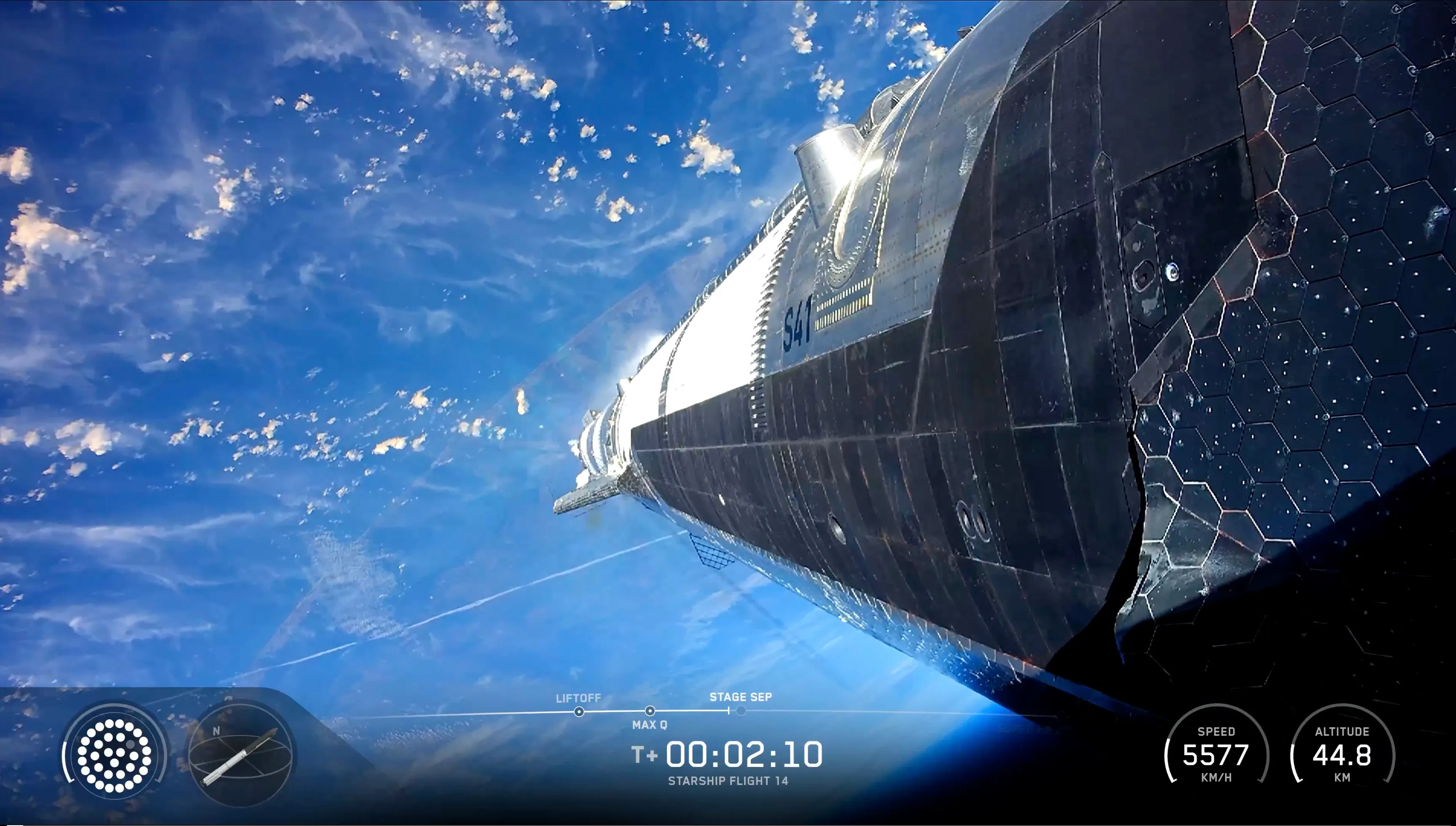
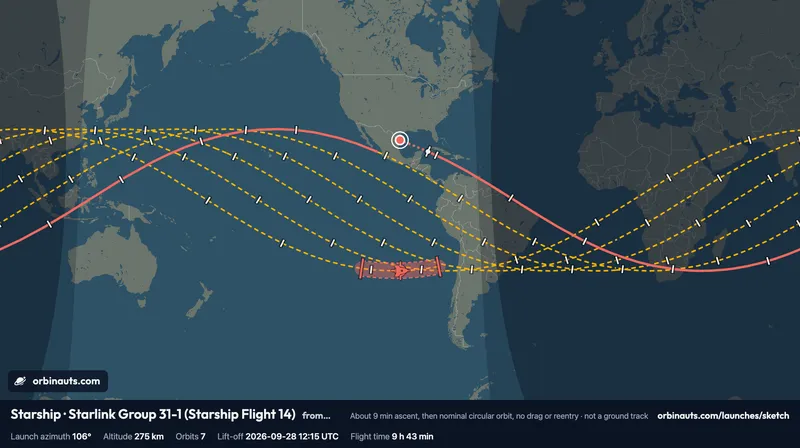
Starship has been to orbit. Flight 14 lifted off from Starbase, Texas, at 12:48:59 UTC on 28 September, and Ship 41 released 26 Starlink V3 satellites, the first Starship payload left in orbit; SpaceX’s Starlink team made contact with all 26. Then SpaceX brought the ship home early. It splashed down in the North Pacific at 15:57 UTC, 3 hours 8 minutes after lift-off, instead of flying about six orbits over nearly 10 hours and landing west of Chile.
“Splashdown confirmed. Congratulations to the entire SpaceX team on the first orbital flight of Starship!”, SpaceX wrote. SpaceX has not said why it ended the flight early.
An engine out on the way up
The first hitch came on the climb. On SpaceX’s webcast, the hosts reported that one of Ship 41’s Raptor Vacuum engines had shut down earlier than planned during the ascent burn. The ship still reached space, but for a few minutes the flight could have stopped there: the hosts first said Starship would not go to orbit that day, then that the team was reassessing.
The rule was set before launch. The ship leaves its ascent burn on a path that falls back into the Indian Ocean whatever happens, and controllers use the coast that follows to decide whether to go on. SpaceX would only fire the orbital insertion burn once the team was sure of enough redundancy in the hardware needed for the deorbit burn at the end. Both of those burns use a single Raptor sea-level engine, not a vacuum one. On the webcast, the team said the vacuum engines were not needed for the rest of the flight, checked the three sea-level engines, found them healthy and went ahead. The insertion burn put Starship in orbit for the first time, and the 26 satellites followed.
The first checkpoint, and home
Once in orbit, SpaceX’s plan was to watch Raptor health, power, communications, the flight computers, the tanks and attitude control, with abort criteria it called intentionally conservative, and to bring the ship down early over the ocean if any of them tripped. After the deployment, the webcast hosts said the team would only continue if it was really confident everything was healthy on those key systems. The decision came at the first checkpoint: “We are looking like we are going to take our first checkpoint and come back early,” one host said, adding that the ship would not spend as many orbits around Earth.
Ship 41 fired its deorbit burn at about T+2 h 12 min, on the webcast’s revised timeline, instead of T+8 h 52 min on SpaceX’s published one. It re-entered, flipped and landed on its engines in the North Pacific. The splashdown fell inside the window the FAA’s Space Operations office had given air traffic controllers for the early reentry option near Hawaii, 14:27 to 18:33 UTC on launch day: the second of the three ways the flight could end that we set out before launch. A fireball followed on the webcast moments after touchdown; Launch Library lists Ship 41 as lost in an explosion just after the soft splashdown.
Planned and flown
| Planned | Flown | |
|---|---|---|
| Lift-off | 12:15 UTC, window open to 13:30 | 12:48:59 UTC |
| Deorbit burn | T+8 h 52 min | about T+2 h 12 min |
| Splashdown | T+9 h 50 min, west of Chile | T+3 h 8 min, North Pacific |
The plan is SpaceX’s Flight 14 page; the flight is Launch Library’s record and, for the deorbit burn, the webcast.
The booster and the satellites
Super Heavy Booster 21 made a soft splashdown in the Gulf of Mexico. On Flight 13 its predecessor had come down hard after only 8 of its 13 landing engines relit.
The satellites are the part of Flight 14 that stays up. Each Starlink V3 is meant to add 1 Tbps of capacity to the network. After release they unfold their antennas and solar arrays, link up with the ground and the rest of the constellation, and raise their own orbits with their thrusters; SpaceX expects them to serve customers as soon as a few weeks after launch. Three of them carry cameras meant to photograph Starship’s heatshield; SpaceX has not yet said what they saw. None of the 26 has public orbital data on CelesTrak yet: CelesTrak’s list of objects launched in the last 30 days had none of them when we published, so their orbits cannot yet be checked independently.
NASA Administrator Jared Isaacman congratulated SpaceX on “getting Ship to orbit and managing every step in a safe, responsible, and especially inspirational way”.
Still to learn
SpaceX has not yet published an account of the flight. It has not said why the vacuum engine shut down, what the first checkpoint showed, or what happened to the ship after it touched the water. We will update this Article when it does.
Sources
- SpaceX, Starship Flight 14 webcast, 28 September 2026
- SpaceX on X, contact with all 26 satellites, 28 September 2026
- SpaceX on X, "Splashdown confirmed", 28 September 2026
- Launch Library 2, Starship | Starlink Group 31-1 (Starship Flight 14)
- SpaceX, "Starship Flight 14"
- SpaceX, "Starship to Orbit", 15 September 2026
- FAA Space Operations (AJR-1800) and Piarco ACC, slides for the CADENA planning web conference, 24 September 2026
- CelesTrak, objects launched in the last 30 days
- NASA Administrator Jared Isaacman on X, 28 September 2026