The satellite that failed to save NASA's Swift has re-entered over the Pacific
LINK, Katalyst's robot built to lift NASA's Swift, re-entered on 24 September; Swift, now sinking fast, may stop observing in October.
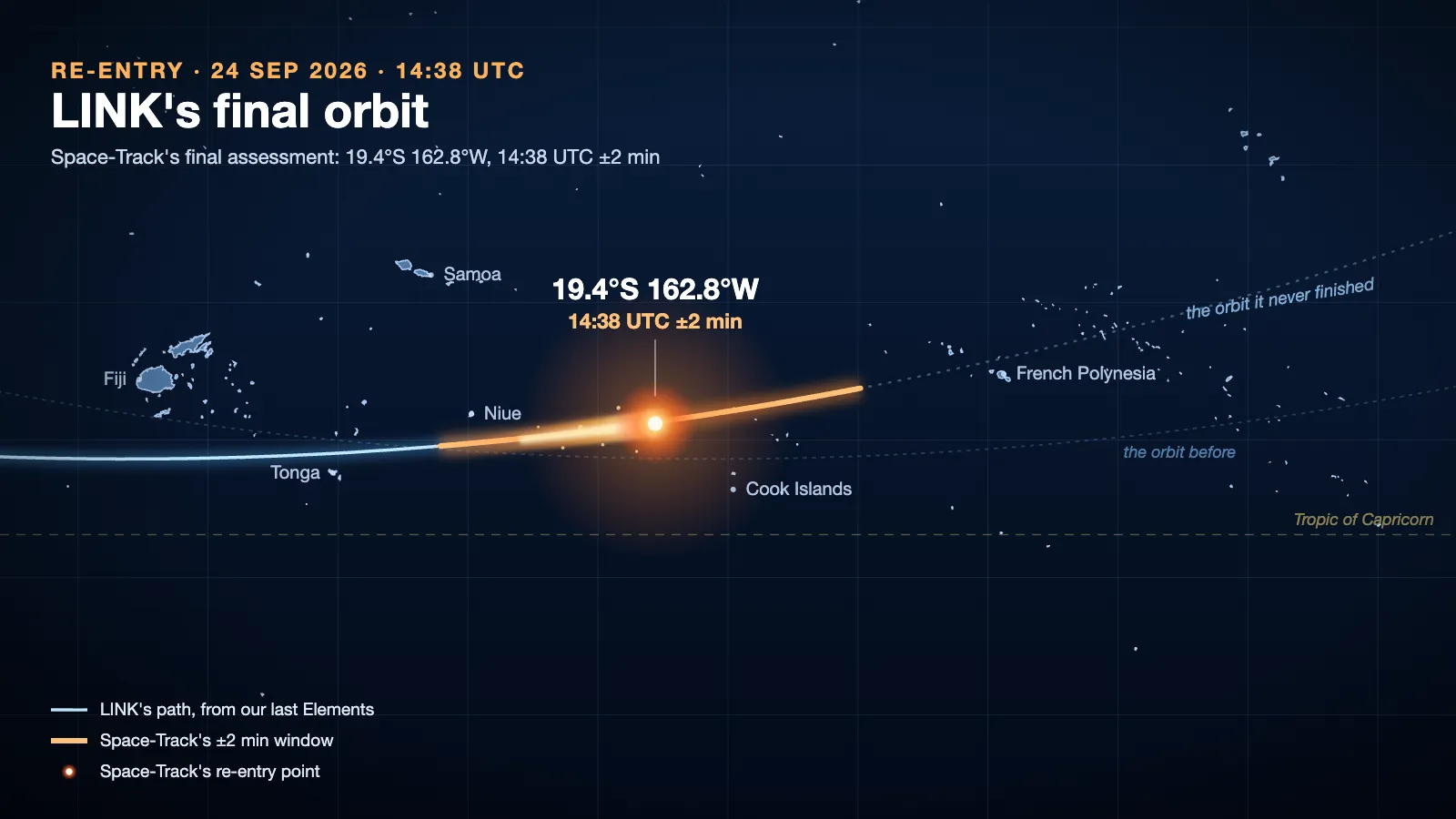
LINK, the robotic satellite Katalyst Space built to raise the orbit of NASA’s Neil Gehrels Swift Observatory, re-entered the atmosphere over the South Pacific at 14:38 UTC on Thursday 24 September. The final re-entry assessment on Space-Track gives that time to within two minutes, at 19.4° south and 162.8° west. Katalyst had operated it for 85 days, and it never took hold of Swift.
Katalyst announced the end of the mission on 25 September and gives that day as the day of the re-entry, as does Space-Track’s own record of re-entries. Space-Track’s forecasts had pointed to 04:08 UTC on 25 September until late on the 24th; its final assessment, issued early on 26 September, placed the re-entry about 13 and a half hours earlier. The US catalogue dates the re-entry on 24 September, and so do the Re-entries we carry.
The last Elements we hold for LINK, dated 23 September at 21:05 UTC, draw its final ground track eastwards from near Tonga towards French Polynesia, passing within about 5 km of the re-entry point that Space-Track’s final assessment gives. They put LINK there at 14:29 UTC, nine minutes before Space-Track’s time, so the map above takes the path’s shape from our Elements and the point, the time and the window from Space-Track.
What went wrong
LINK went up on 3 July on a Pegasus XL. Katalyst designed, built, tested and launched it in nine months, as a $30 million mission. Carrying three robotic arms, it was to meet Swift, grab it and raise its orbit over several months with its ion thrusters.
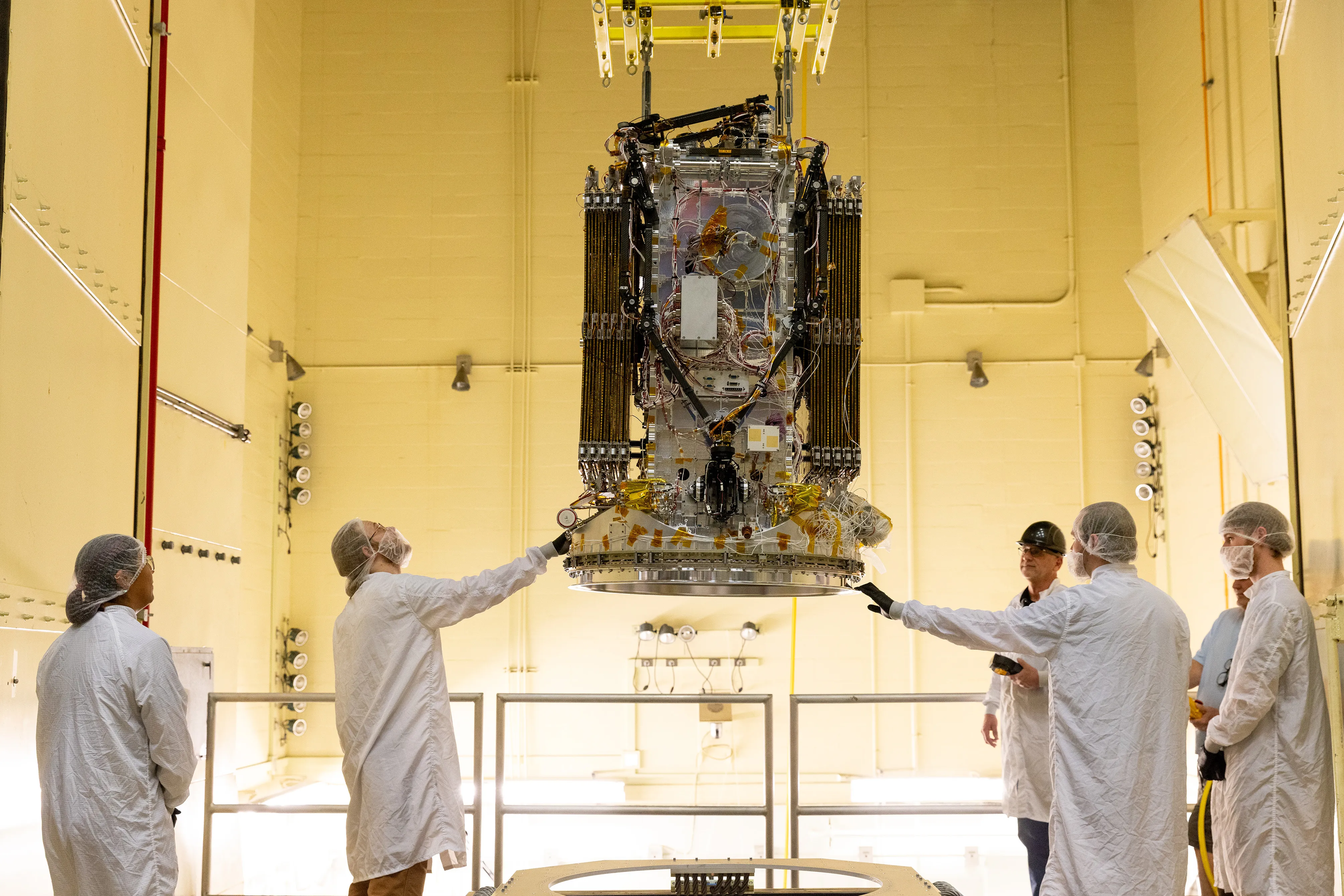
During commissioning, a fault in its electrical power system took out two of its three reaction wheels and sent it into a multi-axis spin, Katalyst says. The team slowed the spin from 9 to 1.47 degrees per second and uploaded new software to steer with its thrusters and the one wheel left. Steering on thrusters burned propellant fast, and Katalyst and NASA concluded that LINK no longer had the fuel to capture Swift and raise its orbit.
LINK was used to test its systems instead. It came to within 12 to 15 km of Swift, close enough to photograph it as a point without detail, and exercised its robotic arms and grippers.
Swift is sinking
Swift, which studies gamma-ray bursts, returned to observing in August and to full science in September: its Burst Alert Telescope was detecting gamma rays again on 18 September, and it resumed pointing itself at new bursts on 21 September. That ended months of pointing chosen to cut drag, and NASA says the observatory has resumed its rapid sinking.
Its latest Elements put it between 315 and 321 km on 25 September. Below 300 km, NASA says, operations become more difficult and science observations will likely cease; the team expects Swift to reach that height in early to mid October. “Without intervention, Swift was going to re-enter the atmosphere by year’s end,” Shawn Domagal-Goldman, director of NASA’s Astrophysics Division, said in Katalyst’s release.
Swift can be followed on the live map.
Sources
- Space-Track, Tracking and Impact Prediction and decay messages for LINK (#69792), 20 to 26 September 2026
- Katalyst Space, "Katalyst Concludes LINK Mission, Advances Future Robotic Space Operations", 25 September 2026
- NASA, "NASA's Swift Powers On Third Instrument, Restarts Automated Slewing", 25 September 2026
- NASA, Swift boost mission timeline
- CelesTrak, SATCAT records for international designator 2026-152
- Orbinauts, the Re-entries
- Orbinauts, the ground track of LINK on 24 September 2026
- Orbinauts, the Elements of Swift
Cite this
Copy either form. The date is the date of the figures above, so it stays true even if you are reading a saved copy.
- In a sentence
- LINK re-entered on 24 September 2026, and Swift orbited between 315 and 321 km on 25 September, according to Orbinauts.
- As a footnote
- Orbinauts, The satellite that failed to save NASA's Swift has re-entered over the Pacific, orbinauts.com/news/the-satellite-sent-to-save-nasas-swift-has-re-entered-over-the-pacific, orbits from Space-Track, retrieved September 26, 2026.
- Under a chart or a table
- Source: Orbinauts (orbinauts.com), orbits from Space-Track