- Earth-watching satellite
- GPM
- NORAD 39574
- 2014-009C
- Low Earth orbit
Current orbit
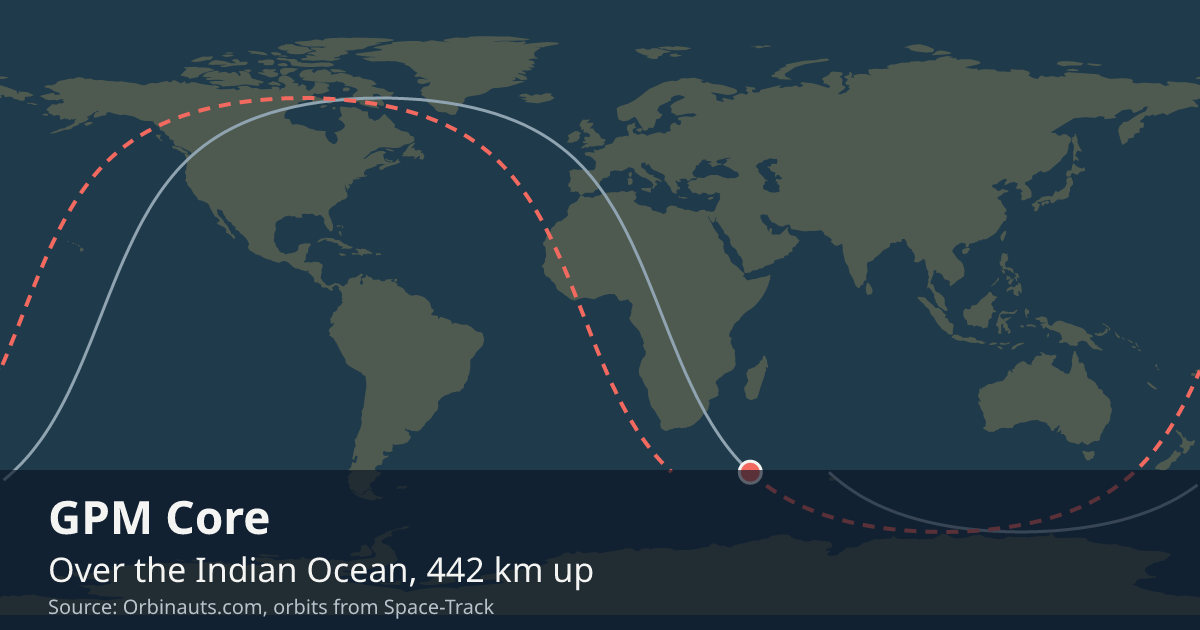 View on live map
Orbit began over the Southern Ocean
Orbit ends over the Southern Ocean
In the Earth’s shadow since
Back in sunlight
In view from you
Nobody watches GPM Core go over, but a receiver still asks whether it is above the horizon. Say where you are and this card answers.
Your position is rounded to about a kilometre and sent only to the Orbinauts API, to find the pass.
No brightness has been published for GPM Core, so it is not a naked-eye satellite and no city page carries pass times for it. Nothing here estimates one.
Seeing it
There is nothing to go outside for: it is too faint for the naked eye. What it is up there for reaches the ground as pictures and measurements, not as a light in the sky.
Timeline
- Launch
Launched, on the day GCAT records. Source
Summary
Over the Indian Ocean LIVE
Where is GPM Core?
At 5:38:53 PM UTC GPM Core was over the Indian Ocean (30.5° S, 67° E), 437 km up, moving at 7.65 km/s and in the Earth’s shadow.
What is GPM Core?
A satellite that watches the Earth in low Earth orbit, in space since Feb 27, 2014.
Can I see GPM Core?
No, not with the naked eye: no brightness has been published for GPM Core, and nothing here estimates one; what people use is its pictures and measurements of the Earth.
General
- Operator
- NASA Goddard Space Flight Center
- State
- United States of America
- Built by
- NASA Goddard Space Flight Center
- What it is
- Earth-watching satellite
- Launched
- Mass
- about 3.9 t
- Operating
- Yes
- Orbit class
- Low Earth orbit
From GCAT, Jonathan McDowell’s general catalogue, licensed CC BY 4.0: the operator, the state, the manufacturer, what it is for, the launch day, the mass, and whether it is operating. The orbit class is read from its current elements.
Latest orbital data
- Position received
- 5:38 PM UTC
- Station time (UTC)
- 5:38 PM UTC
- Latitude / longitude
- 30.5° S, 67° E
- Altitude
- 437 km
- Speed
- 7.65 km/s (27,547 km/h)
- Course
- south-east
- Light
- In the Earth’s shadow until 5:46 PM UTC
- Inclination
- 65°
- Orbital period
- 93.2 minutes
- Orbits per day
- 15.45
- This orbit
- 423 to 439 km
- In shadow
- 32 minutes of each orbit
- In view from
- Within 1,430 km of the point below it
- Elements epoch
- Nov 8, 2026, 5:50 AM, 11 hours old
- Source
- Position from Space-Track orbital elements of Nov 8, 2026, 5:50 AM, 11 hours old.
No operator publishes an ephemeris for GPM Core, so every position here comes from its orbital elements.
In orbit
- Close approaches
- No close approach to GPM Core has been reported publicly in the past thirty days.
From Space-Track’s public conjunction messages; the latest report was issued Nov 8, 2026, 1:11 PM, 3 hours old. Only approaches serious enough to be reported publicly are listed: within three days and, for two bodies near the Earth, closer than a kilometre with a chance of a collision above 1 in 10,000, the level at which NASA moves the ISS.
Beside the others
| Satellite | Typical altitude | Orbital period | Mass | In space since |
|---|---|---|---|---|
| GPM Core | 423 to 439 km | 93 minutes | about 3.9 t | 2014 |
| PAZ | 507 to 510 km | 95 minutes | about 1.4 t | 2018 |
| WorldView-3 | 612 to 615 km | 97 minutes | about 2.8 t | 2014 |
| SAOCOM 1A | 622 to 624 km | 97 minutes | about 3 t | 2018 |
| ALOS-2 | 630 to 632 km | 97 minutes | about 2.1 t | 2014 |
| SMAP | 681 to 683 km | 98 minutes | 944 kg | 2015 |
Data and API
The current elements from Space-Track as an OMM object, epoch Nov 8, 2026, 5:50 AM, 11 hours old.
{
  "OBJECT_NAME": "GPM",
  "OBJECT_ID": "2014-009C",
  "EPOCH": "2026-11-08T05:50:54.394368",
  "MEAN_MOTION": 15.44729097,
  "ECCENTRICITY": 0.00115831,
  "INCLINATION": 64.9701,
  "RA_OF_ASC_NODE": 185.4212,
  "ARG_OF_PERICENTER": 255.3501,
  "MEAN_ANOMALY": 104.6356,
  "EPHEMERIS_TYPE": 0,
  "CLASSIFICATION_TYPE": "U",
  "NORAD_CAT_ID": 39574,
  "ELEMENT_SET_NO": 999,
  "REV_AT_EPOCH": 72006,
  "BSTAR": 0.00032963813,
  "MEAN_MOTION_DOT": 0.00015303,
  "MEAN_MOTION_DDOT": 0
}