- Navigation satellite
- Military
- BD-2-G7
- NORAD 41586
- 2016-037A
- Geostationary
Current orbit
 View on live map
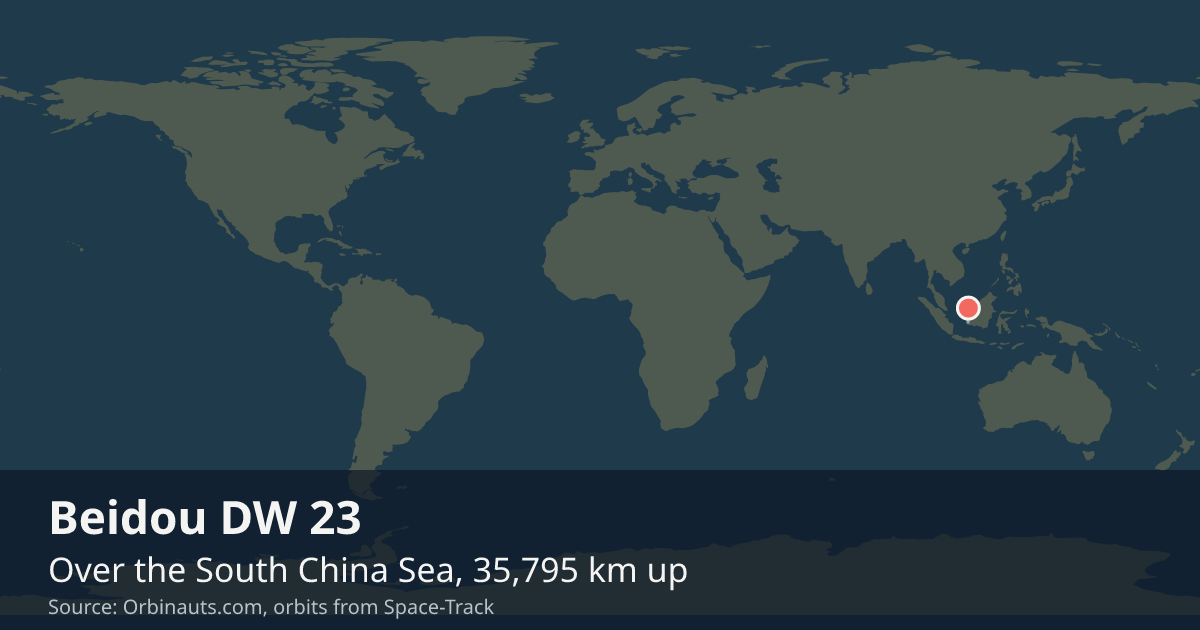
One orbit takes a day, as long as the Earth takes to turn, so Beidou DW 23 keeps above 110.5° E of the equator and never crosses the sky.
It never rises or sets
Beidou DW 23 turns with the Earth, standing over one longitude of the equator. From anywhere it can be seen at all it is up day and night, in the same direction, so there is no pass to wait for.
No brightness has been published for Beidou DW 23, so it is not a naked-eye satellite and no city page carries pass times for it. Nothing here estimates one.
Seeing it
There is nothing to wait for: it never crosses the sky. From the half of the Earth it stands over it keeps the same point day and night, and from the other half it never rises at all.
Timeline
- Launch
Launched, on the day GCAT records. Source
Summary
Over Indonesia LIVE
Where is Beidou DW 23?
At 4:54:05 PM UTC Beidou DW 23 was over Indonesia (0.6° S, 110.5° E), 35,765 km up, standing over one longitude of the equator and in sunlight.
What is Beidou DW 23?
A navigation satellite in geostationary orbit, in space since Jun 12, 2016.
Can I see Beidou DW 23?
No, not with the naked eye, and it never crosses the sky: Beidou DW 23 stands over 110.5° E of the equator; receivers on the ground use its signals instead, whenever it is above their horizon.
General
- Operator
- China National Space Administration
- State
- China, People's Republic of
- Built by
- Chinese Academy of Space Technology, Beijing (CASC 5th Acad)
- What it is
- Navigation satellite
- Military
- Yes: a defence organisation flies it
- Launched
- Mass
- about 3.1 t
- Operating
- Yes
- Orbit class
- Geostationary
From GCAT, Jonathan McDowell’s general catalogue, licensed CC BY 4.0: the operator, the state, the manufacturer, what it is for, that a defence organisation flies it, the launch day, the mass, and whether it is operating. The orbit class is read from its current elements.
Latest orbital data
- Position received
- 4:54 PM UTC
- Station time (UTC)
- 4:54 PM UTC
- Latitude / longitude
- 0.6° S, 110.5° E
- Altitude
- 35,765 km
- Speed
- 3.08 km/s (11,074 km/h)
- Course
- Stands over 110.5° E
- Light
- In sunlight
- Inclination
- 2.1°
- Orbital period
- 1,436.1 minutes
- Orbits per day
- 1
- This orbit
- 35,767 to 35,810 km
- In view from
- Within 7,940 km of the point below it
- Elements epoch
- Nov 8, 2026, 6:21 AM, 10 hours old
- Source
- Position from Space-Track orbital elements of Nov 8, 2026, 6:21 AM, 10 hours old.
No operator publishes an ephemeris for Beidou DW 23, so every position here comes from its orbital elements.
In orbit
- Close approaches
- No close approach to Beidou DW 23 has been reported publicly in the past thirty days.
From Space-Track’s public conjunction messages; the latest report was issued Nov 8, 2026, 1:11 PM, 3 hours old. Only approaches serious enough to be reported publicly are listed: within three days and, for two bodies near the Earth, closer than a kilometre with a chance of a collision above 1 in 10,000, the level at which NASA moves the ISS.
Launched with
Beidou DW 23 shares its launch, 2016-037, with one other body the catalogue lists in orbit.
| Body | What it is |
|---|---|
| CZ-3B R/B | Rocket body |
Read from the international designators of the US catalogue: the year and the launch number every piece of one launch shares. A body that has come down is no longer listed.
Data and API
The current elements from Space-Track as an OMM object, epoch Nov 8, 2026, 6:21 AM, 10 hours old.
{
  "OBJECT_NAME": "BD-2-G7",
  "OBJECT_ID": "2016-037A",
  "EPOCH": "2026-11-08T06:21:20.265696",
  "MEAN_MOTION": 1.00268937,
  "ECCENTRICITY": 0.00051096,
  "INCLINATION": 2.0751,
  "RA_OF_ASC_NODE": 69.7541,
  "ARG_OF_PERICENTER": 337.1759,
  "MEAN_ANOMALY": 206.4249,
  "EPHEMERIS_TYPE": 0,
  "CLASSIFICATION_TYPE": "U",
  "NORAD_CAT_ID": 41586,
  "ELEMENT_SET_NO": 999,
  "REV_AT_EPOCH": 833,
  "BSTAR": 0,
  "MEAN_MOTION_DOT": -0.00000346,
  "MEAN_MOTION_DDOT": 0
}