A German research jet chases a rocket's exhaust in a first test of measuring launch emissions
DLR's MAPHEUS-17 sounding rocket reached 291 km from Sweden on 1 October, giving its experiments about seven minutes of near weightlessness.
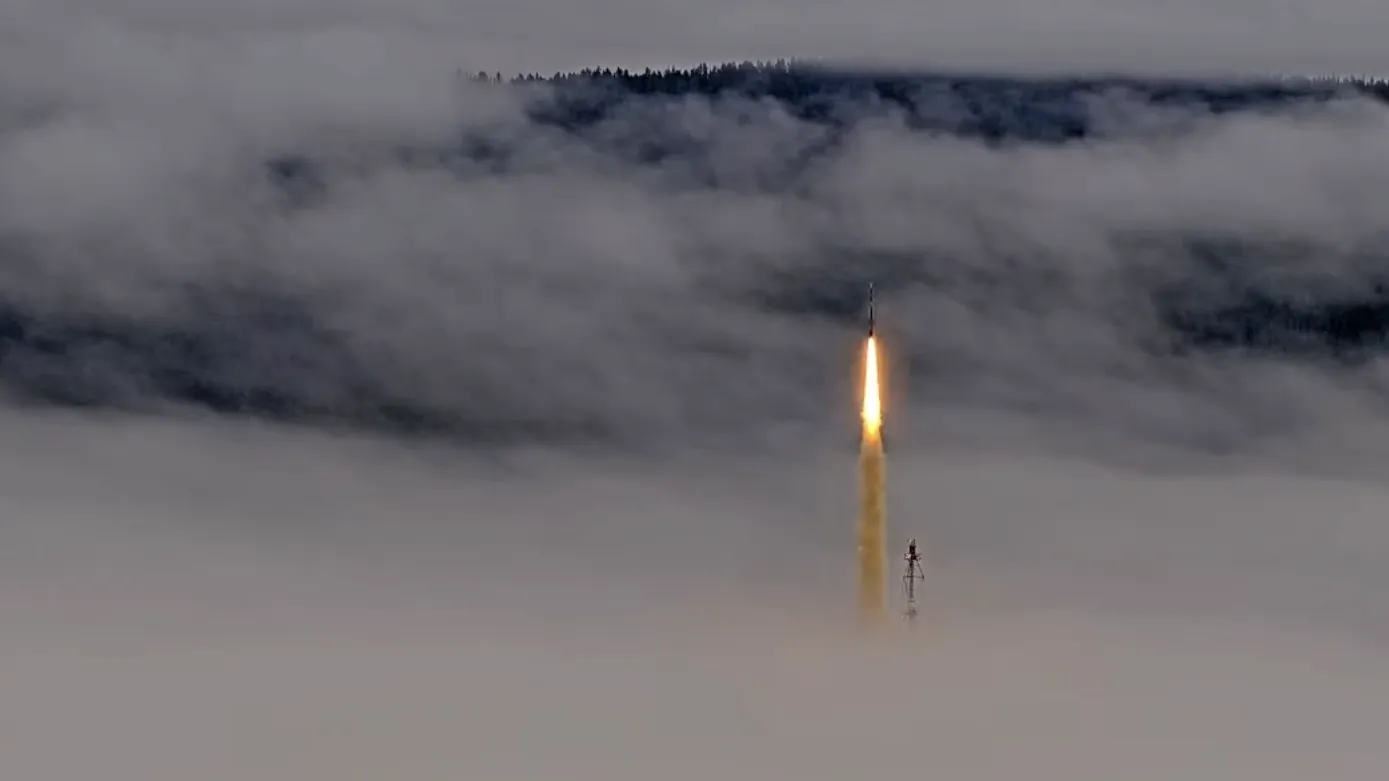
For the first time, the German Aerospace Center (DLR) has tested whether, and how, a rocket’s exhaust can be measured in the atmosphere. A few minutes after its MAPHEUS-17 sounding rocket lifted off from Sweden on 1 October, DLR’s Falcon 20E research jet flew into the airspace that air traffic control had reopened, and circled for about an hour between 2 and 6 km up, trying to fly through the plume as it spread and thinned.
The reason is the number of launches. With rockets launching ever more often, above all to build megaconstellations of hundreds to tens of thousands of satellites, their possible effect on the atmosphere “is increasingly coming into focus”, said Anke Pagels-Kerp, DLR’s board member for space. The aim this time was to show that such measurements are possible and how best to make them; DLR’s release gives no results yet.
The rocket
MAPHEUS-17 lifted off from Esrange Space Center, in northern Sweden, at 08:51 local time on 1 October (06:51 UTC), carrying more than 360 kilograms of experiments. It reached a peak altitude of 291 km, according to SSC Space, which runs the launch site, and its experiments had about seven minutes of near weightlessness before a parachute slowed the payload and a helicopter recovered it.
The flight never went into orbit, and was never meant to: a sounding rocket climbs and falls back, and the minutes of free fall are what the experiments fly for. MAPHEUS, DLR’s programme of materials physics experiments in microgravity, has flown about once a year since 2009, so that an experiment can fly, be improved and fly again.
The rocket is almost 12 metres long, weighed 2.3 tonnes at launch and flew for about 16 minutes over the tundra. Two motors drove it: a Red Kite, developed by DLR and Bayern-Chemie, as the lower stage and an Improved Malemute as the upper one. Once the stages had separated, the payload at the nose carried on along a parabolic path, and the experiments were in free fall.
Last year’s flight carried more, but not as high. MAPHEUS-16, in November 2025, was the first to fly on two Red Kites, and took about 500 kg of experiments to almost 260 km for just over six minutes of microgravity. MAPHEUS-17 carried less, but flew higher and gave its experiments longer in microgravity.
What flew
DLR’s ARTEC experiment flew again: five miniature furnaces melt samples of metal alloys shortly before launch and let them solidify once microgravity begins, to show how an alloy solidifies without gravity shaping it.
Ten smaller experiments rode in two MOSAIC modules, whose basic unit is a 10 cm cube, as with small satellites. Among them were DLR’s VESICOLOS, a miniature microscope for cells, biofilms and membranes which the flight brought a step closer to use on a space station in orbit, and TEGonaut, which tests thermoelectric generators as a power supply with no moving parts. Four came from young teams: the Jugend hackt initiative and pupils at DLR’s school labs in Cologne and Oberpfaffenhofen. DLR also tried out new flight computers, among them systems from the Scottish start-up Aurora Avionics, along with GPS signal processing and the transmission of large volumes of data.
SSC Space flew its own Shared Module, a platform on which several experiments share one set of infrastructure. It carried an alloy solidification study, insect biology, an experiment from a Swedish astronomy youth association and cancer research from Australia.