22 of Starship's 26 Starlink V3s are pausing at 295 km to shift their orbital plane and will presumably climb again
A week after launch, 22 of the 26 hold near 295 km. Astronomer Jonathan McDowell reads it as a pause to shift their orbital plane before they climb on.
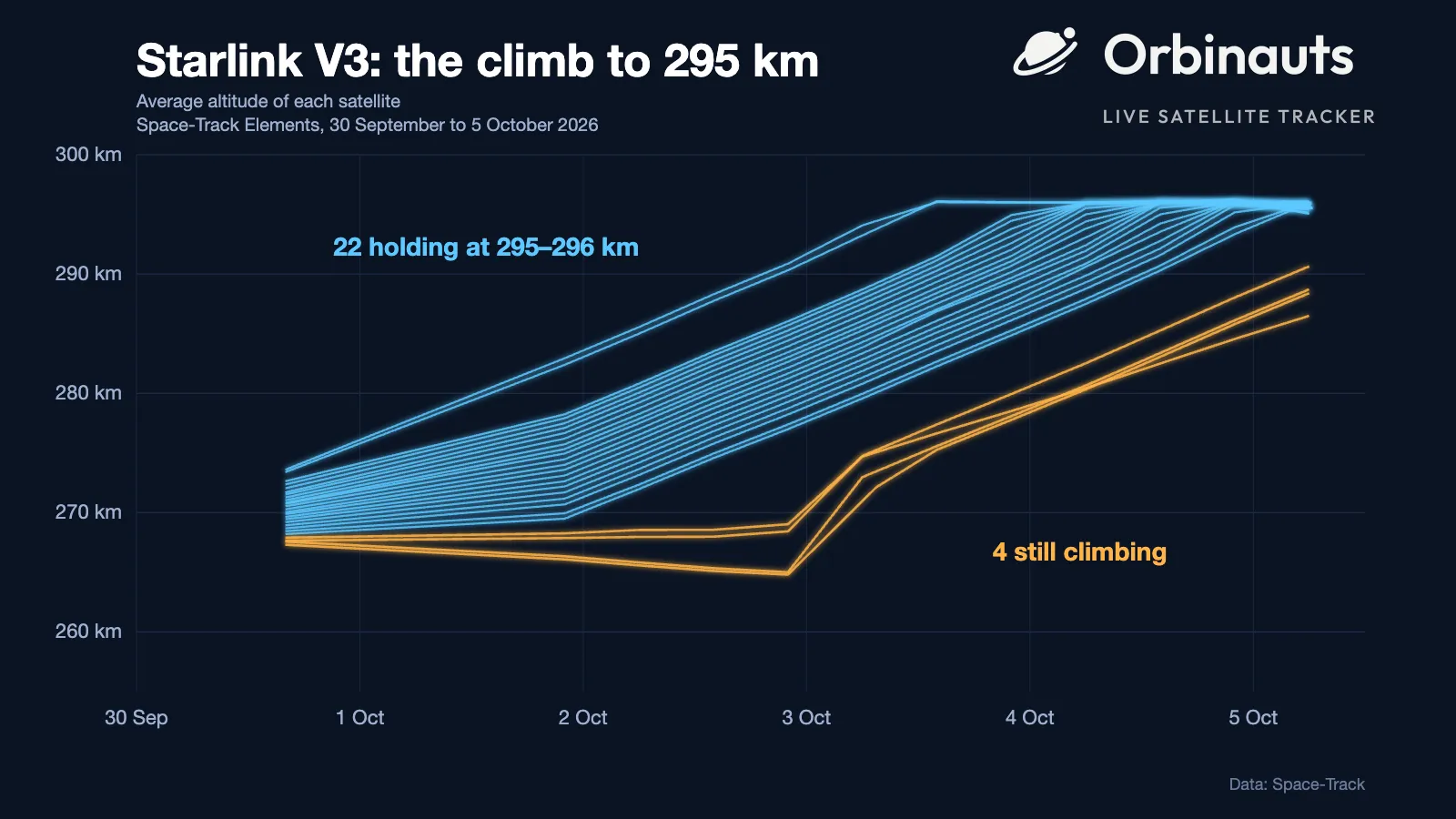
The 26 Starlink V3 satellites that Starship left in orbit on 28 September have all raised their orbits, and most have now stopped. The Elements in our Catalogue, dated the morning of 5 October, put 22 of them on orbits that average between 295.0 and 296.1 km. The other four are between 286.5 and 290.6 km and still climbing. That is low for a Starlink: of the 11,149 in our Catalogue, 9,491 fly between 450 and 500 km.
These are the first satellites a Starship has delivered to orbit. SpaceX said after the flight that they would run on-orbit checkouts and raise their orbits before they begin serving customers. It has not explained why most of them have levelled off where they have.
From 270 to 295 km in five days
The first Elements on Space-Track for the 26 are dated 30 September, two days after launch. They were then between 267 and 274 km, about where Starship had released them: Space-Track lists the ship’s own orbit as 267 by 276 km, tilted 30.5° to the equator.
Then they started to climb, at about 8 km a day. Two of them, STARLINK-40097 and STARLINK-40095, were the first to pass 295 km, on 3 October. Most of the rest arrived on 4 October, and the last two of the 22 on the morning of the 5th. They have stayed at about 295 to 296 km since, which for most of them is a day so far.
Four set off late. For the first days they stayed near 268 km, and two of them sank: the low point of STARLINK-40087’s orbit was down to 259.7 km on 2 October. All four began to climb on 3 October. The lowest of the four in our Catalogue is STARLINK-40080, at 286.5 km.
A pause on the way up
Jonathan McDowell, the astronomer behind Jonathan’s Space Report, reads the stop as a pause. Most of the 26 “are pausing at 295 km for differential orbital plane drift adjustment and will presumably resume ascent after some weeks”, he wrote on X on 5 October.
The manoeuvre is common enough among Starlinks to have a class of its own in his Starlink tables: “Drift”, for “satellites maintained at an intermediate altitude undergoing targeted orbital plane drift”. His page for this launch was last updated on 2 October, before the first satellite levelled off, so it does not show the hold yet. It counts all 26 as working, and none as in its operational orbit.
The idea rests on a quirk of Earth’s shape. The planet’s equatorial bulge slowly turns the plane of a tilted orbit like this one around it, and by an amount that depends on the orbit’s height. NASA’s primer says a mission designer can use that difference to space orbital planes apart: put a satellite on a different orbit and let it drift relative to the others.
Space-Track’s Elements show the effect at work on these satellites. Over the same 16 hours of 2 October, the plane of STARLINK-40097, then climbing through 288 km, turned 4.92° westward; that of STARLINK-40080, still down at 269 km, turned 4.97°. The gap is small, but it adds up over weeks.
SpaceX’s licence fits that reading: it points to a stop on the way, not a destination. The authorisation the FCC gave Starlink’s second generation in January lists the shells its satellites may work in, and the lowest is at 340 km. Two of the shells were asked for with Starship launches from Starbase in mind, one at 365 km and one at 475 km, each tilted 28 or 32° to the equator. The 26 fly between those two tilts, at 30.49°, and SpaceX has not said which shell they are for.
SpaceX itself has not explained the stop, and the orbits alone cannot settle it yet. The same Starlink tables carry a warning for a new shell of the constellation: it may be a while, they say, before he can tell a satellite at its final altitude from one that “was just plane drifting and final altitude is somewhere different”. Starlink says only that V3’s solar arrays are built to reduce drag “in the low orbital altitudes the V3 satellites will operate in”.
Where they fly
All 26 share one orbital plane for now, tilted 30.49° to the equator in our Catalogue. That keeps them over the tropics and subtropics: they pass over Cairo and Houston, never over Madrid or New York. You can follow any of them on our live map; start with STARLINK-40097.
Each V3 is designed for 1 Tbps of downlink and 160 Gbps of uplink capacity, about 10 and 22 times a V2’s, by Starlink’s own comparison.
SpaceX’s account of the flight
When we reported the flight, SpaceX had not said why Starship came home after 3 hours instead of 10. Its account now does: “Out of an abundance of caution given the engine issue experienced during ascent, the flight control team decided to limit the duration spent on orbit.” One of the ship’s vacuum engines had shut down early on the way up.
The same account says contact was made with every satellite “over laser links, ground stations, and Starlink user terminals” soon after release.
Still to learn
SpaceX has not said which of its licensed shells these V3s are bound for, why they are waiting at 295 km, or the day they start serving customers. We will keep watching the 26 and update this Article when they move again.
Sources
- Orbinauts API, the Catalogue
- Space-Track, element set history and satellite catalogue for launch 2026-225 (free account needed)
- Jonathan McDowell, "Starlink Statistics"
- Jonathan McDowell, "Ship 41 (Launch 433, 2026-225)"
- SpaceX, "Starship Flight 14"
- Starlink, "Starlink Version 3 Satellites"
- NASA Goddard Space Flight Center, "GDC Orbit Primer", 10 October 2018 (PDF)
- Federal Communications Commission, Authorization and Order DA 26-36 on the SpaceX Gen2 Starlink system, 9 January 2026 (PDF)
- Jonathan McDowell on X, 5 October 2026
Cite this
Copy either form. The date is the date of the figures above, so it stays true even if you are reading a saved copy.
- In a sentence
- 22 of the 26 Starlink V3 satellites that Starship released on 28 September 2026 were holding between 295.0 and 296.1 km on 5 October 2026, according to Orbinauts.
- As a footnote
- Orbinauts, 22 of Starship's 26 Starlink V3s are pausing at 295 km to shift their orbital plane and will presumably climb again, orbinauts.com/news/starships-starlink-v3s-climb-to-295-km-and-22-of-the-26-stop-there, orbits from Space-Track, retrieved October 5, 2026.
- Under a chart or a table
- Source: Orbinauts (orbinauts.com), orbits from Space-Track