The US retires DSP, the missile-warning satellites it first launched in 1970
The Space Force says the last two DSP satellites retired in September; in our data, two now circle some 350 km above the geostationary ring.
The US Space Force has retired the Defense Support Program (DSP), the satellites that watched for missile launches from geosynchronous orbit for more than half a century, Combat Forces Command said on 1 October. During US Space Command’s Apollo Maneuvers 2026 exercise in September, the 2nd Space Warning Squadron put the last two DSP satellites through dynamic manoeuvres in orbit, ahead of a planned decommissioning into a supersynchronous orbit, an orbit above the geostationary ring.
“These last two satellites were the culminating end to over a half century of space-based early warning,” said Col. Brandon Davenport, the commander of Mission Delta 4, who dated their retirement to September.
Fifty-six years of DSP
The first DSP went up on 6 November 1970, and 23 were launched in all, the last in November 2007, according to Jonathan McDowell’s GCAT. From geosynchronous orbit their infrared sensors picked up the heat of launches and passed it to a network of ground stations around the world. Davenport credits them with deterrence through the Cold War, and with protecting deployed forces from the Gulf War on.
The watch goes on without them. The Space Based Infrared System (SBIRS), whose satellites have flown alongside DSP since 2011, stays in service, and the squadron has begun training to take on the next system in geosynchronous orbit, the Next-Generation Overhead Persistent Infrared Geosynchronous Earth Orbit system (NGG).
Which two
The Space Force does not name the two satellites. In GCAT, USA 149, DSP Flight 20, launched in 2000, ended its regular operations on 3 September 2026; USA 176, Flight 22, launched in 2004, is the one DSP for which GCAT has not yet recorded an end. A third, USA 159, Flight 21, ended its own in March 2026, and it too circles above the ring, between 36,079 and 36,100 km.
Both have climbed since the summer. On 7 August GCAT gave them orbits between 35,775 and 35,794 km, at the height of the geostationary ring, which ESA puts at 35,786 km. Now USA 149 circles between 36,133 and 36,157 km and USA 176 between 36,128 and 36,165 km, according to the Elements we hold: both some 350 km above the ring. They can be followed on the live map: USA 149 and USA 176.
Where the DSP satellites are now
Of the 23, 22 are still in the US catalogue as we carry it; only Flight 23, the last launched, is not, and GCAT tentatively dates the end of its operations to December 2008. Nineteen circle wholly above the geostationary ring, between 35,878 and 36,909 km. Three do not:
| Satellite | Launched | Lowest (km) | Highest (km) |
|---|---|---|---|
| OPS 5960, Flight 1 | 1970 | 25,904 | 36,063 |
| OPS 3165, Flight 5 | 1975 | 35,593 | 35,878 |
| USA 142, Flight 19 | 1999 | 584 | 34,720 |
Figures from our Catalogue as it stood on 6 October 2026, from Elements dated between 16 September and 6 October, with flight numbers and launch years from GCAT. The orbits of Flights 1 and 5 still cross the height of the geostationary ring. GCAT marks Flights 5 and 19 as failed early in their missions, and gives Flight 1’s result as unknown.
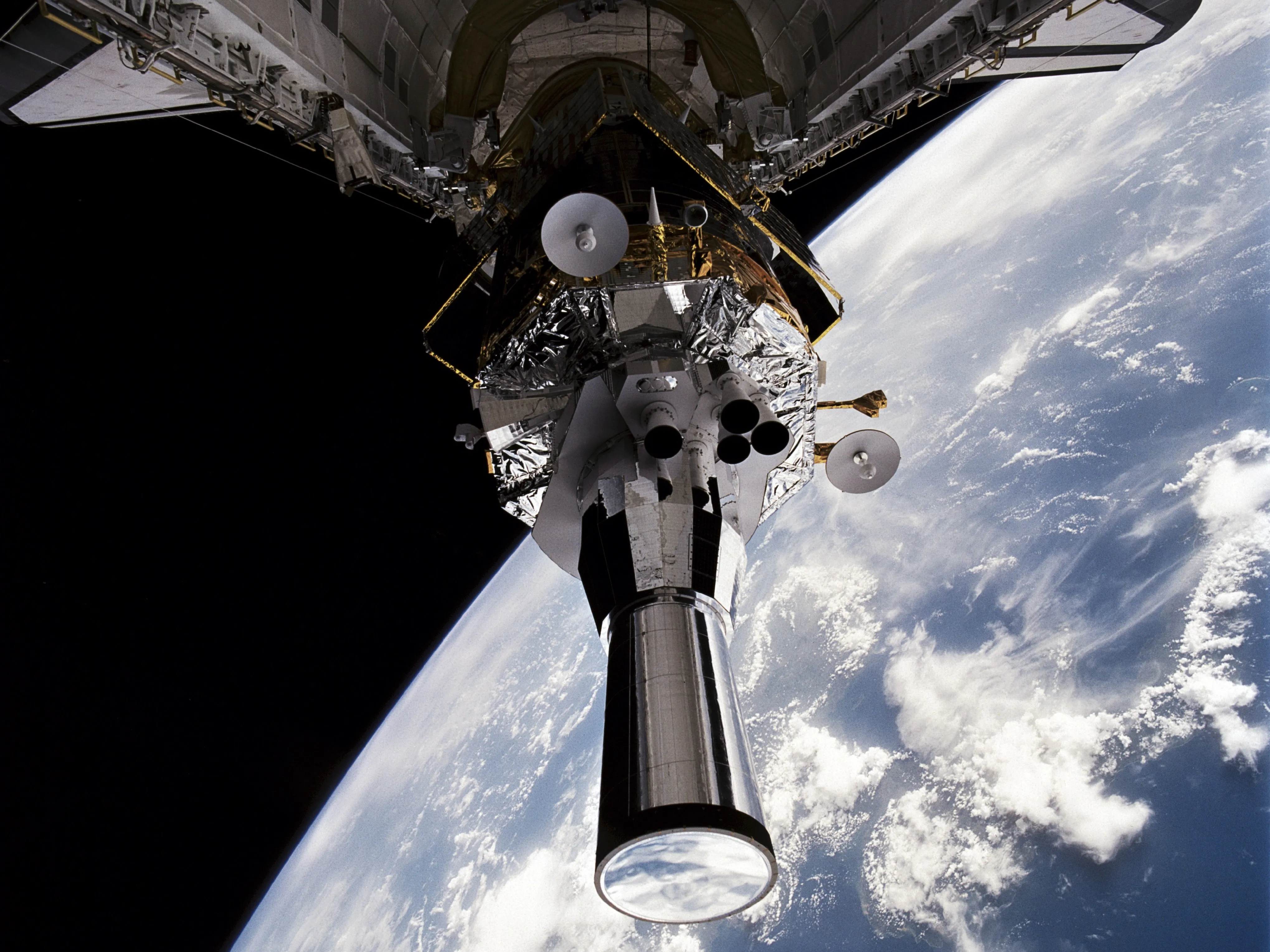
The picture at the head of this page is Flight 16, USA 75, tilted up in Space Shuttle Atlantis’s cargo bay before the crew released it in November 1991. It is one of the nineteen, circling between 36,081 and 36,105 km.
Sources
- U.S. Space Force Combat Forces Command, "USSF retires DSP constellation, prepares for Next-Gen OPIR", 1 October 2026
- Jonathan McDowell, GCAT object catalogue
- Jonathan McDowell, GCAT payload catalogue
- Jonathan McDowell, GCAT payload catalogue columns
- ESA, "Types of orbits"
- NASA, "STS-44 DSP / IUS spacecraft tilted to predeployment position in OV-104's PLB", November 1991
- Orbinauts, the Elements of USA 149
- Orbinauts, the Elements of USA 176
- Orbinauts, the Catalogue
Cite this
Copy either form. The date is the date of the figures above, so it stays true even if you are reading a saved copy.
- In a sentence
- On 6 October 2026, 19 of the 22 Defense Support Program satellites in the US catalogue circled wholly above the geostationary ring, between 35,878 and 36,909 km, according to Orbinauts.
- As a footnote
- Orbinauts, The US retires DSP, the missile-warning satellites it first launched in 1970, orbinauts.com/news/the-us-retires-dsp-the-missile-warning-satellites-it-first-launched-in-1970, orbits from Space-Track, retrieved October 6, 2026.
- Under a chart or a table
- Source: Orbinauts (orbinauts.com), orbits from Space-Track