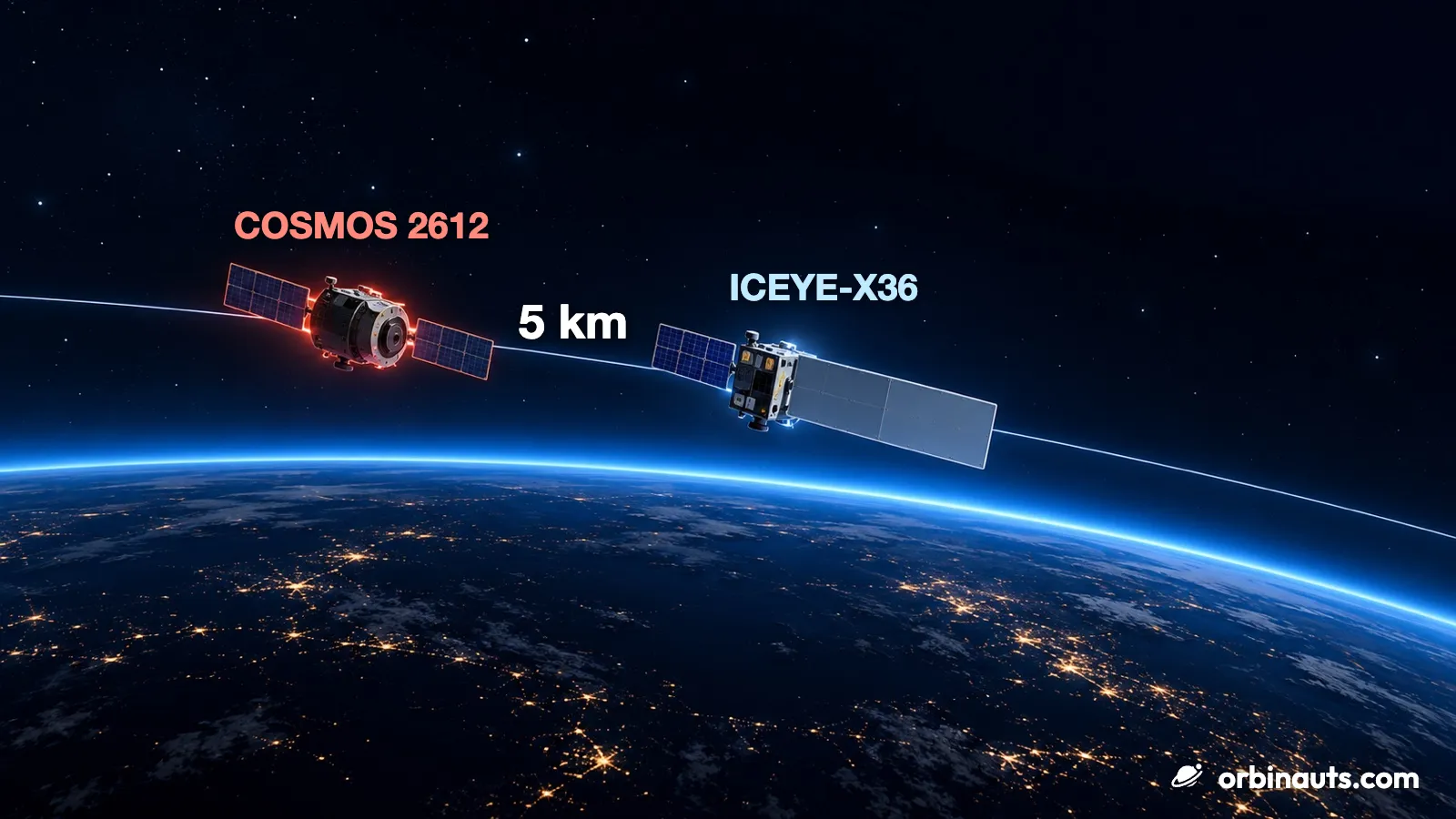
A Russian satellite, Cosmos 2612, now flies in the same orbital plane as ICEYE-X36, a radar satellite operated by ICEYE, the company whose images Ukraine’s armed forces have used since 2022. At 07:38 UTC on Sunday 18 October, the latest public elements of the two put Cosmos 2612 about 5 km behind ICEYE-X36 and some 150 m above it, both orbits tilted 97.85° to the equator and crossing it at the same place in space. Both can be followed on the live map.
In this Article
The space intelligence company LeoLabs said in a statement to Axios that the Russian satellite’s movement “appears to be a deliberate approach toward” ICEYE-X36. By its tracking data the two were roughly three miles (about 5 km) apart on Friday afternoon, 16 October, and more than 200 miles (320 km) apart a day earlier. “While the intent remains uncertain, the behavior warrants continued monitoring,” LeoLabs said. The US Defense Department and ICEYE both declined to comment to Axios.
What the orbits show
The two orbital planes are as close to one as public elements can show. Cosmos 2612’s orbit is tilted 97.8541° to the equator and ICEYE-X36’s 97.8542°, and both cross the equator going north at a right ascension of 71.7953°, the angle that fixes where an orbit’s plane stands in space. Six Russian satellites went up together in April, and none of the other five is in that plane now: their orbits cross the equator between 0.7° and 15.2° away.
Sharing a plane is what matters. Satellites in low orbit rarely change plane, because it takes a large amount of fuel; once in the same plane, a satellite can move in for close-proximity operations quickly and with little more fuel, which could be benign, such as servicing or removing debris, or could presage a counterspace weapon, two analysts at the Center for Strategic and International Studies (CSIS) write.
Run forward with no further manoeuvre, the same elements have the gap widening by about 20 km a day, to some 26 km by 08:00 UTC on Monday 19 October, because Cosmos 2612 circles slightly higher and so slightly slower. Staying close would take another manoeuvre, which the next sets of elements would show. Jonathan McDowell, who compiles the GCAT catalogue of objects launched into space, read the elements of 17 October as showing that Cosmos 2612 manoeuvred on 16 October and “is now stationkeeping within 5 km or less of ICEYE X36”.
Public elements are a fit to tracking data, not a measurement. A 2009 ESA study of their errors put the average uncertainty for objects in low orbit at 0.471 km along the direction of travel and 0.102 km in height. The 5 km gap is well clear of that, while the 150 m between their heights is not much larger than it.
How Cosmos 2612 got there
Cosmos 2612 is one of six satellites, Cosmos 2609 to Cosmos 2614, launched together from Plesetsk on 16 April 2026. “In May 2026, Russia executed fuel-intensive orbital maneuvers to position four military satellites (Cosmos 2610 through 2613) close to a Western commercial radar satellite used by Ukraine for imagery intelligence,” the US Space Force says in its Space Threat Fact Sheet, which does not name that satellite. CSIS counts five of the six raising their inclination that month to match ICEYE-X36’s plane.
The firm COMSPOC, in an analysis of LeoLabs’ tracking data published in July, listed five of them, Cosmos 2610 to Cosmos 2614, in ICEYE-X36’s plane, and three close passes in May, one of them by a satellite outside that five: Cosmos 2613 passed ICEYE-X36 at 3.86 km on 17 May, Cosmos 2609 at 2.54 km on 26 May and Cosmos 2614 at 16 km on 29 May. It also singled out Cosmos 2612, which by its reckoning could intercept ICEYE-X36 with a change of speed of 4.4 m/s, for an intercept within a day of a manoeuvre on 16 July.
None of them then manoeuvred to stay in ICEYE-X36’s plane, so their planes slowly drifted apart. Over two weeks from 30 September, Cosmos 2612 made a series of new manoeuvres that brought it back into the same plane and to nearly the same altitude as ICEYE-X36, those analysts, Clayton Swope and Chantal Li of CSIS, wrote on 15 October. Given Russia’s history of testing weapons in orbit, “policymakers should assume Cosmos 2612 could take an action that threatens the commercial satellite,” they wrote.
Matching another country’s satellite is not new for Russia. It has put probable anti-satellite prototypes into low orbit five times since 2017, and the four most recent “were all placed in orbits matching those of U.S. national security satellites”, the Space Force says. Russia has tested releasing objects from its satellites in orbit too, but none of those tests took place near a non-Russian satellite, CSIS notes. McDowell judged this one a step further: “To my knowledge this is the first LEO rendezvous of two active satellites where the owner of one of the sats did not give approval”.
What a satellite so close could do
At ranges under 5 km, COMSPOC wrote in July, possible missions could include “close inspection, electronic warfare (support/attack), or intelligence gathering”. Swope called the distance essentially “bumper-to-bumper”, and Aaron Brynildson, a space law professor at the University of Mississippi, told Axios that while no strict legal limit exists, countries generally don’t get closer than six miles, about 10 km.
A Ukrainian official told Axios that Ukraine’s military works with ICEYE but that it was unclear whether ICEYE-X36 itself supports the country, and that the military had not been aware of the satellite’s movements in recent days, though it had been told of similar ones in the spring and summer.
The satellite it is following
ICEYE-X36 went up on 4 March 2024, among dozens of objects catalogued from that launch, and the US catalogue lists the United States as its owner: CSIS calls it a U.S.-registered satellite operated by ICEYE, a company founded in Finland, and says it supports Ukraine, which the Ukrainian official who spoke to Axios would not confirm. ICEYE flies a constellation of radar satellites that image by day and night, in any weather.
ICEYE has worked for Ukraine since August 2022, when it agreed to transfer the full capabilities of one of its radar satellites already in orbit to the Government of Ukraine, with ICEYE still operating it, and to give the Ukrainian Armed Forces access to the rest of the constellation. In January 2026 it signed a new agreement with a customer within Ukraine’s Ministry of Defence to keep high-resolution imagery coming. Neither announcement names a satellite, and which one serves Ukraine is not publicly known.
Russia has warned about satellites like these before. Moscow “has repeatedly said ‘quasi-civilian’ commercial satellites used for military purposes ‘may become a legitimate target for retaliation’”, the Space Force’s fact sheet notes.