Chinese company ADA Space has eight more satellites in orbit built to run computers in space. LandSpace’s Zhuque-2E rocket lifted off at 19:40 Beijing time on 14 October (11:40 UTC) from LandSpace’s methane and liquid oxygen launch pad in the Dongfeng commercial space test zone, near Jiuquan, in northwest China, and put ten satellites into their planned orbits, the company said: ADA Space’s eight, and two test satellites of LandSpace’s own. LandSpace declared the flight a complete success.
In this Article
The eight are Xingshidai-39 and Xingshidai-44 to 50, which ADA Space built itself. They will test high-performance computing payloads, high-speed laser links between satellites and down to the ground, and large radiative cooling wings, according to LandSpace.
The cooling wings are there because a computer makes heat, and in a vacuum there is no air to carry it away: the only way out is to radiate it. Google called cooling a crucial research challenge for data centres in orbit a week before its own test satellite, Suncatcher, launched on 1 October.
ADA Space already has twelve of the same series in orbit, Xingshidai-27 to 38, launched on 14 May 2025. It owns them together with Hangzhou’s Zhejiang Lab, according to Jonathan McDowell’s GCAT catalogue. LandSpace does not say whether the new eight will join those twelve in one network.
Between day and night
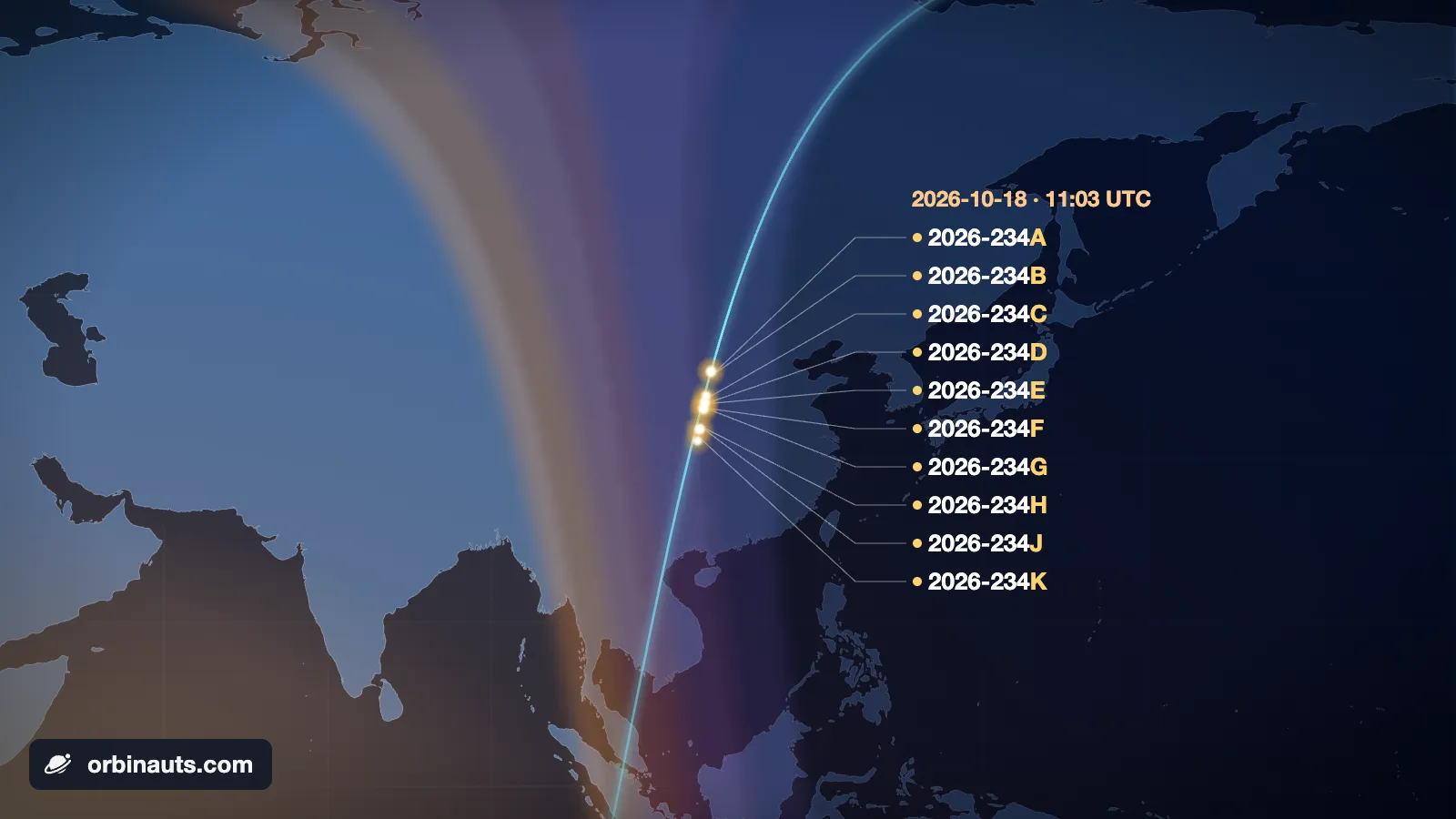
All ten, ADA Space’s eight and LandSpace’s two, ride the line between day and night. They circle about 530 to 550 km above the Earth on a sun-synchronous orbit, one that passes over the same spot on Earth at the same local time every day. Our tracking shows theirs crosses the equator at about 06:15 local solar time heading north and 18:15 heading south: the dawn-dusk kind, which flies in constant dawn or dusk, riding the sunrise or the sunset, as ESA puts it.
That keeps the Sun off to one side of their orbit, so far that for now the Earth’s shadow does not reach it: by our calculation, the ten spend no time in the shadow until early November. From then until early February, around the December solstice, they will cross it on every orbit, for up to about 22 of its 95 minutes. Over a whole year, that comes to about 5% of their time in the Earth’s shadow.
ADA Space’s twelve of May 2025 fly a different orbit, which crosses the equator in the mid-morning and late at night, so they pass through day and night: each of the twelve spends about 35 minutes of every orbit in the Earth’s shadow, all year round: more than a third of their time.
Our Catalogue lists the ten as 2026-234A to K, with an eleventh object: the rocket’s upper stage, left in an orbit so low that it falls back within days of the launch: on 16 October it dipped to about 130 km. Space-Track, the US Space Force’s public catalogue, has not named them yet, so which object is which satellite is not yet known.
LandSpace’s two
LandSpace’s two, Guangchuan-03 and 04, are laser data-transmission test satellites from LandTower, LandSpace’s satellite subsidiary. They will test a highly integrated onboard processing unit, large-aperture high-speed laser communication, a module that combines laser routing and communication, and a new kind of solar wing, technology LandSpace is building up for large networks of satellites. Guangchuan-01 and 02 flew on the first Zhuque-2E, on 27 November 2024.
The launch was the tenth flight of the Zhuque-2 family, and the fourth of this Block 2 version, all four successful. LandSpace says it is moving Zhuque-2E to regular commercial launches while it tests the reuse of its newer rocket, Zhuque-3.
 Read nextGoogle wants to know if AI data centres can work in space. Step one is now in orbit: a satellite testing whether its AI chips survive
Following them
All ten can be followed together on the live map, where this Article lists them and says which are in sunlight and which in the Earth’s shadow. Their Catalogue numbers are 101060 to 101069.
Google is after the same sunlight: the constellation it sketched for Suncatcher in 2025 would likely fly a dawn-to-dusk orbit, exposed to near-constant sunlight.