Miura 1 returns to learn to land: PLD Space's CEO maps the road from Miura 5 to Miura 9
Raúl Torres revealed a landing test vehicle based on Miura 1, and set out what is left before Miura 5 flies and what Miura 9 will be.
PLD Space will build a new version of Miura 1, the suborbital rocket it flew in 2023, as a vehicle that takes off and lands again, to learn the landings its next rockets will need. Raúl Torres, the Spanish company’s chief executive and co-founder, revealed it in a two-hour interview on the Spanish space channel Control de Misión, published on 2 October and filmed at the company’s headquarters in Elche. He also gave the fullest account yet of the last steps before Miura 5’s first launch from Kourou, in French Guiana, the plan to bring its first stage back, and the engines of the larger Miura 9.
The broad lines were already public. On 10 September, during a visit by Spain’s prime minister, PLD gave Miura 5’s first demonstration flight a date in the first half of 2027 and renamed the rocket it had called Miura 5 Block 1.2: it is now Miura 9. The interview fills in much of what those announcements left out.
Miura 5: what is left before launch
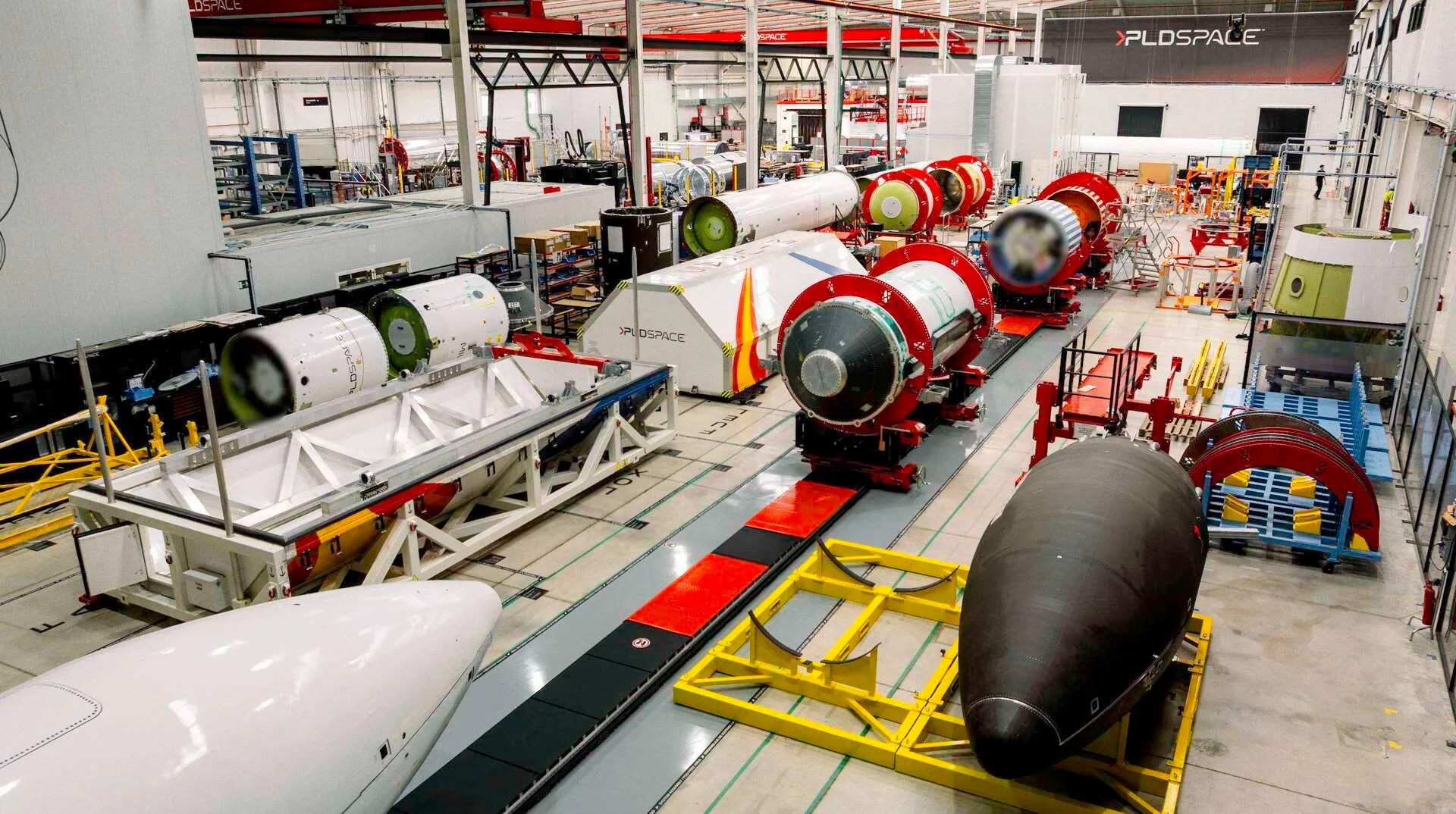
The large pieces of the first flight rocket are built, Torres said: the tanks of both stages, the high-pressure helium tanks, the five combustion chambers of the first stage and the one of the second, the fairing and the interstage. What is still arriving are turbopump parts, among the tens of thousands of smaller pieces inside, and integration is under way.
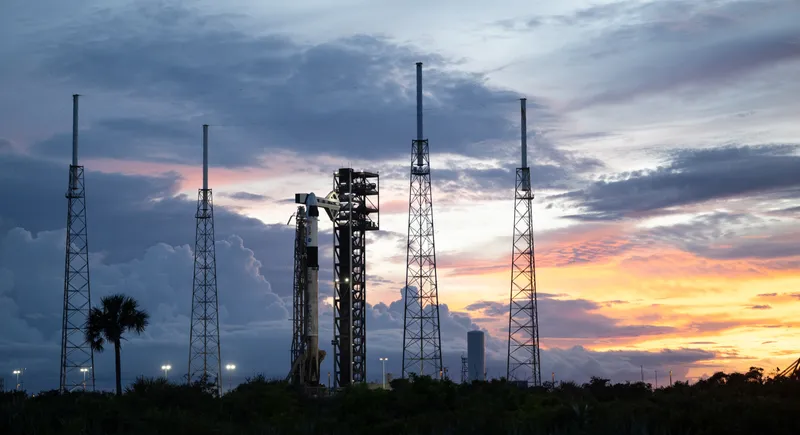
In Kourou, the launch control room is finished, in part of the control centre that served Soyuz until that rocket stopped flying from French Guiana. The hall where the rocket is assembled lying down is built, and its rooms and equipment should be ready in December. The launch zone takes longest: it should be finished in the first quarter of 2027. A twin of Miura 5 that will never fly, the qualification vehicle, will be used first to test the pad: umbilicals, raising the rocket and the fit between rocket and pad.
Then comes the wet dress rehearsal, a countdown with the propellants loaded. Torres counts about three months from that rehearsal to the launch, which PLD targets for the first half of 2027. CNES, France’s space agency, and ESA have already authorised PLD to use Kourou’s facilities and ESA’s tracking stations. Still to come is the safety authorisation: confidence in the flight termination system, a safe trajectory and the rocket’s ability to detect its own failures. Torres expects it around the time of the rehearsal. On 1 October, PLD and CNES also agreed to study a second launch pad at Kourou’s ELM-Diamant complex for Miura 5 and Miura 9.
Asked what keeps him awake, Torres named the launch and building the pad, and, further back, finishing the qualification of the engines, which he called the key. The qualification engines may well still be firing on the test stand while the flight rocket is being integrated in Kourou, he said.
The goal of the first flight is orbit, but Torres set the bar lower: reaching stage separation, as Relativity’s Terran 1 did, would already be a feat, and “there wouldn’t be enough drinks in Kourou” to celebrate it. PLD has the money to survive several failures, and the aim is to have the second rocket in the hangar while the first is on the pad: if the first reaches orbit, the second carries a paying customer.
How the first flight is to fly
The first rocket flies in a configuration PLD calls Block 1.0, with a first stage that is not recovered but whose central engine can restart. The flight, step by step, as Torres described it:
| Step | What happens |
|---|---|
| Lift-off | The five Teprel-C engines light on the pad, fed through an umbilical; all five swivel to steer. |
| After maximum aerodynamic pressure | On some trajectories the central engine shuts down when acceleration reaches about 6 g. |
| Losing an engine | The rocket can lose one engine and fly on with the other four. |
| Separation | Four latches release and four pushers part the stages; the second-stage engine starts as they separate, its small thrusters keeping the propellant settled. |
| Fairing | It opens a few seconds later, and the second stage flies on to orbit. |
| First stage turns | It swings round engines first and relights its central engine, fed from a panel on board, to brake. |
| Braking burn | 5 to 10 seconds on the first flight, up to about 30 seconds on later ones, which cuts the distance the stage travels downrange by more than half. |
| Re-entry | An empty stage the height of an eight-storey building falls at seven to eight times the speed of a bullet, carrying extra sensors to measure the heating. |
On the first flight, assuming everything before goes well, the stage is expected to break up during re-entry. PLD’s model says it should fail between 35 and 40 km of altitude; if it does, Torres would count it a success, because it would confirm the model.
Bringing the first stage back
The next configuration, Block 1.1, adds more thermal protection and a ballute, a cross between a parachute and a balloon. A gas generator, like a car’s airbag, inflates it at 40 to 50 km, around Mach 8. PLD has been developing it with a US company and a US space agency, which Torres did not name, and he said it will be one of the largest hypersonic ballutes in the world. Its job is less to slow the stage than to steady it: without it, the stage would swing back and forth all through re-entry (Torres gave about 7 degrees either way, a figure he said he was exaggerating) and could tumble and break up.
At about 10 km the ballute is released and a parachute opens; the stage lands in the sea, floats and is picked up. Whether a given flight carries the system depends on how much performance the customer’s orbit needs.
Miura 9: nine new engines and a barge
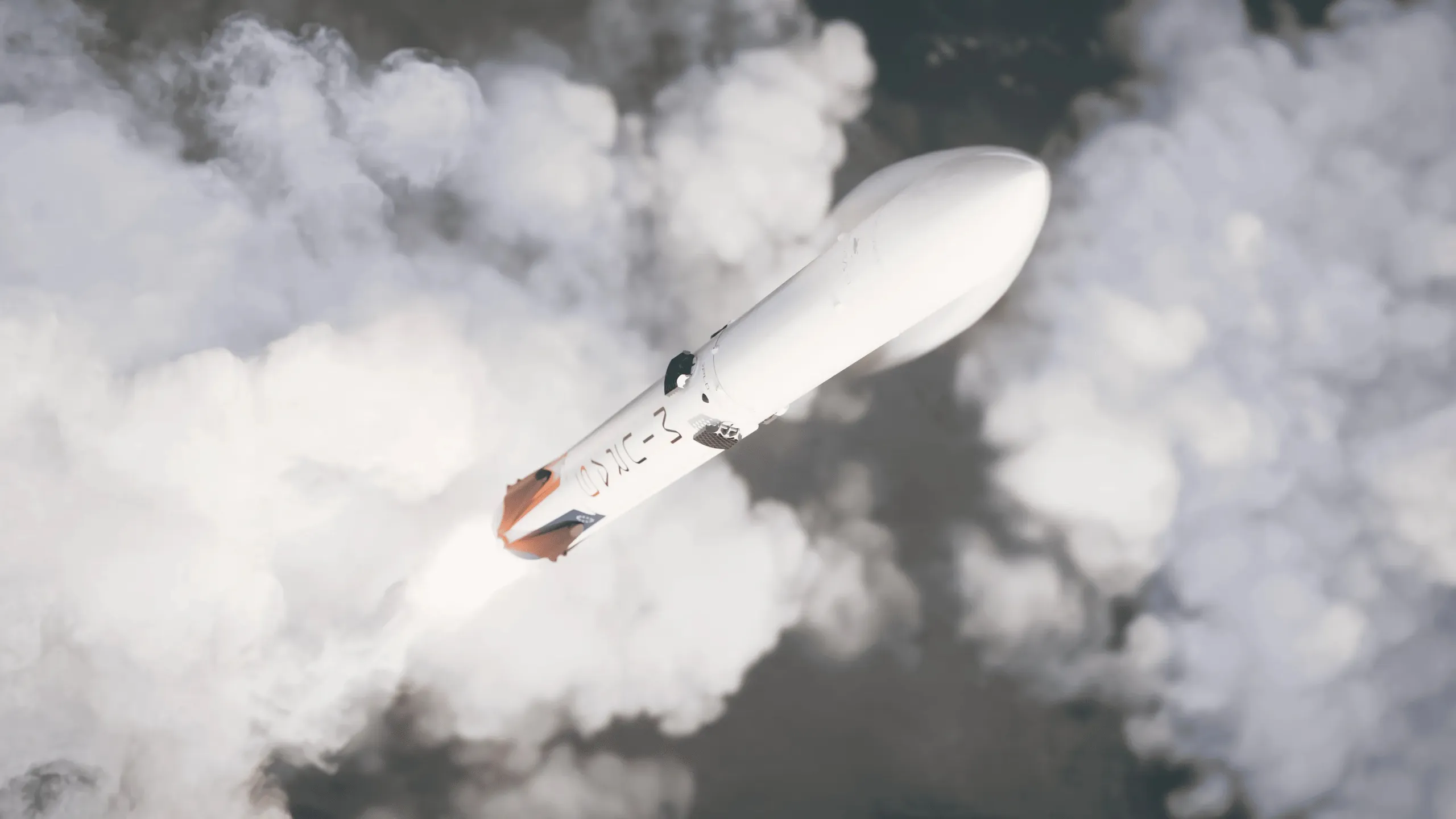
The plan had always been for Miura 5 to land on legs, Torres said, but PLD found that the fuel it would need to come back left a payload close to zero. A 2.5 m rocket with seven engines still fell short; at 3 m and nine engines the numbers worked, even with the stage landing on a barge. That rocket is Miura 9. Its first-stage engines will not be today’s Teprel-C but a new version, Teprel-D, named for the first time in the interview: at least 30 tonnes of thrust each, half as much again as Teprel-C, with the same basic design.
| Miura 5 | Miura 9 | |
|---|---|---|
| Height | 35.7 m | 42 m |
| Diameter | 2 m | 3 m |
| First stage | 5 Teprel-C, 190 kN each | 9 Teprel-D, at least 30 t (about 300 kN) each |
| Second stage | 1 Teprel-C Vacuum | 1 Teprel-C adapted to vacuum |
| To sun-synchronous orbit | about 500 kg | up to 1,500 kg |
| To equatorial orbit | about 1 t | close to 4 t |
| First stage after flight | ballute, parachute and the sea, on later flights | grid fins and legs, landing on a barge |
Miura 9 is designed from the start with grid fins and landing legs, though its first flight may not carry them. It will land on an autonomous barge out at sea, as Falcon 9 does: flying back to Kourou is possible, Torres said, but would cost so much payload that the rocket would probably drop to the low end of Miura 5’s range. Its range of 800 kg to 4 t is aimed at IRIS² and the other European constellations in development. It is part of PLD’s €158.9 million contract with ESA in the European Launcher Challenge.
Almost everything carries over from Miura 5, Torres said: the same tank tooling, avionics and engine production. Of the structure, only the tank domes are made outside the company, by Spanish suppliers.
Miura 1 returns, to learn to land
Before Miura 9, PLD will test landing with a vertical take-off and landing vehicle whose codename is an animal, which Torres would not yet reveal. Its first version is a converted Miura 1, a little bigger and stubbier, with an upgraded Miura 1 engine that can throttle. It will first take off, hover and land at PLD’s test site in Teruel, to prove the guidance software and the engine and thruster control.
Then, for now with this first version, it is to try to reach about 30 to 40 km, fall back with its engine off, steered by grid fins, and come down in the Atlantic. Torres would not say where it will launch from, only that “we can imagine where”. Miura 1 flew from INTA’s El Arenosillo centre in Huelva on 7 October 2023, reaching 46 km before coming down in the Atlantic. PLD is also building buoys to stream the landing live.
A second version uses a full Miura 5 first stage with a single Teprel-D, much like SpaceX’s Grasshopper. Landing needs an engine that can throttle down to 60% of its thrust or less; Teprel-C goes no lower than about 80%, one reason for the new engine.
Miura Next and Lince
Miura Next, the heavy rocket after Miura 9, is only a little wider, at 3.6 m, but needs an engine five times as powerful: 1.5 MN, a closed-cycle engine running rich in oxygen, with an internal codename and no longer a Teprel. Torres compared it with the Soviet NK-33. Each core will carry five; with two side boosters the rocket would sit between Falcon 9 and Falcon Heavy, and a version with four boosters may need a different central core. The engine is the long pole, and the goal is for the first parts of it to be seen in 2027.
Lince, PLD’s crew capsule, is tied to Miura Next. Its in-flight abort test from Kourou could fly on the first stage of either Miura 5 or Miura 9; that is still open, and Torres promised updates on Lince next year. Both programmes will take five to seven years.
How many rockets
PLD can already build the structures of eight rockets a year and almost 60 engines, which in practice means six to eight rockets once engine tests and rejects are counted. Engines are more than half the cost of a rocket. The plan is at least two rockets in 2027 and four in 2028, then to try for eight, then fifteen and eventually about 30 a year, one a week or so. To pay for it, the company has raised €488 million since it was founded; Torres put the split at about 65% private and 35% public, most of the public part as equity.
Europe’s launch market
Satellite builders are short of launches, Torres said, and even two European rockets flying often would not meet the demand. He welcomed Isar Aerospace’s arrival in orbit, on the second flight of its Spectrum rocket on 5 September (“Finally I have a competitor”), while hinting that he doubts its payloads reached the intended orbit. What matters to customers, he argued, is reliability: putting a satellite in the wrong orbit is worse than leaving it on the ground, and PLD aims for far greater reliability than Spectrum.
Asked about a spaceport in the Canary Islands, Torres said PLD has a study of several possible sites that it has offered to the authorities, but that a Canary base would only serve polar orbits and possibly sun-synchronous ones through a narrow corridor, much like Isar’s at Andøya, and that the choice should be made on technical grounds rather than political ones.
Sources
- Control de Misión, "Todos los detalles del cohete más ambicioso de EUROPA: Miura 9 (PLD Space)", interview with Raúl Torres, 2 October 2026 (in Spanish)
- PLD Space, "El presidente del Gobierno visita PLD Space para conocer cómo construye desde España capacidad europea de acceso al espacio", 10 September 2026
- PLD Space, "PLD Space y el CNES avanzan juntos en las futuras capacidades de lanzamiento de Europa desde el Centro Espacial de la Guayana", 1 October 2026
- PLD Space, "La ESA selecciona a PLD Space para desarrollar la próxima generación de lanzadores privados europeos", 27 August 2026
- PLD Space, "PLD Space amplía su ronda Serie C hasta los 288 millones de euros con un tramo adicional de 108 millones de euros", 1 September 2026
- PLD Space, Miura 5
- PLD Space, Miura 9
- PLD Space, Miura 1
- Launch Library 2, Spectrum | Onward and Upward