Crew-13 is set to launch for the ISS today, on the fastest planned US trip to the station
Four astronauts are set to lift off from Florida at 15:10 UTC on 1 October and dock 7 h 50 min later, the fastest US trip to the station yet.
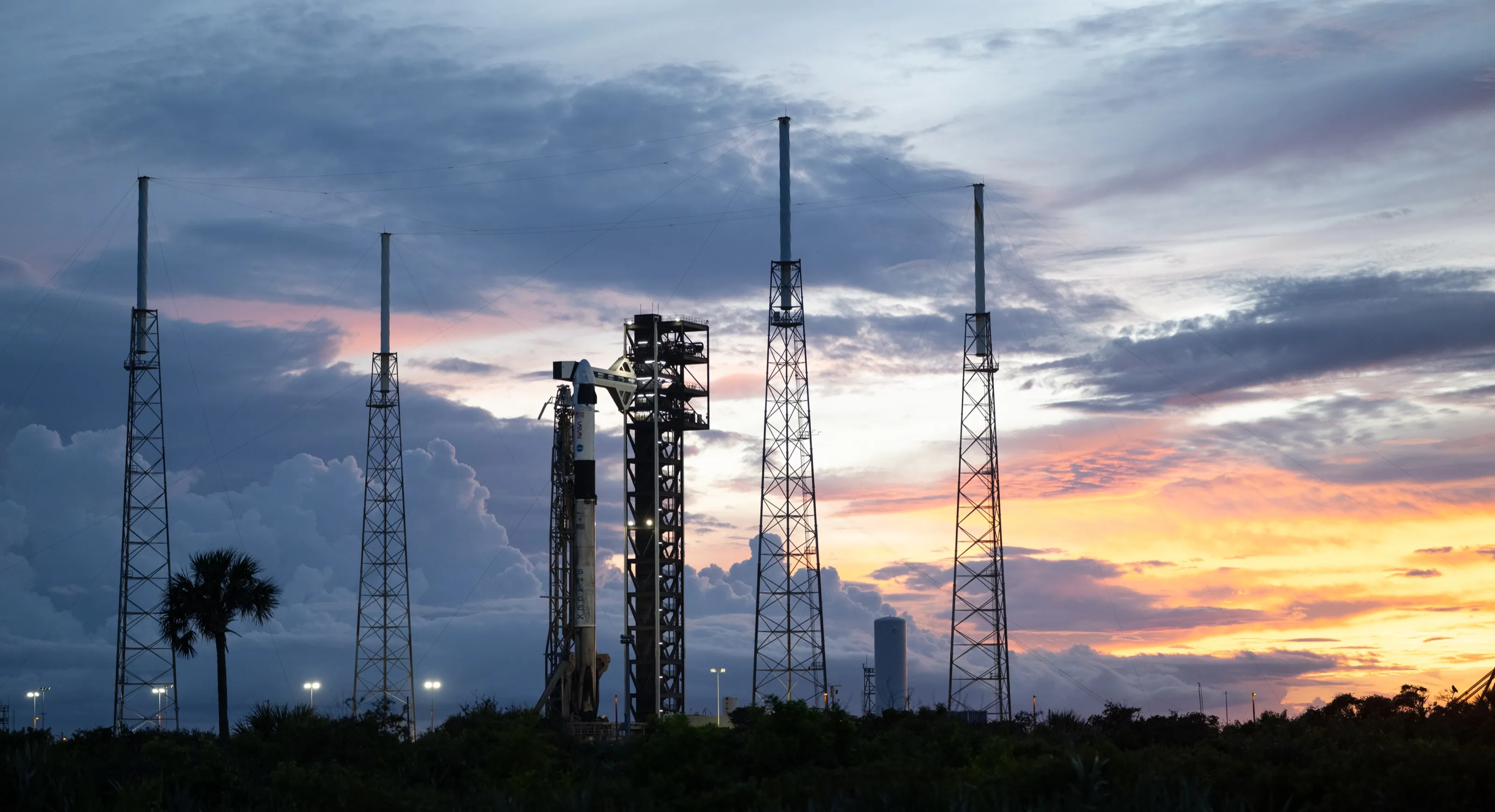
Four people are set to leave for the International Space Station today. NASA’s SpaceX Crew-13 is scheduled to lift off at 11:10 a.m. EDT, 15:10 UTC, on Thursday 1 October, aboard a Falcon 9 from Space Launch Complex 40 at Cape Canaveral Space Force Station in Florida. Mission leaders polled “go” for the launch count on Wednesday after the Launch Readiness Review.
If it flies on time, the Dragon is to dock at about 7 p.m. EDT (23:00 UTC) the same day. NASA says the planned trip of 7 hours 50 minutes from launch to docking will be the fastest by a US spacecraft in the station’s history.
Who is flying
| Commander | Jessica Watkins, NASA |
| Pilot | Luke Delaney, NASA |
| Mission specialist | Joshua Kutryk, CSA (Canadian Space Agency) |
| Mission specialist | Sergey Teteryatnikov, Roscosmos |
Watkins is the only one who has flown before: she spent 170 days in space on Crew-4 in 2022, and today she is set to become the first NASA astronaut to launch twice aboard a Dragon. For Delaney, Kutryk and Teteryatnikov it is a first spaceflight.
They fly in the Dragon named Grace, which last flew in summer 2025 for the private Axiom Mission 4. It is NASA’s 13th crew rotation flight with SpaceX.
The weather is the main risk
The US Space Force’s 45th Weather Squadron gives a 40% chance of favourable weather at the pad for liftoff, down from 60% on Tuesday and 55% on Wednesday. Its concerns are cumulus clouds, thick cloud layers and flying through rain. The launch time is an instant, not a window: if the weather or anything else stops the count, the attempt moves to another day.
The date itself is a new one: at the end of August NASA and SpaceX put the launch off to deal with an oxidiser leak found in the Dragon’s propulsion system during processing before launch.
The day, hour by hour
NASA’s launch-day milestones and its coverage plan, all times approximate:
| Event | EDT | UTC |
|---|---|---|
| Crew enters the Dragon | 8:34 a.m. | 12:34 |
| Hatch closes | 9:15 a.m. | 13:15 |
| NASA’s launch coverage begins | 9:20 a.m. | 13:20 |
| Go for propellant loading | 10:25 a.m. | 14:25 |
| Launch escape system armed | 10:31 a.m. | 14:31 |
| Liftoff | 11:10 a.m. | 15:10 |
| Stage separation | 11:12 a.m. | 15:12 |
| First stage lands | 11:17 a.m. | 15:17 |
| Dragon separates from the second stage | 11:19 a.m. | 15:19 |
| Docking coverage begins | 5:20 p.m. | 21:20 |
| Docking | 7 p.m. | 23:00 |
| Hatch opening | 8:45 p.m. | 00:45, 2 October |
The Falcon 9’s first stage is on its third flight and is to land back at Landing Zone 40, at the Cape. The broadcast streams on NASA’s live page.
Arriving at the station
Falcon 9 will take the Dragon to about 17,500 mph (28,000 km/h), and from orbit the Dragon makes a series of manoeuvres to the forward-facing port of the station’s Harmony module. It docks on its own; the crew can take manual control if needed. On Wednesday, station commander Jessica Meir reorganised cargo in the docking adapter where the Dragon will dock, to make room for the new crew.
Our tracking of the ISS caught the station raising its orbit the week before: between 25 and 26 September its mean altitude rose by about 2 km, a rise drag cannot cause, so a firing of engines, with a further 109 m later on the 26th. On 1 October the station orbits between 416 and 426 km above the Earth, according to Orbinauts.
Seven people are waiting aboard as Expedition 75: NASA’s Jessica Meir, Anil Menon and Jack Hathaway, ESA’s Sophie Adenot, and Roscosmos’s Pyotr Dubrov, Andrey Fedyaev and Anna Kikina. After a short handover, Crew-12 is to start home no earlier than Monday 5 October with Meir, Hathaway, Adenot and Fedyaev.
What Crew-13 will do up there
The crew will study tissues grown from human stem cells to help treat heart disease and Parkinson’s disease, grow crops, look at blood flow problems seen in space and test new medical equipment, NASA says. During their stay they are to receive SpaceX’s 35th cargo mission, bringing new Roll-Out Solar Arrays for the station, and Northrop Grumman’s 25th later this year.
Until liftoff, Crew-13 is on our next launches, with its countdown.
Sources
- NASA, "Launch Day for NASA's SpaceX Crew-13 Mission", 1 October 2026
- NASA, "A Look at Today's Launch Milestones", 1 October 2026
- NASA, "NASA Sets Crew-13 Launch, Docking Coverage", media advisory M26-071, 29 September 2026, updated 30 September
- NASA, "What You Need to Know About NASA's SpaceX Crew-13 Mission", 28 September 2026
- NASA, "NASA, SpaceX Conclude Review, Crew-13 'Go' for Launch", 30 September 2026
- NASA, "Station Prepares to Welcome Crew-13 while Continuing Space Research", 30 September 2026
- NASA, "NASA's SpaceX Crew-13 Rocket Arrives at Launch Pad", 28 September 2026
- NASA, "NASA, SpaceX Adjust Crew-13 Launch Date", 29 August 2026
- NASA, "Weather 60% 'Go' for NASA's SpaceX Crew-13 Launch", 29 September 2026
- NASA, "Weather 55% Favorable for Thursday Crew-13 Mission Launch", 30 September 2026
- Launch Library 2, Falcon 9 Block 5 | Crew-13
- Orbinauts, the ISS's altitude, day by day
- Orbinauts, the Manoeuvres and Close approaches of the ISS
Cite this
Copy either form. The date is the date of the figures above, so it stays true even if you are reading a saved copy.
- In a sentence
- The ISS raised its orbit by about 2 km between 25 and 26 September 2026, the week before Crew-13's scheduled launch, according to Orbinauts.
- As a footnote
- Orbinauts, Crew-13 is set to launch for the ISS today, on the fastest planned US trip to the station, orbinauts.com/news/crew-13-is-set-to-launch-for-the-iss-today-on-the-fastest-planned-us-trip, orbits from Space-Track, retrieved October 1, 2026.
- Under a chart or a table
- Source: Orbinauts (orbinauts.com), orbits from Space-Track