ESA's debris index jumps from 4 to 50 in one year
ESA's yearly debris report puts the long-term risk in low Earth orbit at 50 times its sustainability threshold, up from 4 times in last year's edition.
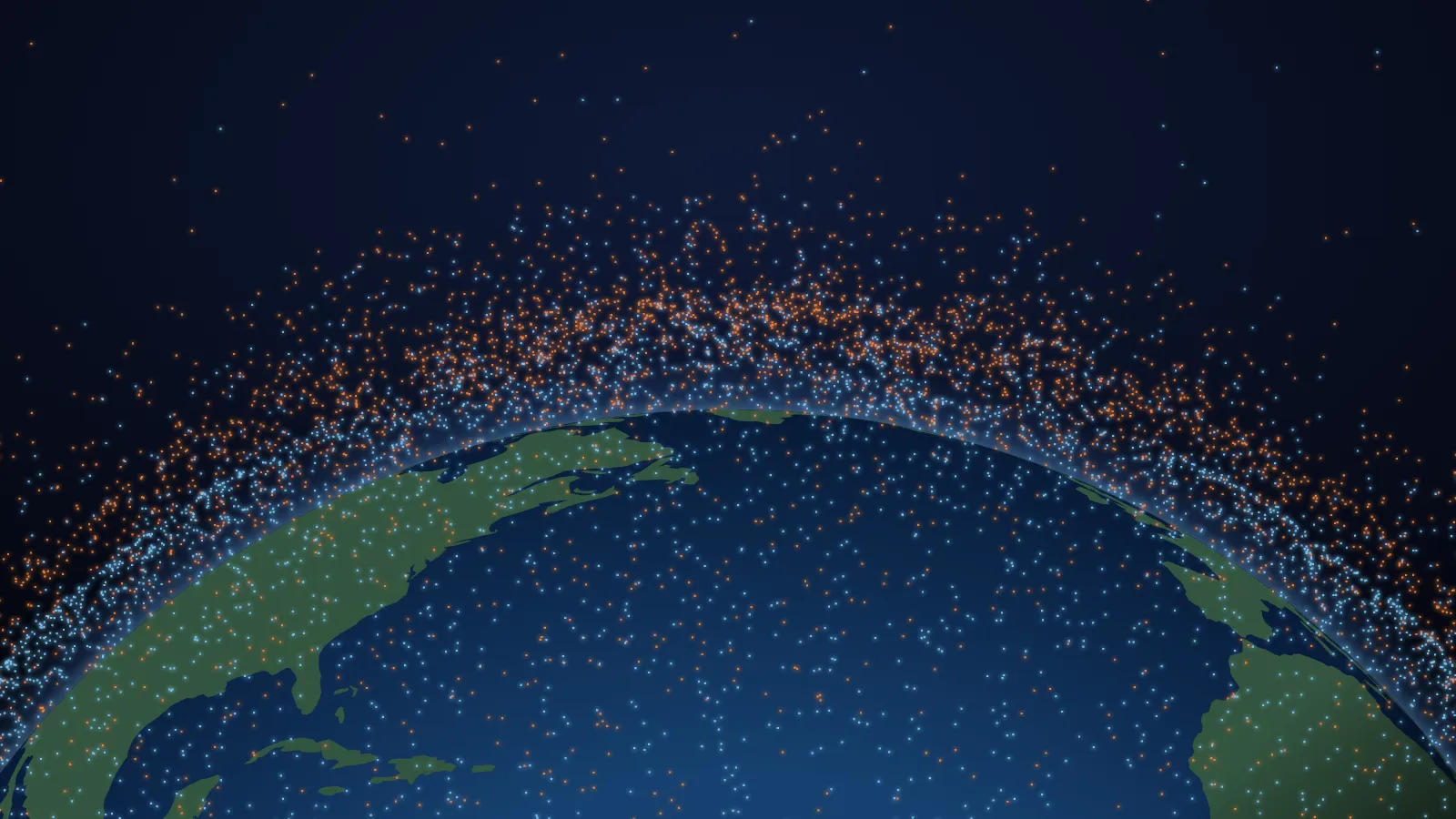
The European Space Agency’s Space Debris Office published its yearly Space Environment Report on 14 September, built on data up to the end of 2025. Its headline figure is a single number for how sustainable spaceflight is in the long run, the Space Environment Health Index. In this edition, continuing today’s behaviour in low Earth orbit is predicted to carry 50 times the risk ESA sets as a first threshold for sustainability; last year’s edition put it at 4 times. ESA says the long-term effect of our activities in space got an order of magnitude worse in just one year.
What the index measures
For every object in low Earth orbit, ESA multiplies the chance of a catastrophic collision by how badly the resulting cloud of fragments would endanger working satellites, and follows the object’s orbit over 100 years. The sum is held against a target: the launch traffic of 2014, the last year before small satellites changed it, with the international debris guidelines well applied, including 90% of spacecraft cleared from low orbit within 25 years of their end. ESA calls the target a subjective choice and compares it to the Paris Agreement’s 1.5 °C limit on warming. Of the index as it stands today, 96% comes from inactive objects, the largest share from spent rocket bodies, and the risk is most concentrated around 850 km in orbits tilted 70 to 80° to the equator.
Why it jumped
The report puts the rise down mainly to the much larger future population its projection now arrives at, with large constellations weighing more and more. The simulation deploys and replenishes each of the 54 constellation groups and shells already in systematic deployment, and assumes that 90% of a constellation’s satellites are disposed of within 25 years wherever the operator’s own figures are unknown, a rate the report calls the bare minimum: far higher compliance would have to be seen to limit the growth of debris. ESA also refined its method in this edition, with a new model for forecasting explosions in orbit, and shortened the projection from 200 to 100 years, which still ends with much higher numbers than a year ago.
ESA hedges the figure itself. It rests on the best information available and on assumptions about future traffic, should not be read as a deterministic forecast, and could improve substantially, or worsen further, as operators’ actual disposal behaviour shows over the coming years. Even if nothing had been launched after 2025, the number of debris objects in low Earth orbit would likely still grow, as it did in every run of that scenario, because collisions among the objects already there are expected to make fragments faster than the atmosphere removes them.
2025 in the report
More than 300 launches put more than 4,000 new payloads in orbit, and 1,200 intact objects re-entered. Some trends point the right way: rocket stages brought down under control outnumbered those that fell uncontrolled for the second year, and new break-ups added comparatively few catalogued fragments, after more than 3,000 in 2024, though most fragments from 2025’s new events were spotted by other surveillance networks rather than catalogued by the US one. Others do not: not enough satellites leave crowded orbits at the end of their lives, and a growing number of objects can be detected but not yet linked to the object or break-up they came from. The report adds a new measure this year, the risk to people on the ground from pieces that survive re-entry: still low next to everyday risks, but rising with the number of launches and re-entries.
Where the crowding is
ESA describes low Earth orbit as bands that are changing from year to year: below 600 km, busy but dominated by satellites that can manoeuvre around each other; between 600 and 1,100 km, full of debris left over from decades of spaceflight; above 1,100 km, where orbits can take centuries to decay, a growing number of satellites, particularly around 1,200 km.
The US catalogue as we carry it on 23 September shows the same split. Of its 32,517 objects in orbit, 14,170 circle at average altitudes below 600 km, and 12,919 of those are satellites, working or not; SpaceX’s Starlink constellation alone has 11,110 in all. Between 600 and 1,100 km, 6,973 of the 10,257 objects are debris, another 651 are spent rocket bodies, and 2,250 are satellites.
What ESA asks for
Preventing new debris, through space traffic management, disposal at the end of a mission and ESA’s Zero Debris approach, remains essential, the agency says, but prevention alone is no longer enough: removing debris already in orbit has to become part of the solution, and soon. ESA is testing that with its ClearSpace-1 mission.
Sources
Cite this
Copy either form. The date is the date of the figures above, so it stays true even if you are reading a saved copy.
- In a sentence
- On 23 September 2026, 6,973 of the 10,257 objects the US catalogue listed at average altitudes between 600 and 1,100 km were debris, according to Orbinauts.
- As a footnote
- Orbinauts, ESA's debris index jumps from 4 to 50 in one year, orbinauts.com/news/esas-debris-index-jumps-from-4-to-50-in-one-year, orbits from Space-Track, retrieved September 23, 2026.
- Under a chart or a table
- Source: Orbinauts (orbinauts.com), orbits from Space-Track