Sentinel-3C and FLEX share a Vega-C in a week of twelve launches
ESA's new Earth Explorer and the third Sentinel-3 flew on one rocket, Progress 96 reached the ISS, and two pieces of debris were due to pass 11 m apart.
The week behind · The week ahead
The week behind
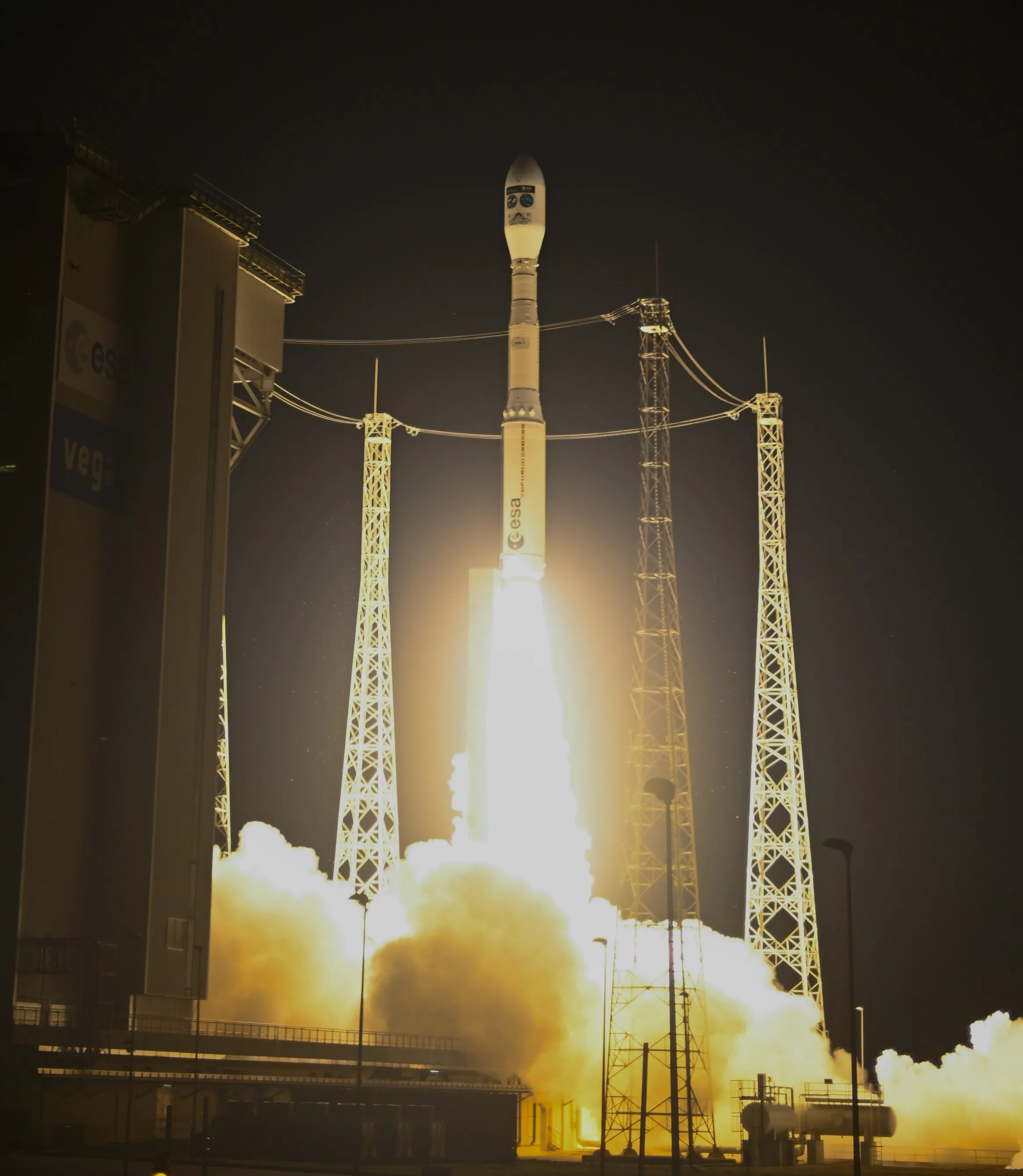
The week’s launch to remember left Europe’s Spaceport in French Guiana at 01:21 UTC on Monday 15 September (22:21 on Sunday evening in Kourou), when Vega-C flight VV30 carried two ESA satellites at once: Copernicus Sentinel-3C and FLEX, the latest Earth Explorer. An adapter called Vespa stacked the two inside the fairing: Sentinel-3C, on top, was released first, and FLEX about an hour later; both satellites made contact with ESA’s operations centre in Darmstadt. FLEX is the first satellite built specifically to measure photosynthesis from space, reading the faint fluorescence that plants give off; it will fly in tandem with Sentinel-3A so that its readings can be matched with Sentinel-3’s near-simultaneous ones, and Sentinel-3C, the third of its series, is to take Sentinel-3A’s place in that pair later on. Once commissioned, Sentinel-3C passes to Eumetsat for routine operations while FLEX stays with ESA.
The International Space Station got its supplies. Roscosmos’ Progress 96 lifted off from Baikonur at 13:33 UTC on 16 September with about three tons of food, fuel and supplies for the Expedition 75 crew, and docked to the Poisk module at 13:44 UTC on Saturday 19 September; it stays about five months before a destructive re-entry that takes the station’s rubbish with it.
Two more Western launches: a Falcon 9 carried the USSF-259 national security mission from Vandenberg’s Space Launch Complex 4 East on the evening of 16 September local time (01:07 UTC on the 17th), the 63rd launch the base has supported in 2026, and the Space Force says nothing of what the payload is. And Rocket Lab’s Electron flew its 96th mission from Mahia at 03:22 UTC on 19 September, “Owl By The Dozen”, putting Synspective’s twelfth StriX radar-imaging satellite into a 572 km orbit; it was Electron’s 17th flight of the year, and Rocket Lab has fifteen more Synspective missions booked through the end of the decade.
China launched six times. LandSpace’s Zhuque-2E took ten SpaceSail broadband satellites to polar orbit from Jiuquan on 15 September, and that same evening Orienspace’s Gravity-1 took nine more from a ship in the Yellow Sea off Haiyang. A Long March 12 from Wenchang added nine satellites to the state-owned SatNet constellation on the 17th, a Kuaizhou 11 from Jiuquan carried two SpaceTY radar satellites two hours later, a Long March 2D from Taiyuan flew four PIESAT-2 X-band radar satellites on the 19th, and a Kinetica 1 closed the week from Jiuquan on Sunday morning. Russia’s Space Forces launched a Soyuz 2.1b with a Fregat upper stage from Plesetsk on 17 September; Launch Library lists it as a Glonass-K navigation satellite, while noting that the serial number and Cosmos designation are unconfirmed. Whichever it is, it joins the GLONASS constellation.
Our own count for the week: twelve orbital launches, ten of them with a successful outcome and two, Sunday’s, still without one in our data when this Briefing was written. Launch Library’s own entries have since marked both the Starlink flight and the Kinetica 1 successful.
| Lift-off (UTC) | Launch | From | Outcome |
|---|---|---|---|
| 15 Sep 01:21 | Vega-C · Sentinel-3C and FLEX | Kourou, French Guiana | Success |
| 15 Sep 06:26 | Zhuque-2E · SpaceSail Polar Group 15 | Jiuquan, China | Success |
| 15 Sep 22:00 | Gravity-1 · SpaceSail Polar Group 16 | Yellow Sea, off Haiyang | Success |
| 16 Sep 13:33 | Soyuz 2.1b · Progress MS-35 | Baikonur, Kazakhstan | Success |
| 17 Sep 00:32 | Long March 12 · SatNet LEO Group 25 | Wenchang, China | Success |
| 17 Sep 01:07 | Falcon 9 · USSF-259 | Vandenberg, California | Success |
| 17 Sep 02:40 | Kuaizhou 11 · SpaceTY-51 and 52 | Jiuquan, China | Success |
| 17 Sep 16:50 | Soyuz 2.1b/Fregat · Glonass-K | Plesetsk, Russia | Success |
| 19 Sep 03:22 | Electron · Owl By The Dozen (StriX 12) | Mahia, New Zealand | Success |
| 19 Sep 10:50 | Long March 2D · PIESAT-2 13 to 16 | Taiyuan, China | Success |
| 20 Sep 01:47 | Falcon 9 · Starlink Group 15-27 | Vandenberg, California | Without one yet |
| 20 Sep 04:00 | Kinetica 1 · nine satellites | Jiuquan, China | Without one yet |
The closest approach
The week’s closest pass in our conjunction data came at its very end: a fragment of the NOAA 16 weather satellite and a piece of a Long March 6A rocket, catalogue numbers 41295 and 54530, were predicted to pass 11 m apart at 20:35 UTC on Sunday 20 September, with a chance of collision of about 1 in 9,700 in the single report received so far. The best-observed was between two pieces of the same satellite: two fragments of Fengyun-1C, catalogue numbers 30464 and 36262, were predicted to pass 21 m apart at 01:34 UTC on 14 September, with a chance of collision of about 1 in 620 across nine reports; no collision was reported. Fengyun-1C was a Chinese weather satellite destroyed by an anti-satellite test on 11 January 2007, which NASA’s Orbital Debris Program Office called the single worst contamination of low Earth orbit in fifty years of spaceflight; nearly twenty years on, its pieces are still crossing each other’s paths. The week’s other approaches are on the Events page.
Manoeuvres
One Manoeuvre in the week among the Satellites we follow: Metop-C raised its orbit by about 128 m between the elements of 16 September 10:20 UTC and 17 September 13:22 UTC. EUMETSAT, which flies it, has said nothing of this burn; its newest polar satellite, Metop-SG A1, is drifting in tandem with Metop-C so that the two series’ data can be compared.
| Satellite | Between (UTC) | Change |
|---|---|---|
| Metop-C | 16 Sep 10:20 and 17 Sep 13:22 | raised 128 m |
Re-entries
The site’s Re-entries list is new and had not received its first decay query when this Briefing was drafted, so what came down this week is not told here.
The week ahead
Four launches are on the calendar for 21 to 27 September, all with dates that can still move; the Next launches page has them as they stand. Two are Chinese state launches whose payloads are not yet announced: a Long March 8A from Wenchang on the 23rd and a Long March 6A from Taiyuan on the 24th. On the 26th, Rocket Lab’s next Electron, “Owlright, Owlright, Owlright”, carries Synspective’s thirteenth StriX from Mahia, and a Falcon 9 flies USSF-385 from Vandenberg, a classified mission for the Space Force.
| NET (UTC) | Launch | From |
|---|---|---|
| 23 Sep 13:30 | Long March 8A · payload not announced | Wenchang, China |
| 24 Sep 08:45 | Long March 6A · payload not announced | Taiyuan, China |
| 26 Sep 00:15 | Electron · Owlright, Owlright, Owlright (StriX 13) | Mahia, New Zealand |
| 26 Sep 11:56 | Falcon 9 · USSF-385 | Vandenberg, California |
Sources
- ESA, "FLEX and Sentinel-3C launched", 15 September 2026
- NASA, "Progress 96 Cargo Spacecraft Lifts off to Resupply Station on Saturday", 16 September 2026
- NASA, "Progress 96 Cargo Spacecraft Docks to Station to Resupply Crew", 19 September 2026
- Space Launch Delta 30 (DVIDS), "Vandenberg Supports USSF-259 Launch", 16 September 2026
- Rocket Lab, "Mission Success: Rocket Lab Launches 96th Electron Mission", 19 September 2026
- The Space Devs, Launch Library 2 (each launch's entry is linked in its row)
- NASA Orbital Debris Program Office, "Chinese Anti-satellite Test Creates Most Severe Orbital Debris Cloud in History", Orbital Debris Quarterly News 11-2, April 2007
- EUMETSAT, "EUMETSAT assumes control of inaugural Metop Second Generation satellite"
- Orbinauts API, v1 reference (Launches, Close approaches and Manoeuvres, fetched 20 September 2026)
Cite this
Copy either form. The date is the date of the figures above, so it stays true even if you are reading a saved copy.
- In a sentence
- Orbinauts holds twelve orbital launches in the week of 14 to 20 September 2026, according to Orbinauts.
- As a footnote
- Orbinauts, Sentinel-3C and FLEX share a Vega-C in a week of twelve launches, orbinauts.com/news/sentinel-3c-and-flex-share-a-vega-c-in-a-week-of-twelve-launches, orbits from Space-Track, retrieved September 20, 2026.
- Under a chart or a table
- Source: Orbinauts (orbinauts.com), orbits from Space-Track