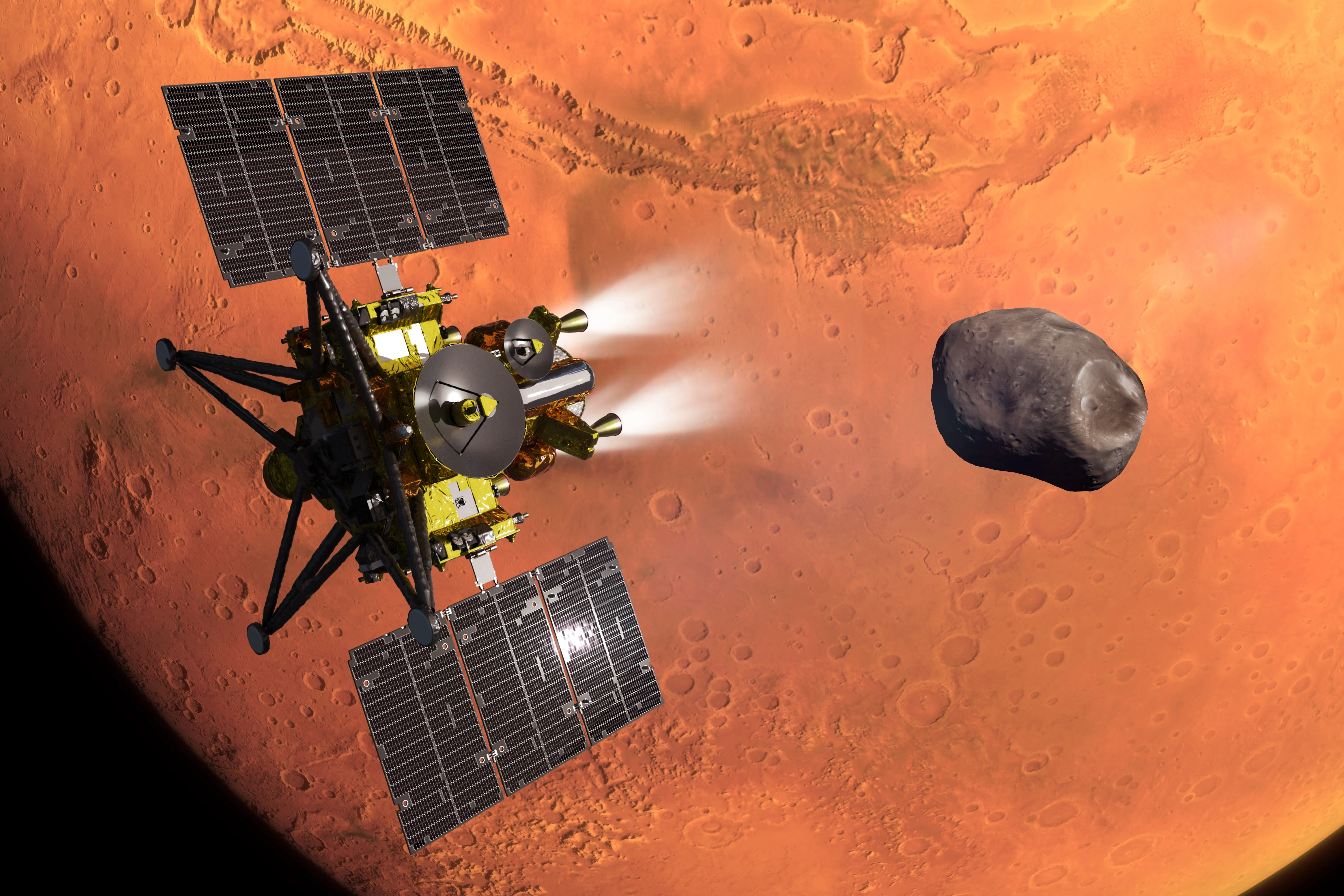
Japan is about to send a spacecraft to fetch a piece of a moon of Mars. JAXA is targeting 4:41:03 a.m. Japan time on 20 October, which is 19:41:03 UTC on Monday 19 October, to launch the Martian Moons eXploration spacecraft, MMX, on the tenth H3 rocket from the Yoshinobu Launch Complex at the Tanegashima Space Center. MMX is to be the first mission to collect a sample from Phobos and bring it back to Earth.
JAXA has set aside a reserve period from 21 October to 7 November, Japan time, and says the launch time may change from one day of it to the next.
Straight on its way to Mars
The rocket’s second stage fires twice, and about 1 hour 11 minutes after liftoff it releases MMX straight onto its transfer orbit to Mars, 592 km up and at 11.2 km/s.
| Event | Time after liftoff |
|---|---|
| First pair of solid boosters separates | 1 min 56 s |
| Second pair separates | 1 min 58 s |
| Fairing separates | 3 min 17 s |
| First stage separates | 4 min 59 s |
| Second stage’s first burn | 5 min 12 s to 10 min 40 s |
| Second stage’s second burn | 1 h 3 min 57 s to 1 h 10 min 21 s |
| MMX separates | 1 h 11 min 12 s |
These times come from JAXA’s launch plan and are approximate. They are for a launch on 20 October, Japan time. If the launch moves to another day, the part of the plan after the first burn changes.
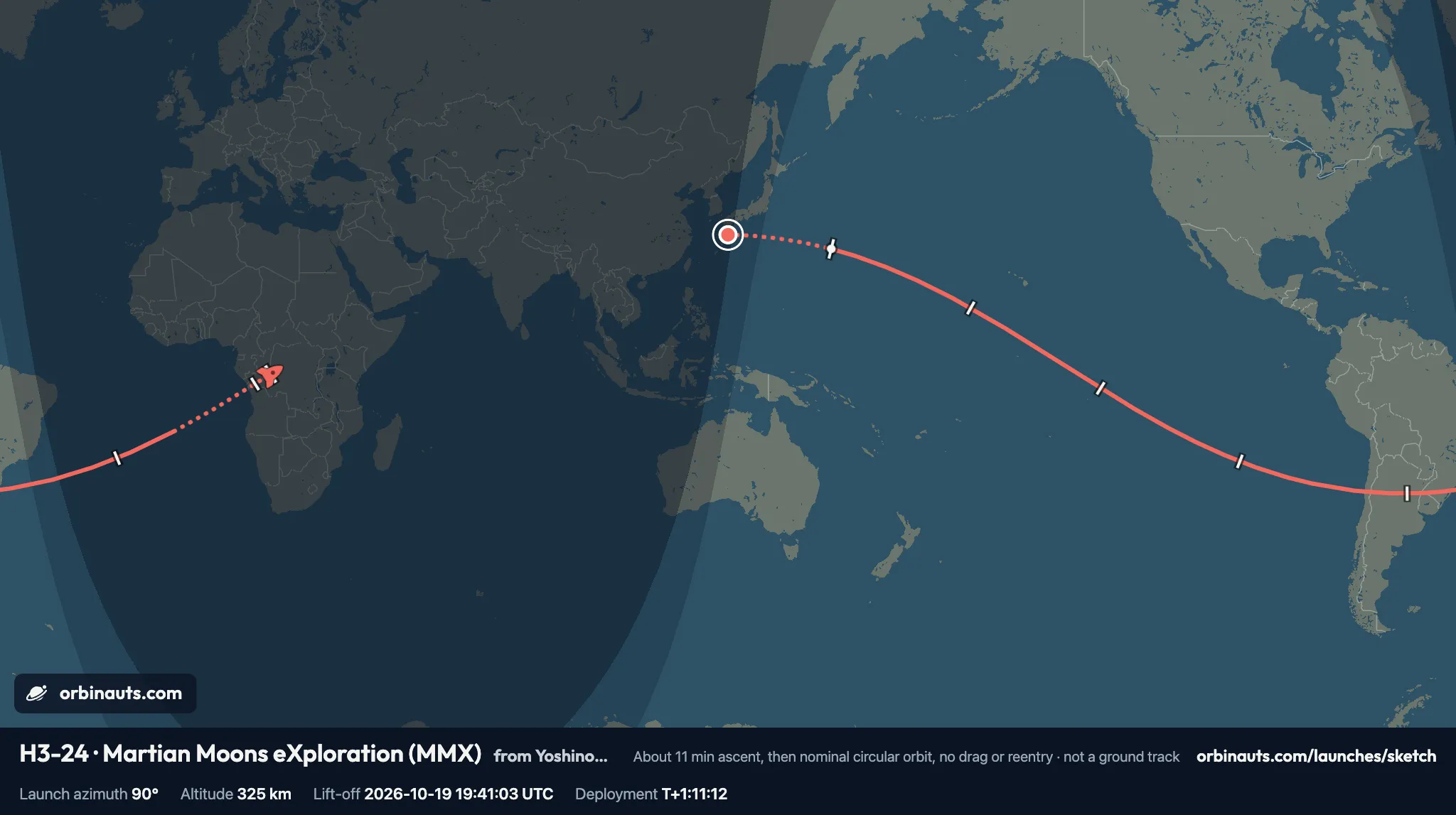
The map below is our Orbit sketch of that flight, drawn from JAXA’s numbers. The rocket heads due east, on a Launch azimuth of 90°, coasts at about 325 km across the Pacific and over South America, and fires its second stage again over the South Atlantic. The sketch ends where MMX leaves the Earth, over central Africa. Open the Orbit sketch to play the flight minute by minute, or type your town to see whether it passes over. It is a sketch, not a prediction: the orbit is nominal, and once the second stage fires again the rocket speeds up from about 7.7 to 11.2 km/s, faster than the drawn orbit, so the dotted stretch shows only roughly where it flies.
JAXA’s live broadcast starts about 55 minutes before liftoff and runs until about 75 minutes after, on JAXA’s YouTube channel and on Niconico, at times JAXA says may change. ESA says it will be in Japanese and English.
The rocket
The H3 flies in its 24 configuration, H3-24L: two LE-9 engines on the first stage, four SRB-3 solid boosters and the long fairing. It is the second flight of that configuration, after the seventh H3 launched the HTV-X1 cargo ship to the space station, and the first with the long fairing. JAXA’s press kit calls it the most powerful configuration, 63 m tall and 574 tonnes without its payload.
On the eighth H3, in December 2025, the second stage’s engine failed to restart properly and the QZS-5 navigation satellite, Michibiki 5, could not be put into its planned orbit. Since then the sixth, a test flight, flew as planned on 12 June, and the ninth put Michibiki 7 in its orbit on 10 August.
What MMX will do
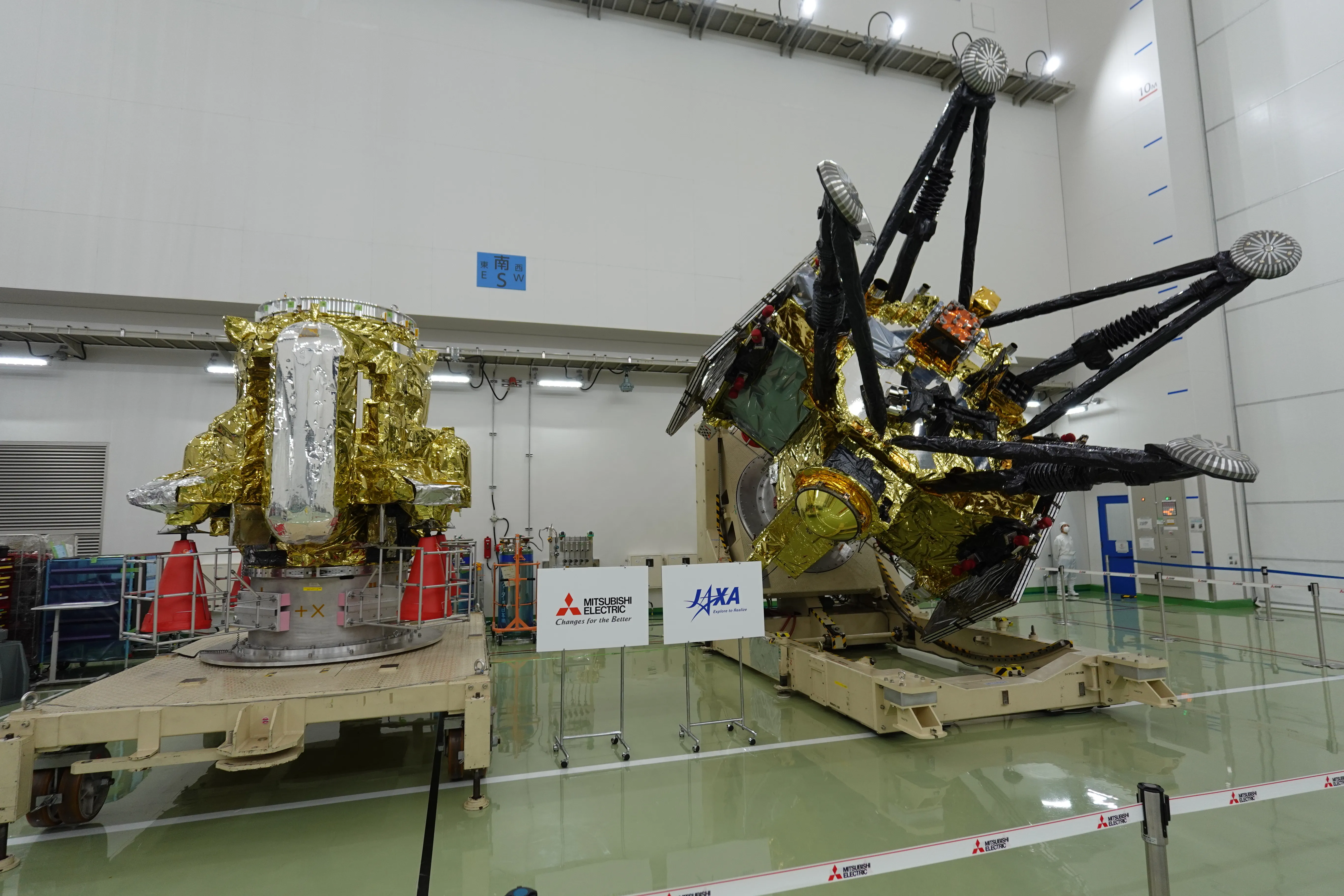
The spacecraft, built by Mitsubishi Electric, weighs 4,480 kg at launch and is three modules joined into one: a propulsion module for the journey out, an exploration module, and a return module for the journey home. ESA expects it to enter orbit around Mars in August 2027 and around Phobos from September 2027.
After studying Phobos from a distance, MMX is to release a 25 kg rover, Idefix, in early 2029, then land on the moon itself in 2030. It aims to collect more than 10 g of Phobos from at least 2 cm below the surface; JAXA plans two landings. On the way home it is to fly past the other moon, Deimos, and in 2031 send the sample down in a capsule to be recovered in Australia.
Who else is on board
JAXA leads the mission, with NASA, CNES, DLR and ESA. Among the instruments, JAXA’s launch plan lists a near-infrared spectrometer, MIRS, from CNES; a gamma-ray and neutron spectrometer, MEGANE, and a pneumatic sampler from NASA; and the Idefix rover from CNES and DLR. MEGANE was developed by the Johns Hopkins Applied Physics Laboratory with the Lawrence Livermore National Laboratory.
ESA provided the spacecraft’s deep space radio, including a transponder and a power amplifier, and its Estrack ground stations will help send commands and receive data. JAXA’s own deep space antennas at Misasa (54 m) and Usuda (64 m) are the main stations, with NASA’s Deep Space Network supporting them too.
Until liftoff, MMX is on our next launches, with its countdown.