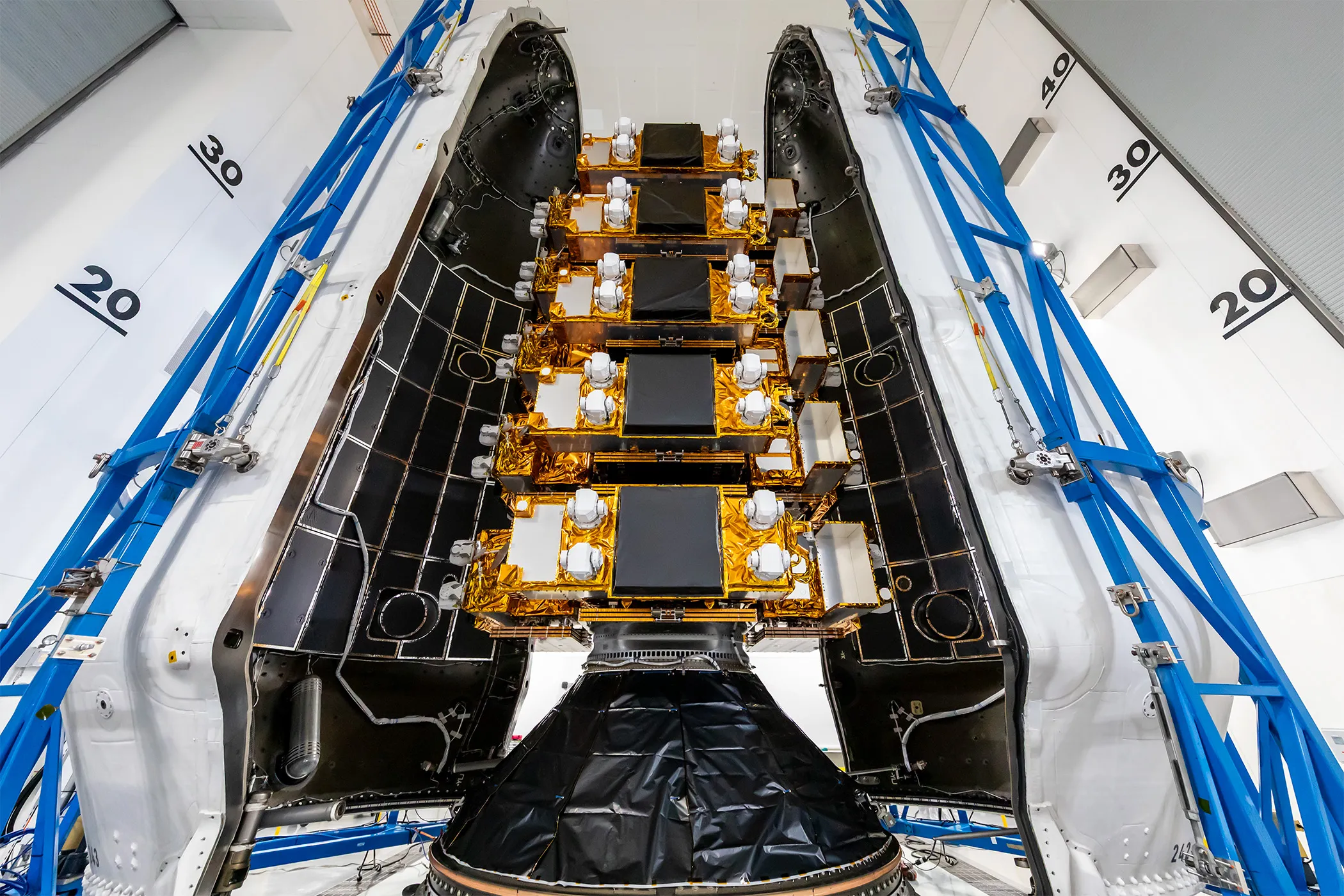
The new generation of the US Space Force’s data-relay network in low Earth orbit grew by a third on Saturday. A SpaceX Falcon 9 lifted off from Space Launch Complex 4 East at Vandenberg Space Force Base, California, at 07:39 UTC on 10 October (00:39 local time) and delivered 21 data transport satellites for the Space Development Agency (SDA). They make up the fourth orbital plane of Tranche 1, the new generation, which the agency calls its initial warfighting tranche, and bring the Tranche 1 satellites in orbit to 84. Tranche 1 follows Tranche 0, the first generation, whose first satellites launched in April 2023.
They are also the first Tranche 1 satellites that Northrop Grumman built. “This launch marks the delivery of satellites built by the third of four vendors selected to field Tranche 1 of the proliferated LEO architecture,” said GP Sandhoo, the SDA’s director. “SDA’s model emphasizes regular industry competition and vendor diversity.” The plane before it, launched in July, was built by York Space Systems.
Five days late
The first attempt was on 5 October, when Falcon 9’s automated systems halted the countdown just before liftoff. After the abort, our Launches data saw the target date move three times: to 6 October, then to 8 October, then to 10 October.
The first stage was flying for the sixth time, after the NROL-179 mission, the SDA’s T1TL-E mission and three Starlink missions, and it landed back at Vandenberg, on Landing Zone 4. SpaceX calls the flight the fourth of nine Tranche 1 missions Falcon 9 will launch for the SDA.
What the network is for
The SDA calls its constellation the Proliferated Warfighter Space Architecture: in SpaceX’s words, a mesh network of optically connected satellites in low Earth orbit for military tactical communications and for missile warning and tracking. The Transport Layer is the part that carries the data. Its satellites are to provide secure, low-latency data links beyond the line of sight in support of tracking advanced missile threats. Northrop Grumman says its satellites help extend Link 16, the military’s secure, jam-resistant data network, to space.
Once complete, Tranche 1 is to number 154 operational satellites: 126 in the Transport Layer and 28 in the Tracking Layer, plus four missile defence demonstrators, run from two operations centres in Alabama and North Dakota. It is to provide initial warfighting capability beginning in 2027.
Where the first three planes fly
After launch, the SDA’s satellites go through test and checkout, then raise their orbits to about 1,000 km. The 63 satellites of the first three planes, 42 launched in 2025 and 21 in July 2026, are all in the US catalogue. On 10 October they flew between 930 and 972 km, on orbits tilted 81.3° to 81.5° to the equator, according to the Elements we hold. Each can be followed on the live map, such as PRAETORIAN SDA_602 from the first plane.
The 21 new satellites were not yet in the public catalogue when this Article was written. Once they have Catalogue numbers, they can be followed on the live map too.
What comes next
Northrop Grumman says its second plane of 21 satellites is to follow, with several dozen more satellites for the constellation launched over the next six months. The company is building about 150 satellites for Tranches 1, 2 and 3, and is also under contract for more than 30 of the missile warning and tracking satellites that work with the Transport Layer.