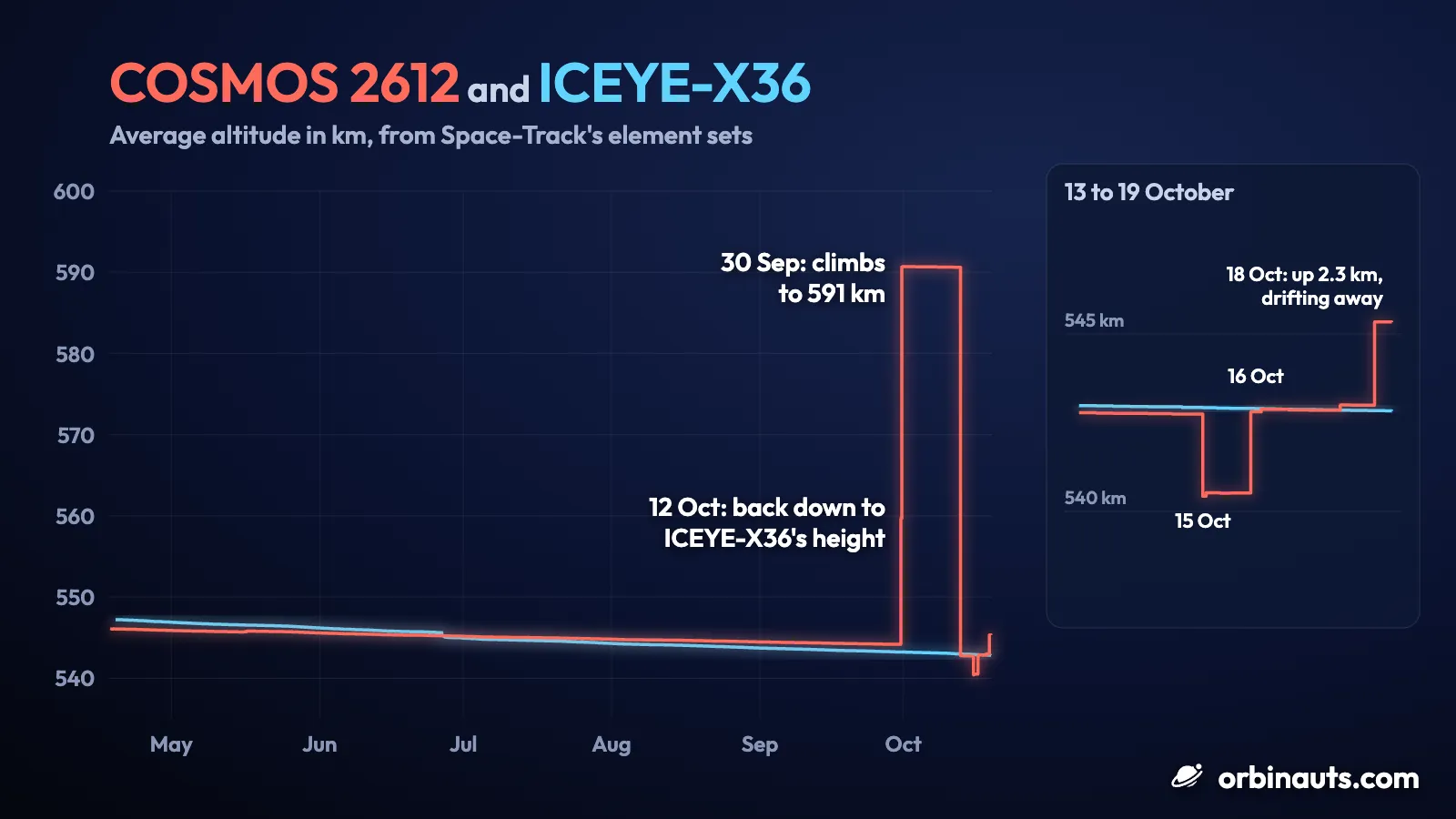
Cosmos 2612, the Russian satellite that had moved to about 5 km behind ICEYE-X36, has raised its orbit and is drifting away from it. ICEYE-X36 is a radar satellite of ICEYE, the company whose images Ukraine’s armed forces have used since 2022. The element sets Space-Track publishes for it, the public descriptions of each orbit, show its orbit about 2.3 km larger after a manoeuvre made between 12:25 and 23:34 UTC on Sunday 18 October.
In this Article
- Cosmos 2612
Satellite
- ICEYE-X36
Satellite
A higher orbit is a slower one, so Cosmos 2612 now falls further behind on every lap. At 12:00 UTC on Monday 19 October it was about 360 km behind ICEYE-X36, and the gap was growing by some 350 km a day, by our propagation of the latest public elements of both, from 07:32 UTC that morning. Both can be followed on the live map.
The two still share an orbital plane: in those sets both orbits are tilted 97.854° to the equator and cross it heading north within 0.001° of each other. What has changed is the size of the orbit: Cosmos 2612’s, some 150 m larger than ICEYE-X36’s before the burn, is now about 2.5 km larger. Run forward, the elements of the morning of 18 October had the gap widening by about 20 km a day, and staying close would have taken another manoeuvre. The manoeuvre came, but it raised Cosmos 2612 further, and the gap now grows by some 350 km a day instead.
Six months, set by set
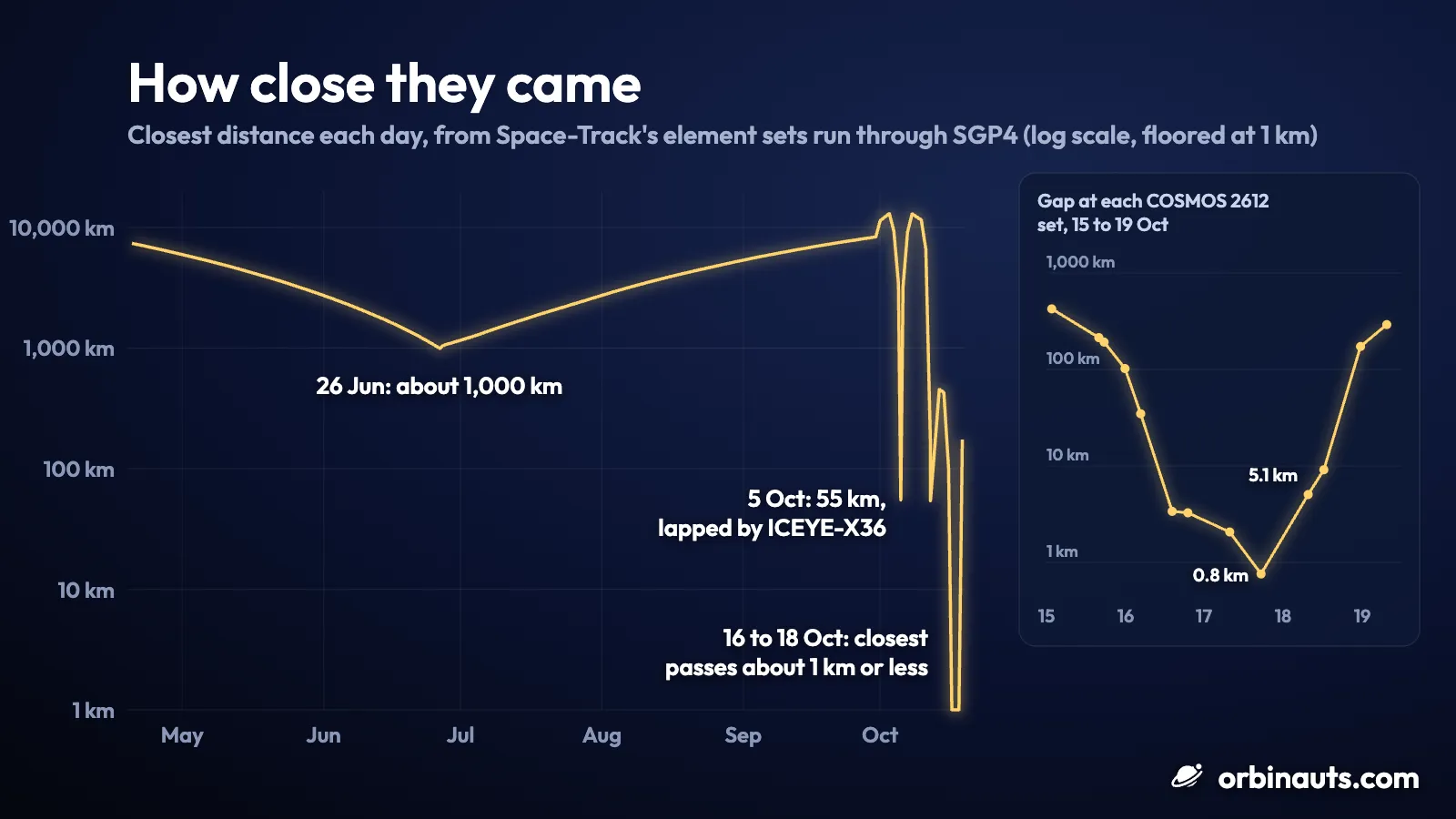
Space-Track holds every element set of the two since April. Run through SGP4, the model they are made for, they give the whole approach and the departure. The dates are UTC; a distance on a day is the closest the two came that day, and on 16 to 18 October it is the distance at the time of a Cosmos 2612 set.
| Date | What the elements show | Distance |
|---|---|---|
| 16 Apr | Cosmos 2612 goes up with five other Russian satellites, its orbit tilted 96.95° to the equator | |
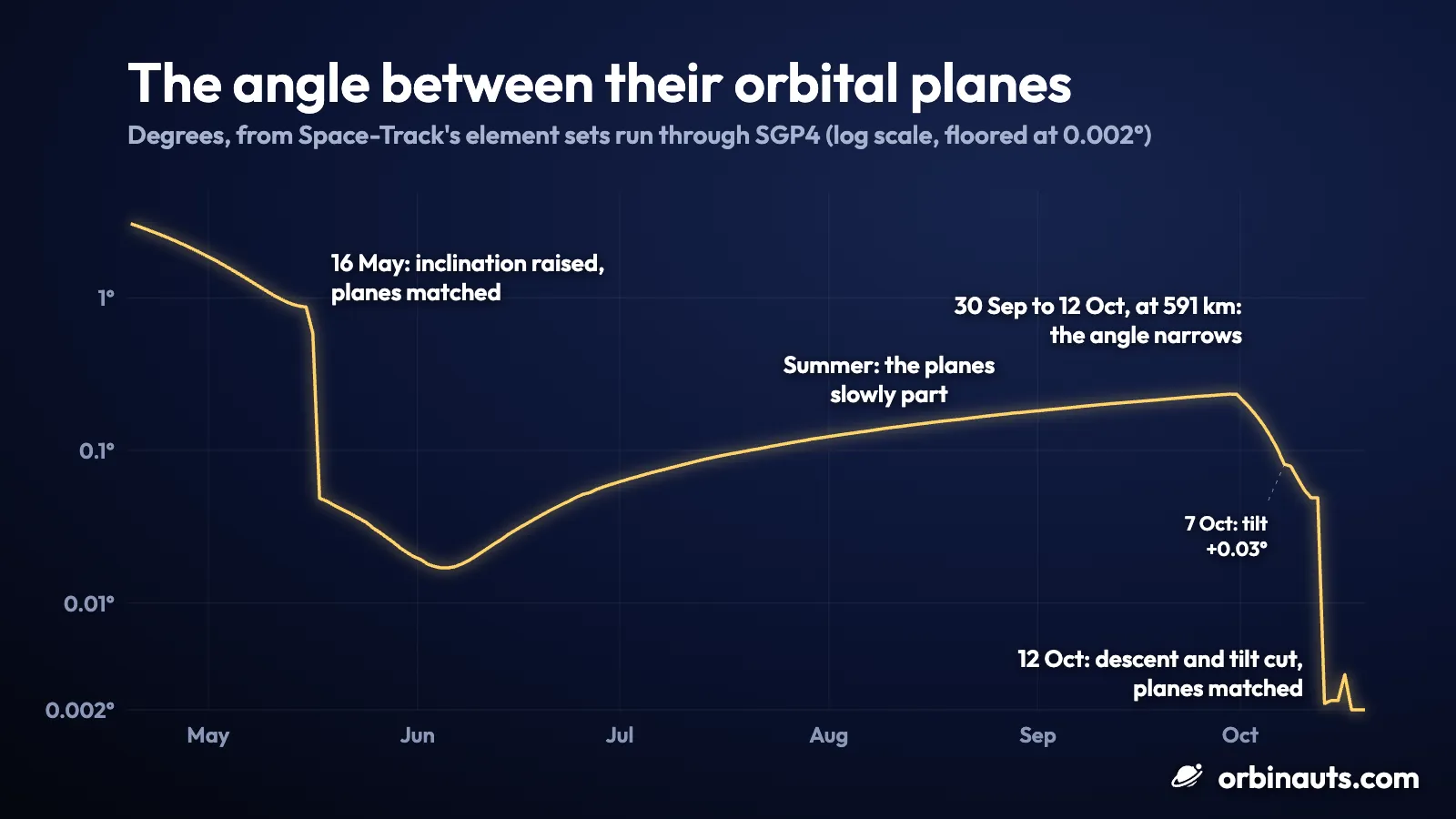
| 16 May | In two steps, its tilt is raised to 97.85°, cutting the angle between the two orbital planes from 0.87° to 0.05° | 4,100 km |
| 26 Jun | The closest it comes all summer, before ICEYE-X36 lowers its own orbit by about half a kilometre and pulls away | 1,000 km |
| 30 Sep | Two burns lift it from about 544 km to about 591 km; the planes are now 0.23° apart | 8,300 km |
| 5 Oct | Higher and so slower, it is lapped by ICEYE-X36, which passes about 55 km beneath it | 55 km |
| 7 Oct | A small change of tilt, from 97.870° to 97.900°, away from ICEYE-X36’s 97.852° | 9,100 km |
| 12 Oct | Lapped once more, then comes back down to about 543 km, ICEYE-X36’s height, and takes ICEYE-X36’s tilt; by the next day the planes are about 0.002° apart | 54 km |
| 15 Oct | Drops about 2.3 km, into a faster orbit that closes the gap | 100 km |
| 16 Oct | Climbs back, matching ICEYE-X36’s height | 3.4 km |
| 17 Oct | Its orbit now takes almost exactly as long as ICEYE-X36’s | 0.8 km |
| 18 Oct, 07:38 | Slower again, and not where the previous set put it (see below) | 5.1 km |
| 18 Oct, after 12:25 | Raises its orbit 2.3 km; the distance is at 23:34 | 173 km |
| 19 Oct, 12:00 | Drifting away | 360 km |
The climb of 30 September did more than change the height. Through the summer the angle between the two orbital planes had grown, from 0.017° in early June to 0.23°, most of it a difference in where the two orbits cross the equator. At a different height an orbit’s plane turns around the Earth at a different rate, so while Cosmos 2612 flew at 591 km that difference closed by about 0.02° a day, to nothing by 11 October. What was left was the tilt: the change of 7 October had put Cosmos 2612’s about 0.05° above ICEYE-X36’s, and the descent of 12 October also cut it by that much, leaving the planes about 0.002° apart. Those manoeuvres, two analysts at the Center for Strategic and International Studies (CSIS) wrote on 15 October, brought it back into the same plane and to nearly the same altitude as ICEYE-X36.
The descent also matched the shape of the orbit. By the evening of 12 October both orbits had an eccentricity, how stretched an orbit is, of about 0.00047. From April to the end of September, Cosmos 2612’s had been 0.0011 to 0.0015 and ICEYE-X36’s 0.0004 to 0.0008.
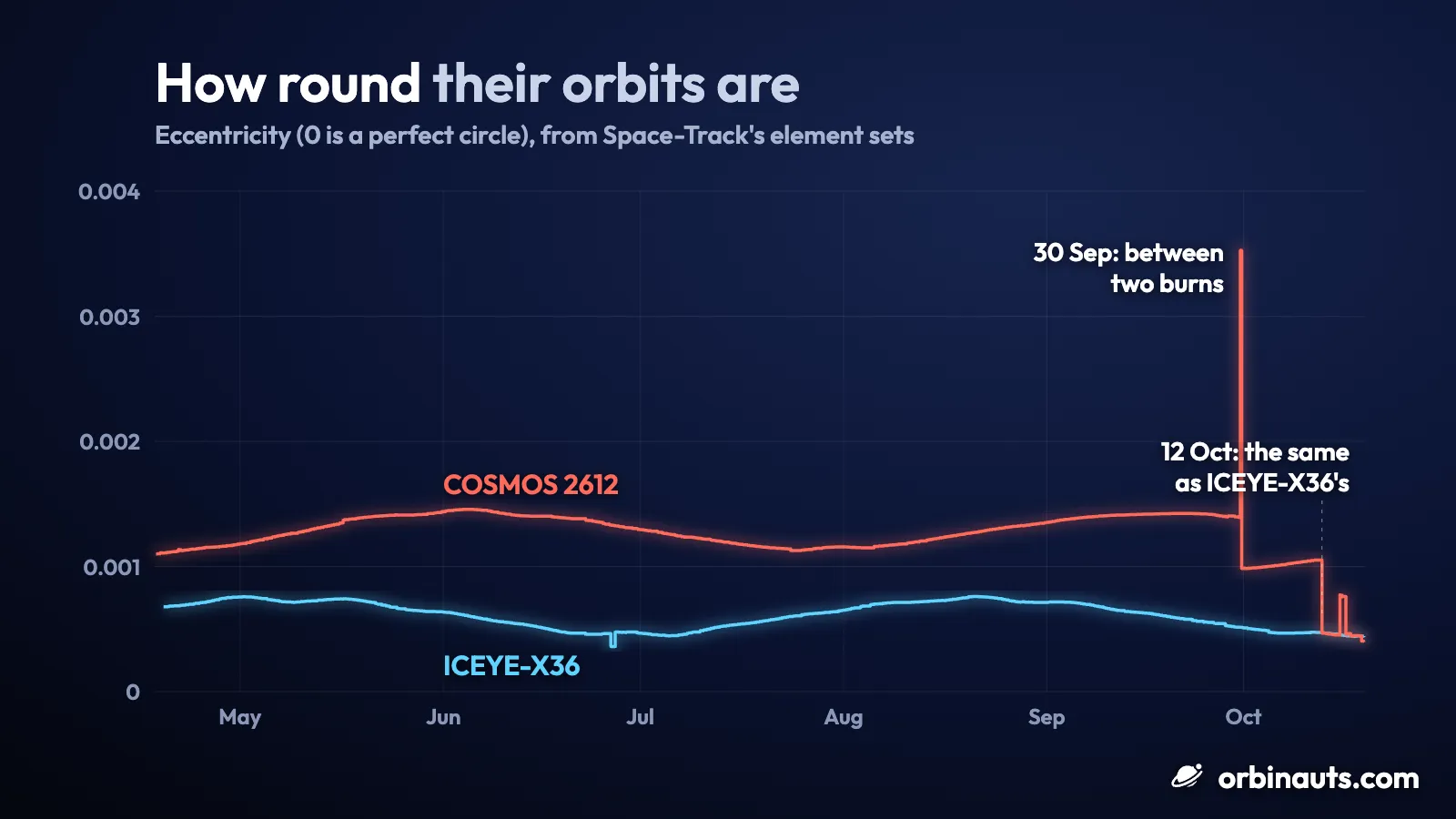
ICEYE-X36’s own sets show no manoeuvre in October: its orbit shrank smoothly, by roughly 20 m a day.
Deliberate or routine?
The record points to a deliberate approach, not routine upkeep. Read together, Cosmos 2612’s manoeuvres from May to 16 October matched ICEYE-X36’s orbit one element at a time: the tilt in May, when, CSIS notes, five of the six satellites from its launch raised their inclinations to match ICEYE-X36’s plane; the plane, the height and the shape between 30 September and 12 October; and the position along the orbit on 15 and 16 October. That is the sequence an approach needs, and moving a satellite in low orbit into another’s plane, the CSIS analysts write, is unusual because it takes a large expenditure of fuel and “is not part of the standard mission profile for most satellite missions”. In between, Cosmos 2612’s record shows no manoeuvre at all from 17 May to 30 September, while its plane drifted away from ICEYE-X36’s; then, in just over two weeks, came the run of burns that lined it up with it.
LeoLabs, which tracks both, told Axios the move “appears to be a deliberate approach” toward ICEYE-X36, though “the intent remains uncertain”. The CSIS analysts wrote that “policymakers should assume Cosmos 2612 could take an action that threatens the commercial satellite”, and also that “no one should assume to know what Russia will do next” with it. The departure is less clear: a climb of 2.3 km takes it away fast, but the record does not say whether it is the end of the approach or a step towards something else.
What the last sets can and cannot tell
On 17 October Jonathan McDowell read the elements as showing Cosmos 2612 “now stationkeeping within 5 km or less” of ICEYE-X36. Public elements are a fit to tracking data, though, and at these distances they are at their limit. A 2009 ESA study put the uncertainty of such elements in low orbit at about 0.5 km along the direction of travel, for each satellite, so the closest passes of 16 to 18 October, about 1 km or less, are about as close as these elements can resolve. The set of 07:38 UTC on 18 October also puts Cosmos 2612 about 5 km from where its previous one, of 17:18 UTC on 17 October, had it, and slightly slower: either it made a small manoeuvre overnight, or observations of the two satellites, flying so close, were mixed up in the fits. The public data cannot tell which. What a satellite so close could do, and what LeoLabs, CSIS and the US Space Force said of the approach, is in our Article on it.
 Read nextA Russian satellite is flying 5 km behind a radar satellite of ICEYE, the company that supplies Ukraine
What is not known
Nothing public says why Cosmos 2612 has moved away. Its next element sets will show whether it stays on its new orbit.