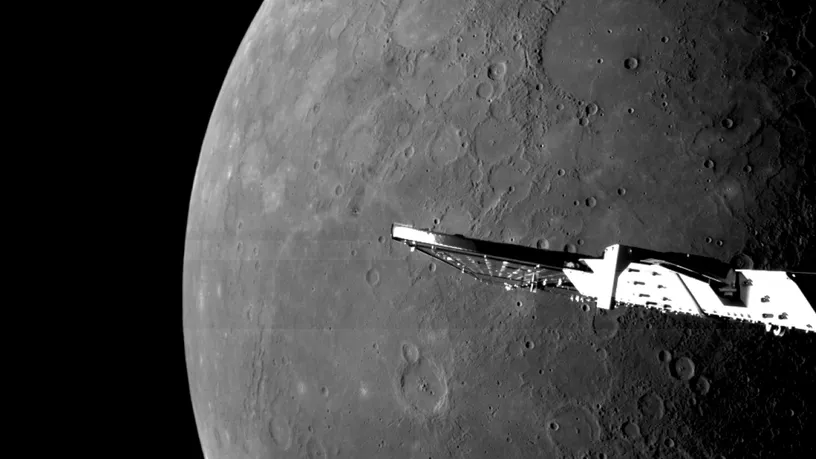
BepiColombo, the joint mission of the European and Japanese space agencies, is due to enter orbit around Mercury on 21 November. Its two science orbiters are still stacked together: ESA’s Mercury Planetary Orbiter (MPO) with JAXA’s Mercury Magnetospheric Orbiter, called Mio, on top. On that day MPO’s own thrusters are to fire the burn that turns Mercury’s loose hold on it into a proper orbit. ESA has not announced a time, but its operations team will post live updates on X on the day. ESA’s planned path, published in NASA JPL’s Horizons system, has the burn running from about 18:25 to 19:00 UTC. BepiColombo will be about 150 million km from Earth, so word of the burn takes more than eight minutes to reach ESA’s control room in Darmstadt.
Getting there is the hard part: because of the Sun’s pull, entering a stable orbit around Mercury takes more energy than sending a mission to Pluto. Only one spacecraft has orbited Mercury before: NASA’s MESSENGER, from 2011 until it crashed into the surface in 2015. If it all works, BepiColombo will be the second mission to orbit the planet and the first to place two spacecraft there. It is already Europe’s first mission to the planet.
That burn opens the arrival rather than closing it. ESA plans 16 burns between 21 November and March 2027. In ESA’s broadcast on 3 September, its spacecraft operations manager, Ignacio Clerigo, set out what comes next: a first block of five burns, one every three days or so, is to shrink the still very elongated orbit until Mio, the Japanese orbiter, can be released. Those five have to be done by early December, before Mercury’s long eclipse season: without them, the spacecraft would risk draining its batteries.
Caught slowly
BepiColombo is not racing in. Two weeks out, it was 220,000 km from Mercury, closing at under 40 m/s, the speed of a car on a motorway. Mercury’s pull then speeds it up, to more than 600 m/s by 21 November and about 3.7 km/s as it swings closest, during the burn.
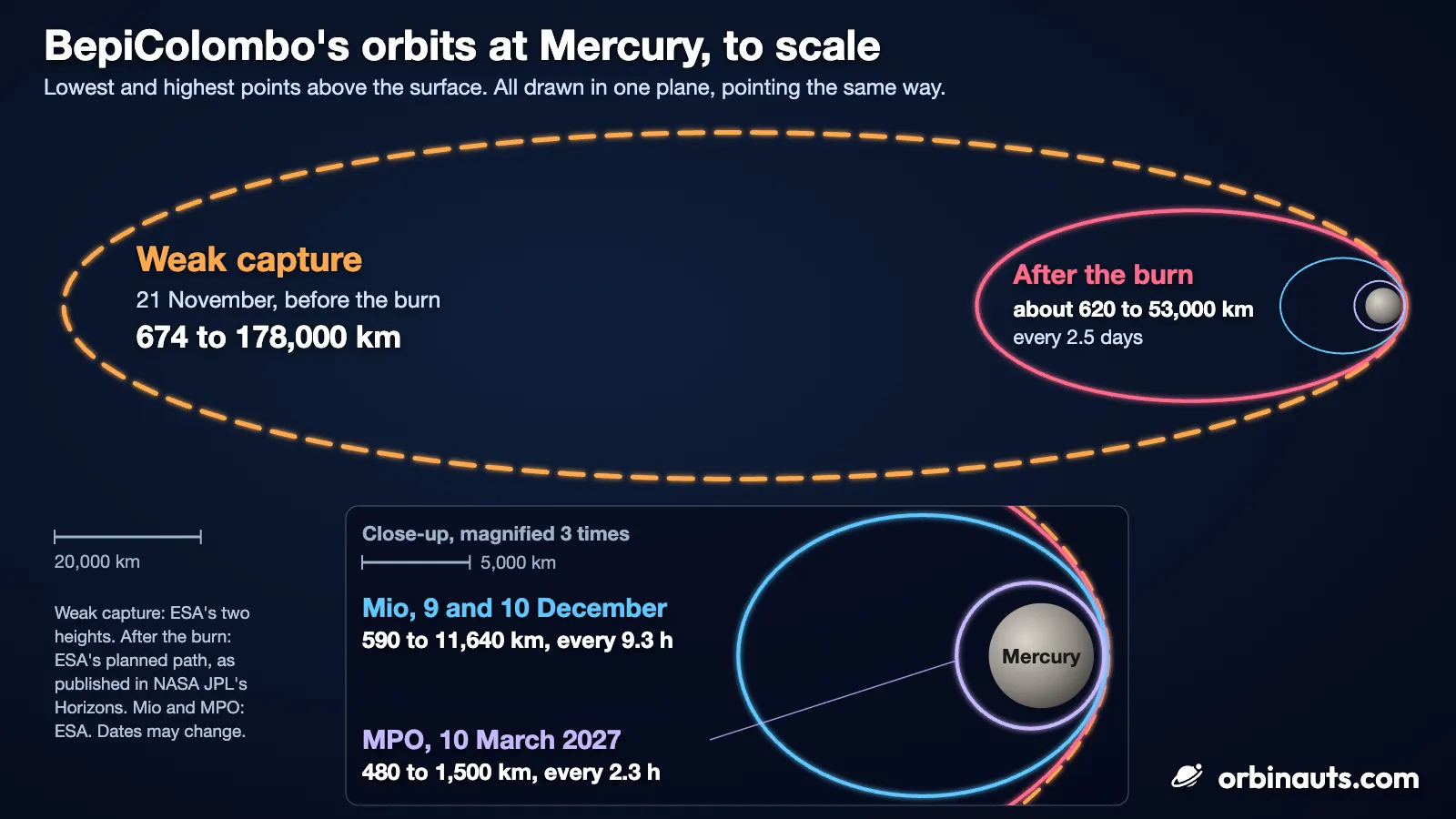
Clerigo called the approach a “weak capture”: ESA steers the spacecraft to a chosen point near Mercury at a chosen time, the planet’s gravity takes a loose hold of it, and it swings around Mercury on a path that does not close on itself, from 674 to 178,000 km above the surface. He believes it is the first time a planet, rather than a moon, has caught a spacecraft this way.
After the burn, on the planned path, the orbit runs from about 620 to 53,000 km up, once every two and a half days.
Eight years on the way
BepiColombo left Earth on 20 October 2018 and had covered 9.9 billion km and flown past planets nine times by September. A third module carried the two orbiters all that way: the Mercury Transfer Module, with its electric thrusters. Its route had to be redrawn after a fault in April 2024 kept those thrusters from full power. The thrusters fired for the last time on 15 June, and on 3 September the module separated cleanly, leaving MPO’s thrusters to steer the rest of the stack to Mercury. They fired for the first time in that role on 24 September: 8 minutes and 42 seconds, a push of 11.4 m/s, the first course correction since the separation, with more small ones planned before the arrival.
What comes after 21 November
The next steps, on dates that may change for operational reasons:
- 9 and 10 December: MPO releases Mio onto its own polar orbit, which takes it between 590 and 11,640 km above the surface every 9.3 hours.
- 16 December: MPO drops the sunshield that has sheltered Mio since launch, and starts lowering itself with its thrusters.
- 10 March 2027: MPO reaches its own polar orbit, 480 to 1,500 km up, once every 2.3 hours.
- 6 April 2027: the science phase begins.
What it will look for
Mercury’s surface reaches 450°C, yet craters at its poles seem to hold water ice, which MPO’s instruments aim to measure directly. Its core fills more than half the planet’s volume. Besides Earth, it is the only rocky planet with a global magnetic field, though it seems too small to have one. And it is dotted with “hollows”, dents that look recent: if BepiColombo finds them changed since MESSENGER’s visit, Mercury is still an active world. MPO will map the surface and what it is made of; Mio, spinning 15 times a minute, will study the charged particles and thin gas around the planet, and the two will measure its magnetic field together. First tests on 15 September found MPO’s instruments in good health.
We will report the orbit entry once ESA confirms it.