SpaceX wants to catch both halves of Starship this time. Flight 15 is set to lift off from Starbase, Texas, as soon as Friday 13 November, in a 75-minute window that opens at 4:45 p.m. Central time, 22:45 UTC. The Super Heavy booster is to fly back to the launch tower minutes later. The ship is to release 26 Starlink satellites, fly about 14 orbits and then come home to the same tower, more than 22 hours after lift-off: on Saturday afternoon, Texas time, if it leaves on time. If both catches work, SpaceX says it will be the first full recovery of an orbital launch system.
The flight is not cleared yet. SpaceX’s page still says it is pending regulatory approval, and the Starship licence in force allows only one reentry of the ship from orbit, Flight 14’s, over the Pacific. The FAA has not yet issued the revision Flight 15 needs to bring the ship home. The FAA has, though, already published notices closing the airspace around Starbase for both ends of the flight. They ban aircraft for the launch from 22:30 UTC on 13 November to 00:40 UTC on the 14th, with a backup a day later, and for the ship’s “recovery” from 20:53 UTC on 14 November to 00:14 UTC on the 15th, also with a backup a day later.
The flight at a glance
| Vehicle | Super Heavy Booster 22 and Ship 42 |
| Pad | Pad 2, Starbase, Texas |
| Window | 13 November, 22:45 to 00:00 UTC (4:45 to 6:00 p.m. CST) |
| Licence | Flight 15 revision not yet issued |
| Orbit | about 275 km, about 14 orbits |
| Payload | 26 Starlink V3 satellites |
| Booster | return and catch at the tower, 6 min 35 s after lift-off |
| Ship | return and catch at the tower, 22 h 33 min after lift-off |
The booster: a first catch for the new version
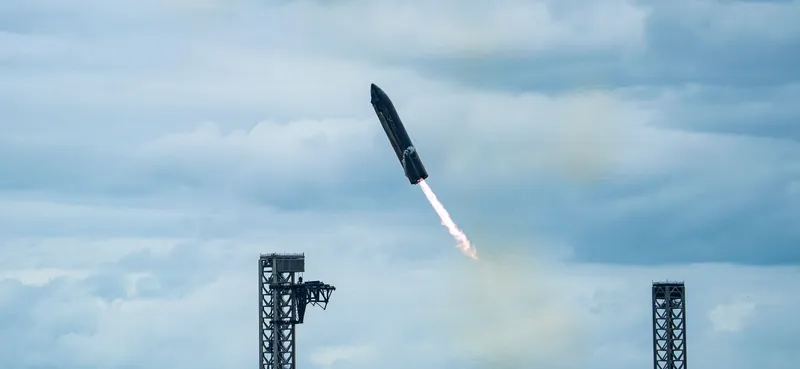
After stage separation, Booster 22 fires a boostback burn to head back to Starbase and is to be caught by the tower’s arms, the first catch attempt for a Super Heavy of version 3. Three boosters of the first version were caught on earlier flights, and two of them have flown again. On Flight 14, the booster made a soft splashdown in the Gulf of Mexico instead.
A day in orbit
The ship starts out as Flight 14 did. Its ascent burn puts it on a suborbital path that would bring it down in a cleared area of the Indian Ocean if anything went wrong; flight controllers then check its systems and give a “go” or “no-go” for orbit. On a “go”, a single sea-level Raptor fires the orbital insertion burn.
Once in orbit, the ship releases its 26 Starlink V3 satellites. Each is meant to add 1 terabit per second of capacity to the network, so the 26 together equal about ten Falcon 9 launches of V2 Mini satellites. Three of them carry cameras to look back at the ship’s heatshield, one of the sources SpaceX will use to decide whether the ship may come home. The heatshield keeps the changes made for Flight 14 and adds curved tiles over a large part of it, meant to reduce heating in the gaps between tiles.
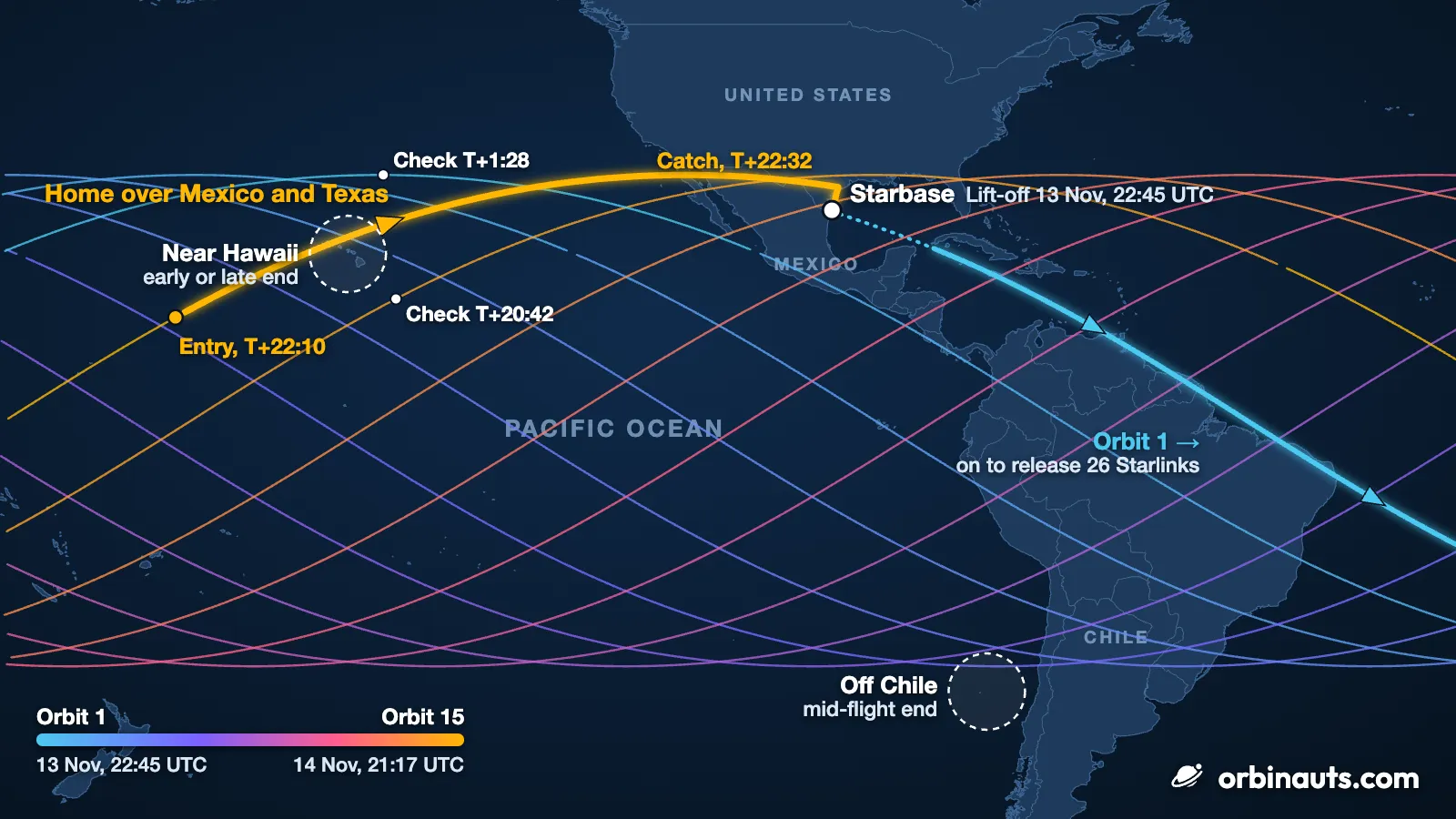
Then the ship coasts for about 21 hours, until its orbit lines up with Starbase. Controllers keep checking the same systems as on Flight 14, with criteria SpaceX calls intentionally conservative: the Raptors, power and communications, the flight computers and navigation sensors, the tanks and feedlines, tank pressure and attitude control. If anything trips them, the ship can end its flight early in areas of the Pacific cleared in advance: near Hawaii early or late in the mission, or several hundred kilometres off Chile in the middle of it. SpaceX’s timeline puts its return checks at 1 h 28 min (Hawaii), 7 h 16 min (Chile) and 20 h 42 min (Hawaii) after lift-off.
SpaceX has not published the direction Flight 15 will fly. The map sketches the day as if it flies like Flight 14, whose ascent the FAA’s hazard areas showed and whose 26 satellites orbit at an inclination of 30.5° in our Catalogue: a circle at 275 km on which each orbit runs about 22.6° west of the one before, until the last brings the ship in from the Pacific over Mexico. It leaves out the deorbit burn and the turns over Texas, and the areas near Hawaii and off Chile are placed from SpaceX’s words, since no hazard areas for them have been published yet. Open the Orbit sketch to play the flight minute by minute.
Home over Mexico and Texas
Every ship that has flown to space so far was planned to end its flight in the ocean, re-entering over empty water by design. To reach the tower, it will now fly over inhabited areas in northern Mexico and southern Texas, and only if the ship meets the conditions for a return that SpaceX drew up and the FAA approved. SpaceX points out that every returning Space Shuttle, its own Dragon capsules on their way to splashdowns off Florida, and every Soyuz and Shenzhou have re-entered over land.
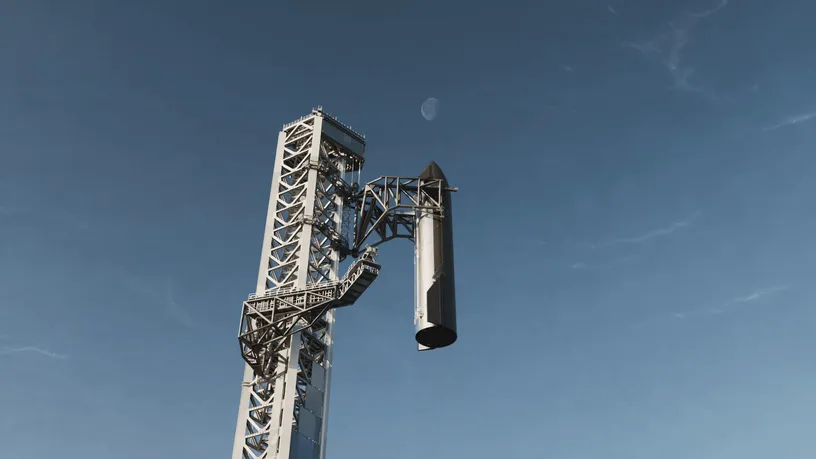
A single Raptor 3 fires the deorbit burn, aiming the ship at an entry point over the Pacific thousands of kilometres from Starbase. Its four flaps steer it through a series of small turns over sparsely populated land, around the major cities of the Rio Grande Valley, north of South Padre Island and out over the Gulf, before a final turn south towards Starbase. People in Cameron County and nearby may hear one or more sonic booms. Over the pad, the ship falls belly first, lights three Raptors, flips upright, drops to two engines to slip between the tower’s arms, then to one as it nears a hover, and the arms close on two fittings just below its forward flaps.
There are ways out along the way. During reentry, controllers can end the flight by deliberately tumbling the ship so that it breaks up in the atmosphere before it reaches land, and a late option sends it into the Gulf if the ship or the tower has a problem that rules out a catch.
For a lift-off at the opening of the window, the main events fall at these times:
| Event | T+ | UTC |
|---|---|---|
| Lift-off | 0:00:00 | 22:45, 13 November |
| Booster landing burn and catch | 0:06:10 to 0:06:35 | 22:51 |
| Ship engine cutoff | 0:08:09 | 22:53 |
| Orbital insertion burn | 0:26:10 to 0:26:30 | 23:11 |
| Starlink deployment | 0:35:01 to 1:17:40 | 23:20 to 00:02, 14 November |
| Deorbit burn | 21:35:57 to 21:36:07 | 20:20 |
| Entry | 22:10:46 | 20:55 |
| Landing burn, flip and catch | 22:32:16 to 22:32:34 | 21:17 |
The T+ times are SpaceX’s approximate flight timeline. A ship catch at 21:17 UTC on Saturday is 3:17 p.m. in Texas; a lift-off at the close of the window would move it to 22:32 UTC, still inside the FAA’s recovery closure.
What came before
Flight 14 put Starship in orbit for the first time on 28 September and released the first 26 Starlink V3 satellites. All 26 are still in orbit, at about 345 km in our Catalogue on 12 November. The ship itself did not fly its full plan: it came home after about three hours instead of ten, to a splashdown near Hawaii, one of the early ways out that Flight 15 keeps. SpaceX has still not said why it cut that flight short.
 Read nextStarship reaches orbit and releases 26 Starlinks, then cuts its flight short
Where to watch
SpaceX’s webcast starts about 30 minutes before lift-off, on its site and on X, and is planned to run through the ship catch, with the potential for hours of live views from orbit in between. SpaceX warns that the schedule is dynamic and likely to change. Our Flight 15 launch page follows its time and every move of it until lift-off.