ESA’s Hera spacecraft is almost there. On 22 October it fired its thrusters for 31 minutes and cut its speed relative to the asteroids Didymos and Dimorphos by 70 m/s, from 2,300 km away, ESA’s Hera team said on 23 October. Some 90% of the burn was done in the early morning; the team checked how it had gone, then fired the remaining 10% that afternoon. Hera is now closing on the pair at 20 m/s, and three smaller “transition” manoeuvres in the coming week are to bring that down to near zero.
It was the second of two braking manoeuvres. The first, a 93-minute burn on the morning of 15 October, “performed within required parameters”, the team said the next day. ESA had set out the plan on 7 October: three hydrazine thrusters firing at once for those 93 minutes to shed “a few hundred metres per second”, then a second, shorter burn a week later to do most of what was left and to make up for any shortfall in the first.
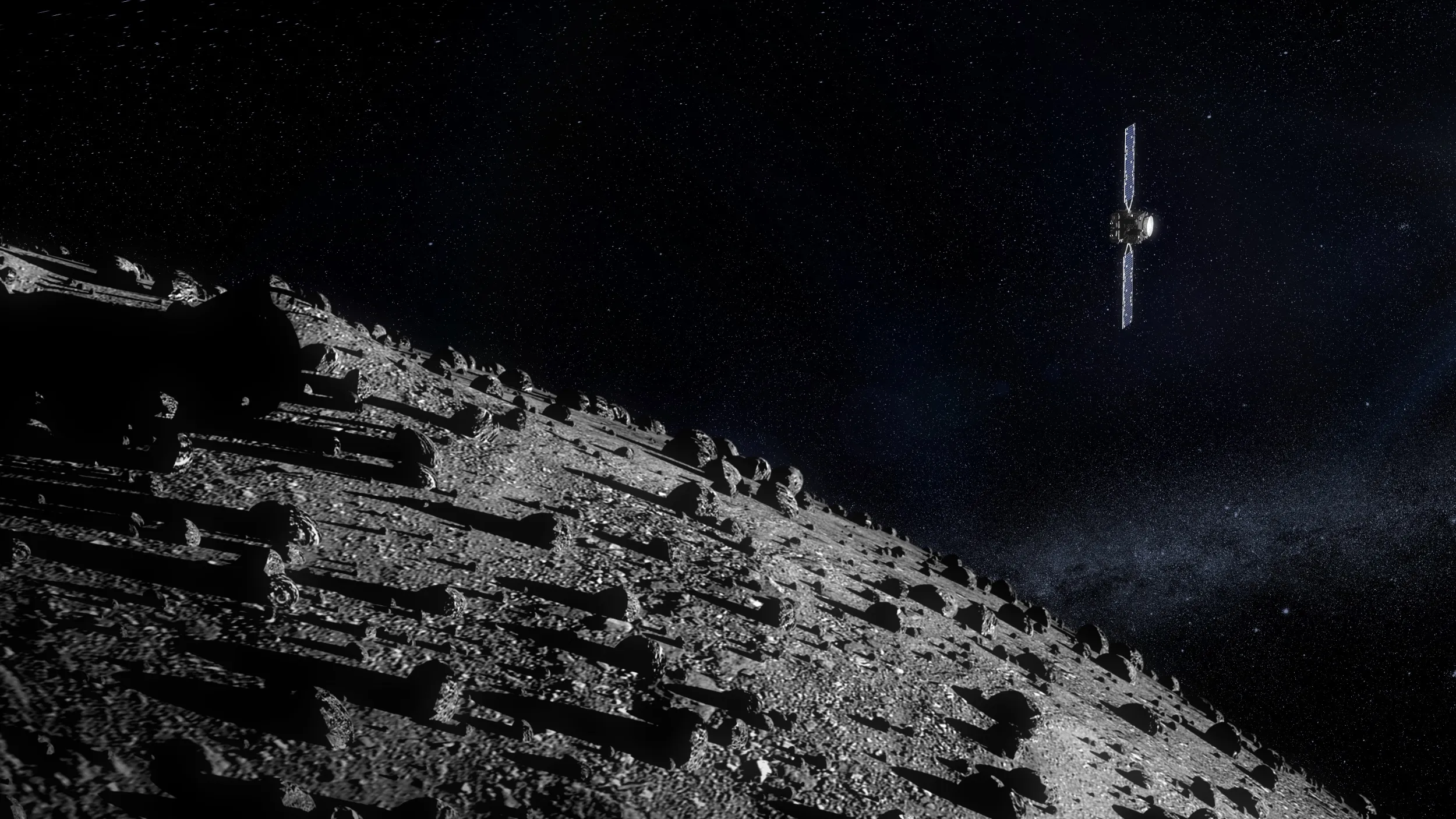
After two years of flying away from Earth at more than 12 km/s, Hera is braking to a near standstill next to two rocks 780 m and 151 m across, at 20 m/s now and heading for a walking pace. ESA’s mission timeline puts the arrival on 4 November.
What it took to slow down
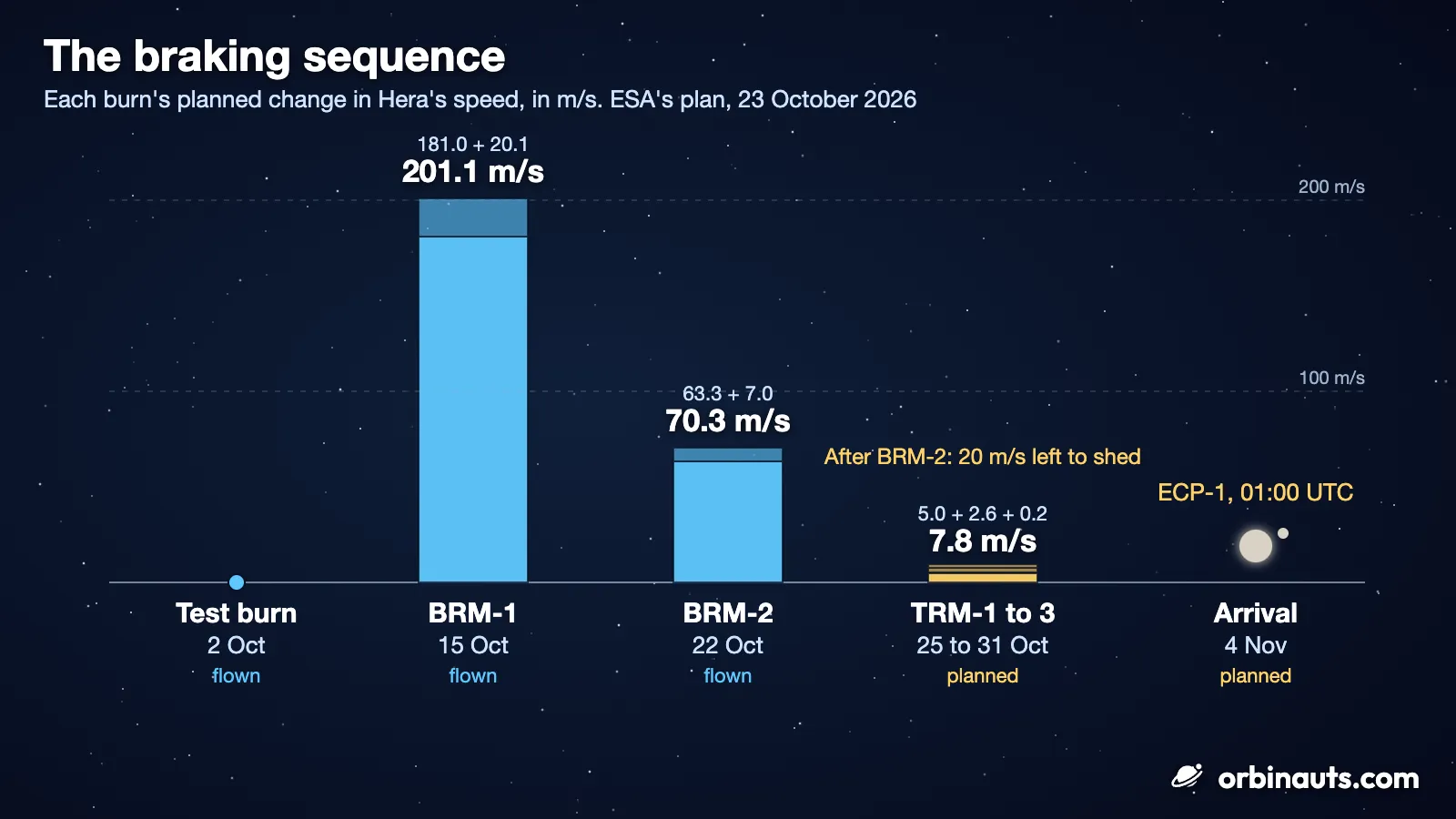
ESA’s mission site lists each burn in the sequence as planned. The first braking manoeuvre, BRM-1, was planned as two legs of 181.0 and 20.1 m/s, fired ten hours apart so the second could be trimmed from the Doppler tracking of the first; ESA has not yet said how much it actually shed. The second, BRM-2, was planned as two legs of 63.3 and 7.0 m/s, 70.3 m/s together, which matches the 70 m/s the team reported. The three transition manoeuvres, TRM-1 to TRM-3, between 25 and 31 October, are much smaller: 5.0, 2.6 and 0.2 m/s. A brief test burn on 2 October opened the sequence.
ESA’s Flight Dynamics team at ESOC, in Darmstadt, reads each burn off the spacecraft’s own sensors and off the Doppler shift and ranging of its radio signal, picked up by one of ESA’s 35 m deep-space antennas at New Norcia, in Australia. The team rehearsed all this in February, when the second deep-space manoeuvre of the cruise, three burns and a correction over four weeks, changed Hera’s speed by 367 m/s on 123 kg of hydrazine, the mission’s biggest use of fuel.
Didymos is in sight
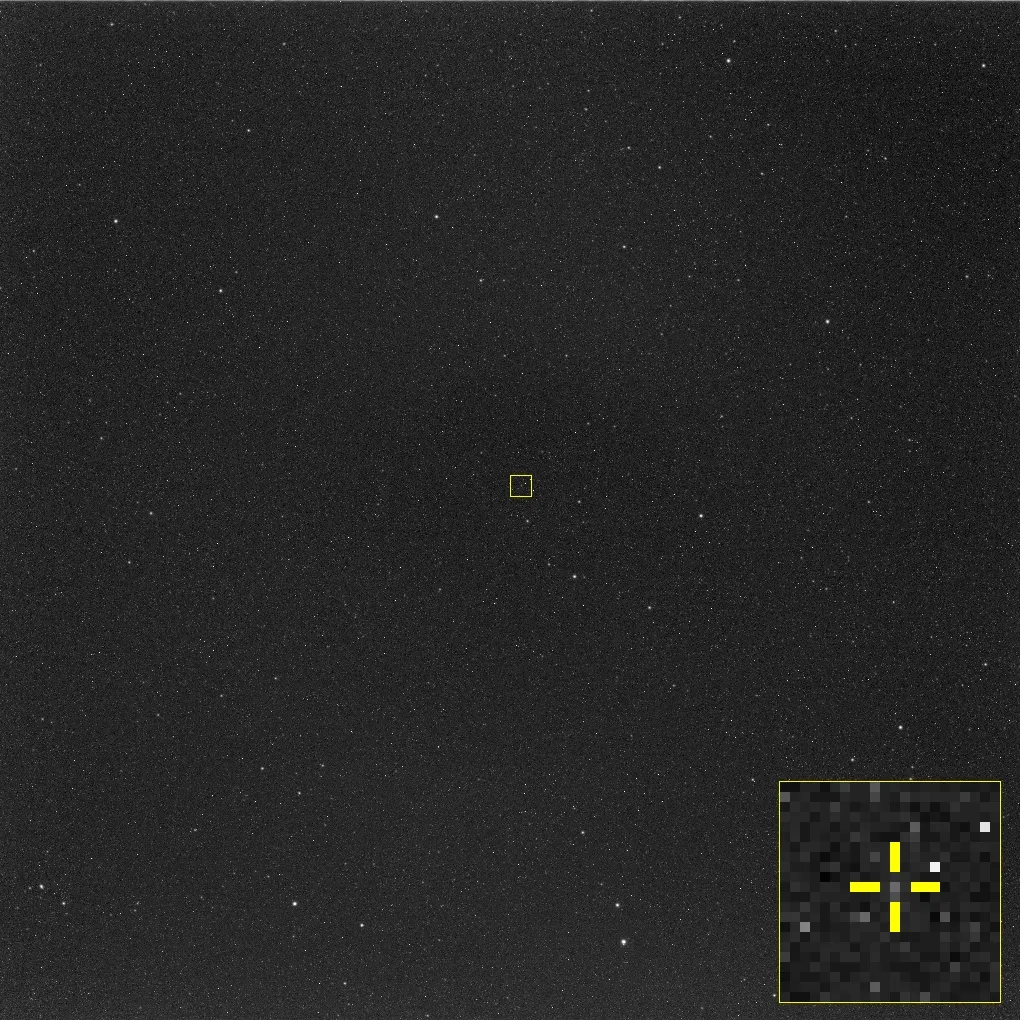
Hera has already seen where it is going. On its second birthday in space, ESA published Hera’s first picture of Didymos: a single bright point among the stars, smaller than a pixel, picked out by combining several images and measuring their brightness, from about 236,500 km away. The two asteroids will only separate in Hera’s cameras much closer in.
From here on, Hera has to find the asteroids itself. They are small and dark, so the spacecraft searches for them and keeps them centred in its field of view as it navigates, on software uploaded this year. Once they fill the view, the navigation tracks features on their surfaces to work out where Hera is and how it is moving, with more of the job done on board the closer it gets.
What “arrival” means here
There is no orbit to fall into. Didymos’s gravity is about 40,000 times weaker than Earth’s, and Dimorphos’s about 200,000 times weaker, so Hera will fly a series of “hyperbolic arcs” past the pair, as Rosetta did at its comet: arcs of three days and four days, in a weekly cycle, that bring it within 20 to 30 km of Dimorphos’s surface at a typical relative speed of around 12 cm/s. Each arc ends in a manoeuvre, and if one fails Hera simply drifts away rather than hitting anything.
The first of those manoeuvres, ECP-1, is the mission’s arrival date: 4 November 2026, at 01:00 UTC, the start of the early characterisation phase. ESA’s timeline noted that a slip of more than a day in BRM-1 would have pushed arrival to 2 December; BRM-1 flew on the day.
| What | When | Distance to the asteroids |
|---|---|---|
| Transition manoeuvres TRM-1 to TRM-3 | 25 to 31 October 2026 | |
| Arrival: first proximity manoeuvre, ECP-1 | 4 November, 01:00 UTC | |
| Early characterisation phase | 4 November to 15 December | 20 to 30 km |
| Arrival event in Berlin, first pictures expected | 25 November | |
| Detailed characterisation phase | 16 December to 12 January 2027 | 9 to 20 km |
| Juventas CubeSat released | 16 January | |
| Milani CubeSat released | 30 January | |
| Close observation phase | 10 February to 28 April | 4 to 22 km |
| Experimental phase | 1 May to 1 June | down to about 1 km from Dimorphos |
| End of the nominal mission | 2 June 2027 |
The dates are ESA’s mission timeline as it read on 23 October, and the plan moves if a manoeuvre does. The 25 November date is a public arrival event in the dinosaur hall of Berlin’s natural history museum, where ESA expects to show the first pictures from the characterisation phase. In that phase, six weeks at 20 to 30 km, the whole pair fits in the framing camera’s field of view: the first maps of both asteroids, and the first close look at the crater DART left. ESA’s Flight Dynamics team puts that phase in November and December, from 25 to 30 km, with a closest pass of 10 km later in December, the two CubeSats released early in the new year, a close observation phase down to 4 km, and an experimental phase aiming at a single kilometre from Dimorphos.
The CubeSats are the mission’s second act. Juventas carries a radar to sound the inside of Dimorphos, then tries to land on it; Milani flies lower than Hera, from 10 km down to 2 km, and also attempts a landing. Whether Hera itself ends its mission by touching down on one of Didymos’s poles is still under consideration.
Why it is going there
In September 2022 NASA’s DART spacecraft hit Dimorphos at about 22,500 km/h, and shortened its orbit around Didymos by 32 minutes, from 11 hours 55 minutes to 11 hours 23 minutes, give or take two minutes. NASA calls it humanity’s first time purposely changing the motion of a celestial object. What it left behind, a crater or a reshaped asteroid, and how much of the push came from the rock thrown off, has only been inferred from telescopes on Earth. Hera goes to measure Dimorphos’s response to the impact in detail, so that the technique can be understood and repeated if an asteroid ever threatens Earth.
Dimorphos is 151 m across and orbits the 780 m Didymos at an average 1.15 km, at just 18 cm/s. Both are dark, silicon-rich rock, about as bright as the lunar highlands.
The road so far
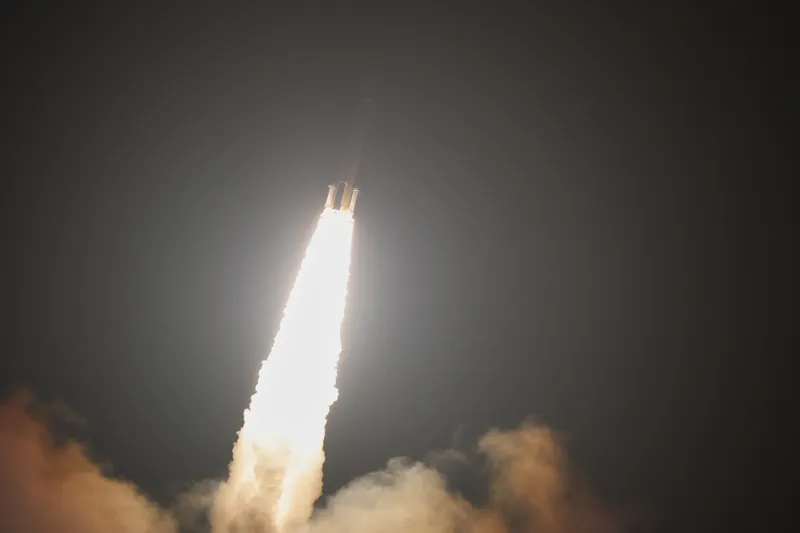
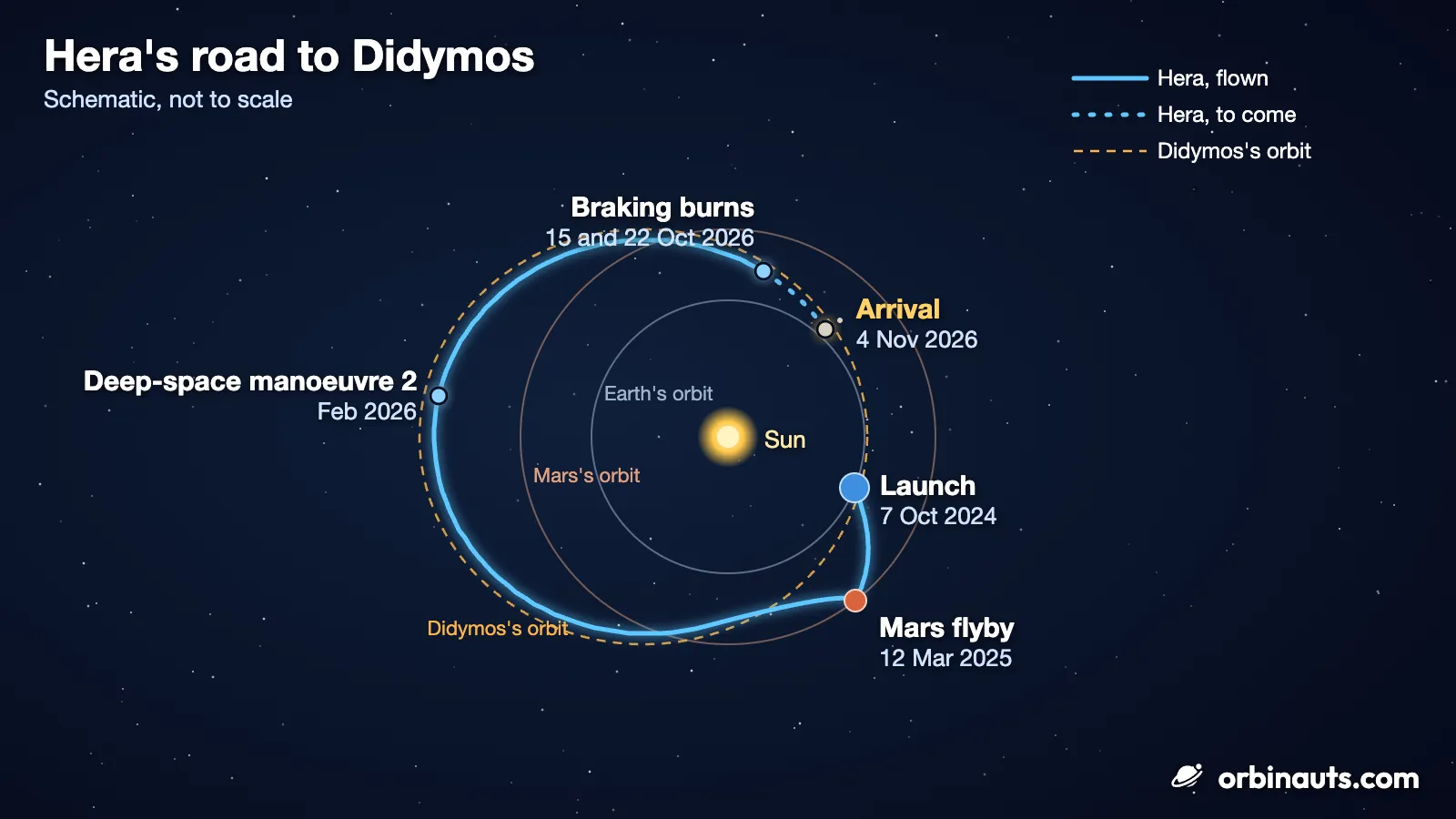
Hera lifted off on 7 October 2024 at 14:52 UTC on a Falcon 9 from Cape Canaveral, just ahead of Hurricane Milton, and separated from the rocket 76 minutes later. A first deep-space manoeuvre in late October 2024 pointed it at Mars. On 12 March 2025 it flew past Mars at 5,000 km, letting the planet’s gravity bend its path towards Didymos, a swing that cut months off the journey and saved fuel, and imaged the moon Deimos from 1,000 km at 9 km/s relative to Mars. The second deep-space manoeuvre in February 2026 lined it up for the rendezvous, and the braking began this month.
The spacecraft is about the size of a small car: a 1.6 m cube with solar arrays spanning 11.5 m, about 1,150 kg fully fuelled at launch, with 12 instruments counting those on the two CubeSats. It is flown from a dedicated control room at ESOC through ESA’s 35 m deep-space antennas in Spain, Argentina and Australia. On 23 October ESA’s mission site put it 197.2 million km from Earth, with a one-way light time of 10 minutes 58 seconds.
Hera is far beyond Earth orbit, so it is not on our map. We will report the arrival when ESA confirms it.