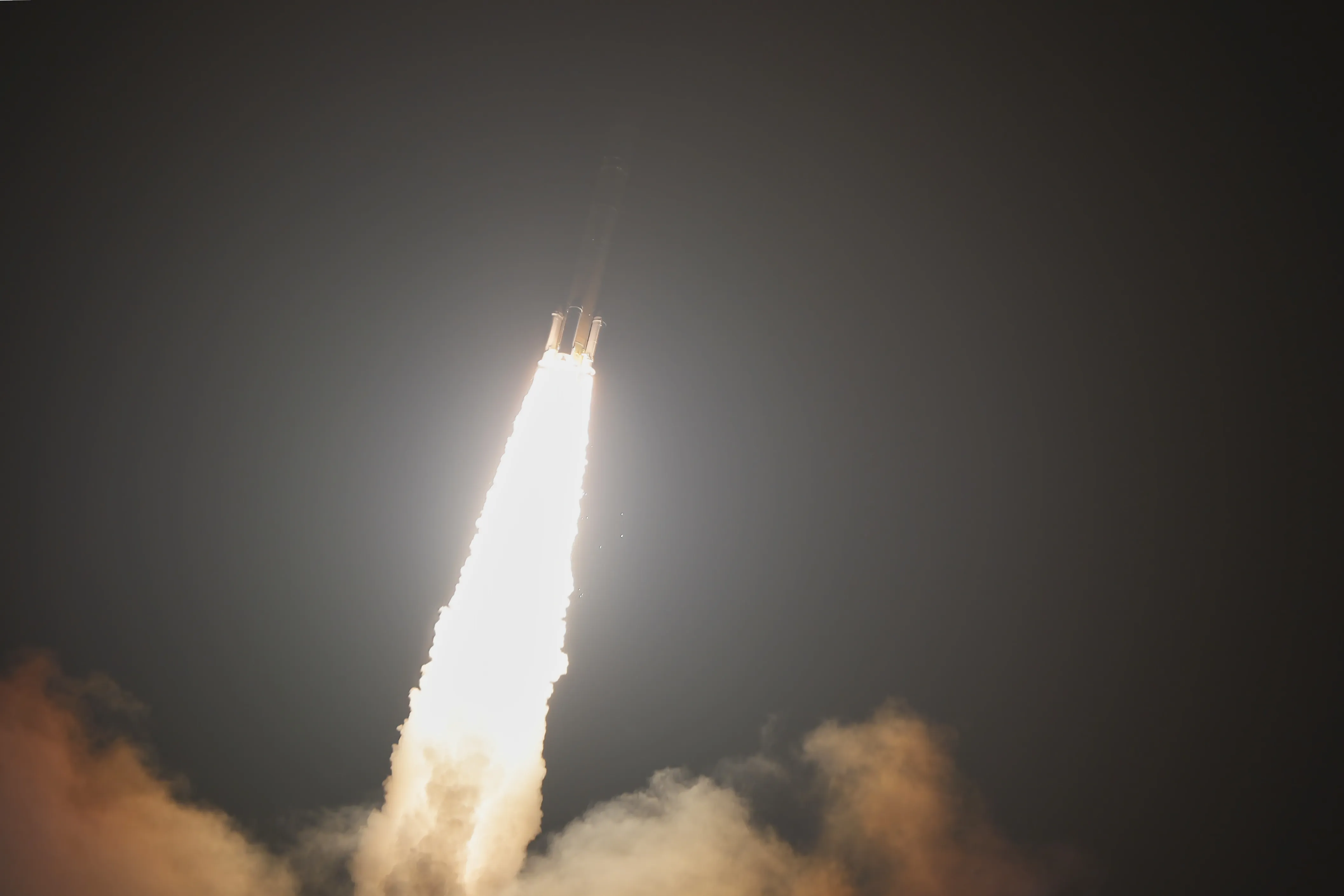
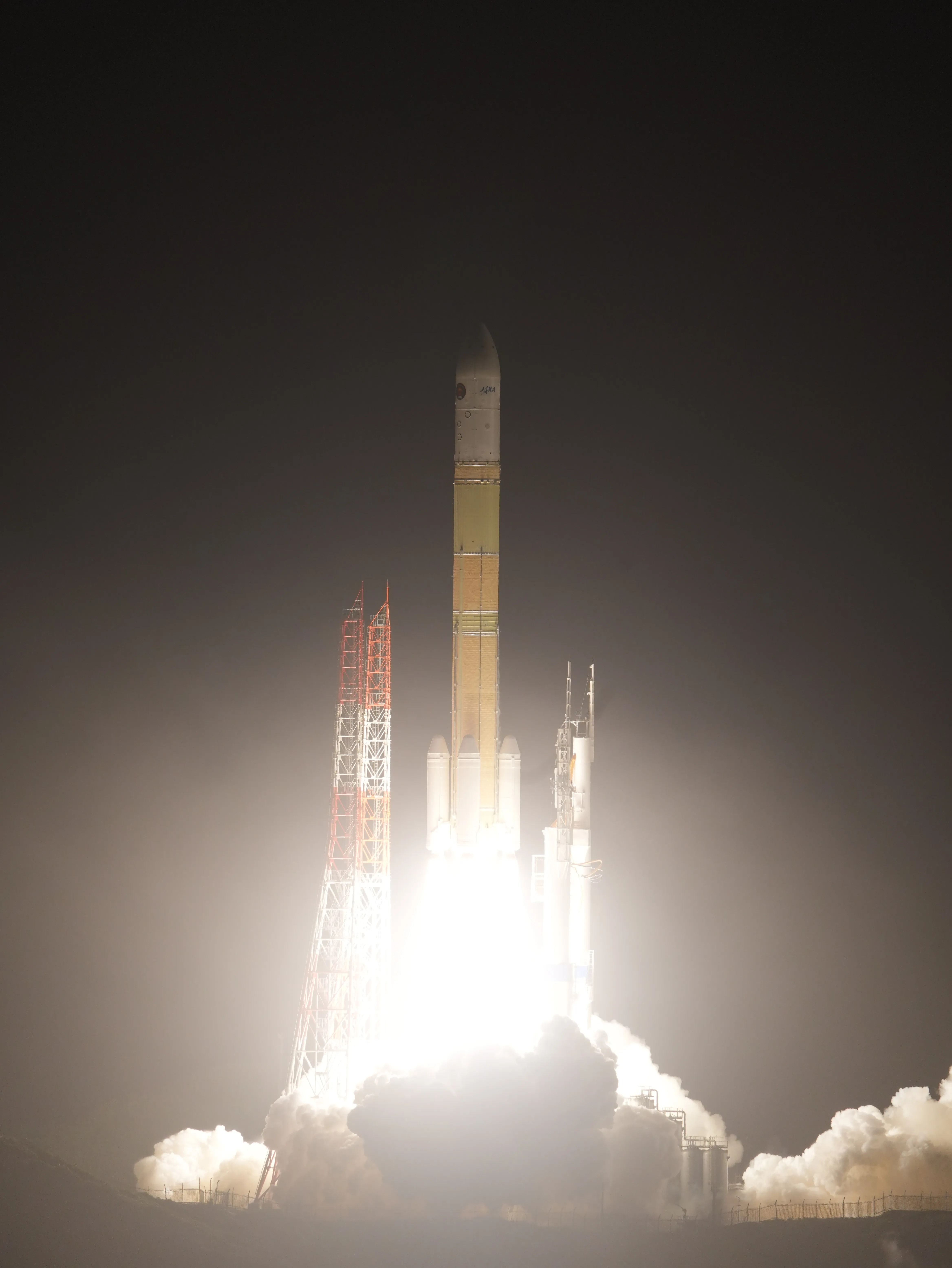
Japan’s Martian Moons eXploration spacecraft, MMX, is on its way to Mars. The tenth H3 rocket lifted off at 04:41:03 Japan time on 20 October, 19:41:03 UTC on Monday 19 October, from the Tanegashima Space Center, and JAXA says the rocket flew as planned and released MMX about 71 minutes 13 seconds later, on the orbit it was meant to reach. The launch plan had put separation at about 1 hour 11 minutes 12 seconds, so the rocket flew to its timetable; JAXA gives both times as approximate.
The next day, Japan time, the spacecraft had passed its first test on its own. On 21 October JAXA confirmed that the critical sequence of its early operations was complete and that MMX is in good health: its solar array paddles have opened, it holds its attitude on three axes, and it has released the latch that held its medium-gain antenna for launch. JAXA now moves on to the first functional checks of the equipment on board while it prepares for the cruise to Mars.
The most powerful H3
The H3 flew in what JAXA’s press kit calls its most powerful configuration, with four solid boosters and the long fairing, and its second stage fired twice: the plan had the second burn from 1 h 3 min 57 s to 1 h 10 min 21 s after lift-off, taking MMX out of Earth orbit at 11.2 km/s and onto its path to Mars, with separation a minute later, 592 km up. ESA’s project scientist for the mission, Elliot Sefton-Nash, said the H3 “performed fantastically” and that the team is now preparing for arrival at Mars next summer.
The rover rides along, docked
MMX carries a 25 kg rover, Idefix, built by the German and French space agencies. For the cruise to Mars it stays docked to the spacecraft, and its control centres in Cologne and Toulouse take turns to run its health checks, calibrate its instruments and charge its battery; a software update is planned in flight. DLR expects MMX to drop the rover onto Phobos around the turn of 2028 and 2029 from 40 to 100 metres up. It lands unbraked, bounces, rights itself, opens its solar panels and then has about 100 days to work on a moon whose gravity is less than a thousandth of Earth’s, where the temperature swings by more than 200 °C in a seven-hour day.
Next summer, Mars
ESA, which provided MMX’s deep-space radio and supports it from its Estrack ground stations, expects the spacecraft to enter orbit around Mars in August 2027 and around Phobos from September 2027. ESA says MMX will be the first spacecraft to orbit Phobos (in a “quasi-satellite orbit”, as it put it before the launch), the first to take a sample from its surface and the first to come back to Earth from the Mars system. The sample, more than 10 g from at least 2 cm below the surface, is to come down in a capsule in Australia in 2031. What MMX is, who built it and what each agency put on board, we set out before the launch.
 Read nextJapan's MMX is set to launch for Mars on Monday at 19:41 UTC, on the most powerful version of its H3 rocket
What happens now
The initial functional checks JAXA is turning to are the last step before the outbound cruise phase, the roughly ten months between leaving the Earth and arriving at Mars. MMX will not be back on our map, which draws what is in Earth orbit; this News section follows the mission from here, through its cruise, its arrival and its landings.