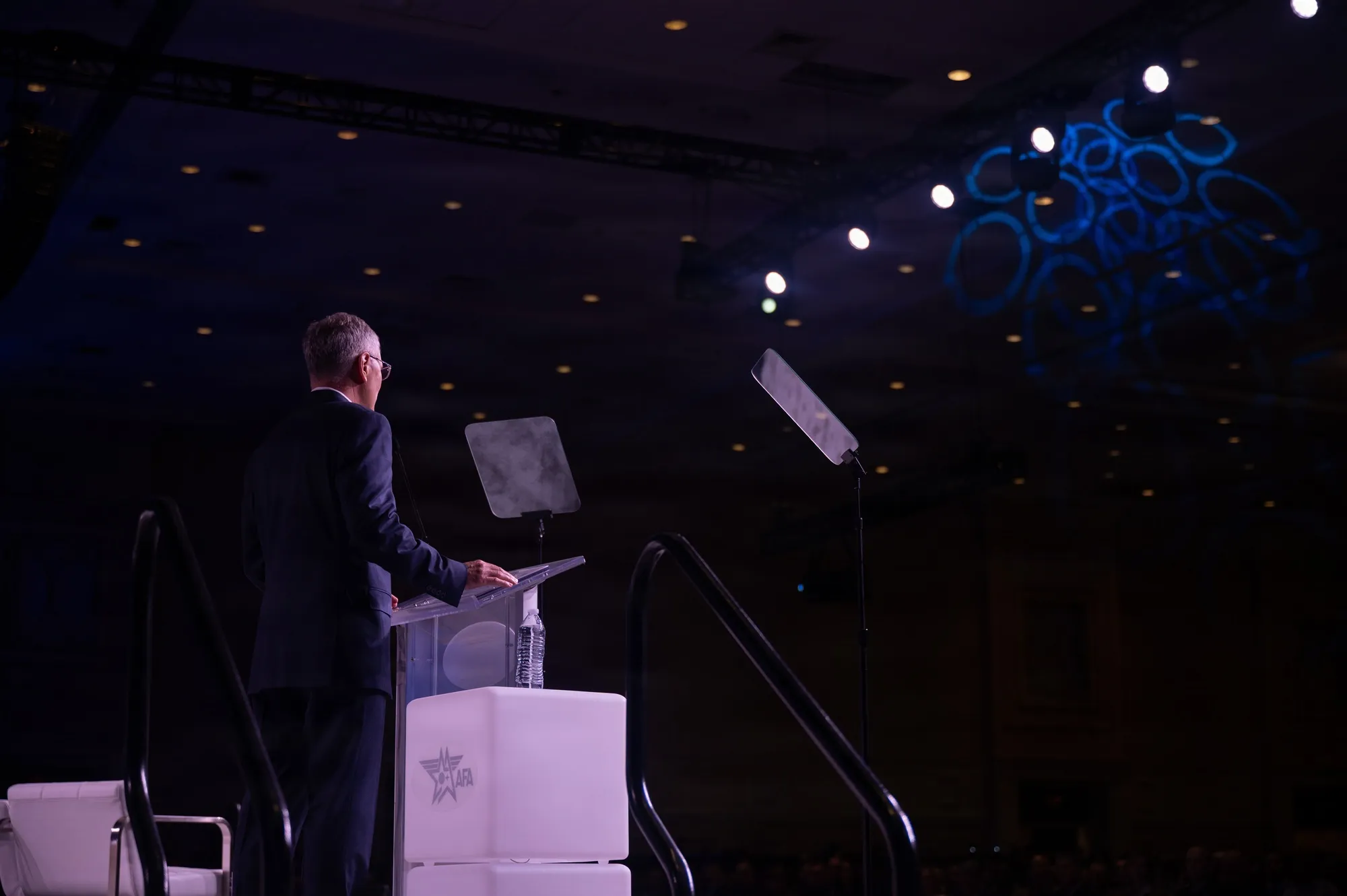
The United States has weapons in Earth orbit, Troy Meink, the Secretary of the Air Force, said on Monday 14 September, acknowledging for the first time that the Space Force has deployed weapons in space, according to his own public affairs office. “We are increasing readiness against existing threats, and the United States has on-orbit space control weapons capable of defending the Joint Force against hostile adversary action,” he said in his keynote at the Air and Space Forces Association’s Air, Space and Cyber Conference, at National Harbor, Maryland.
The next day the Space Force’s senior officer said it again from the same stage. “So let me be crystal clear: Today, Guardians operate on-orbit weapons that can defend the Joint Force against space-enabled attacks,” said Gen. Douglas Schiess, the Chief of Space Operations, whose Guardians are the Space Force’s service members.
What was not said
Neither speech says what the weapons are, how many there are, which orbits they are in, when they were launched, or what they do to a target. Meink’s words were “space control weapons”; Schiess’s were “on-orbit weapons”. Both described them by what they are for, defending the Joint Force, the US military’s services fighting together, rather than by what they are.
Why they say they need them
Schiess gave the reason in the sentence before. “We face determined and credible adversaries who are building and fielding counterspace systems at incredible speeds to target directly the United States’ space advantage. That is why we don’t just monitor the domain, we stand ready to defend it,” he said. He did not name the adversaries.
He closed on deterrence. “Our aim is deterrence. Deterrence is strongest when we have a credible force and a resolve to do it and that is what the Space Force brings to you,” Schiess said.
What else is coming to orbit
Both speeches named programmes that are not secret, though neither said whether any of them is among the weapons. Meink said the Space-Based Interceptor programme moved “from initial contract to flight-ready hardware in less than one year”, and added: “we start launching our Air Moving Target Indication constellation this month”. Schiess, who called it Airborne Moving Target Indication, described it as a space-based sensing and tracking architecture that will feed long-range precision fires. Schiess said a Victus Haze mission earlier this year, one of a series of exercises the Space Force runs each year to test different capabilities, demonstrated the ability to launch and respond to an on-orbit threat in 17 hours.