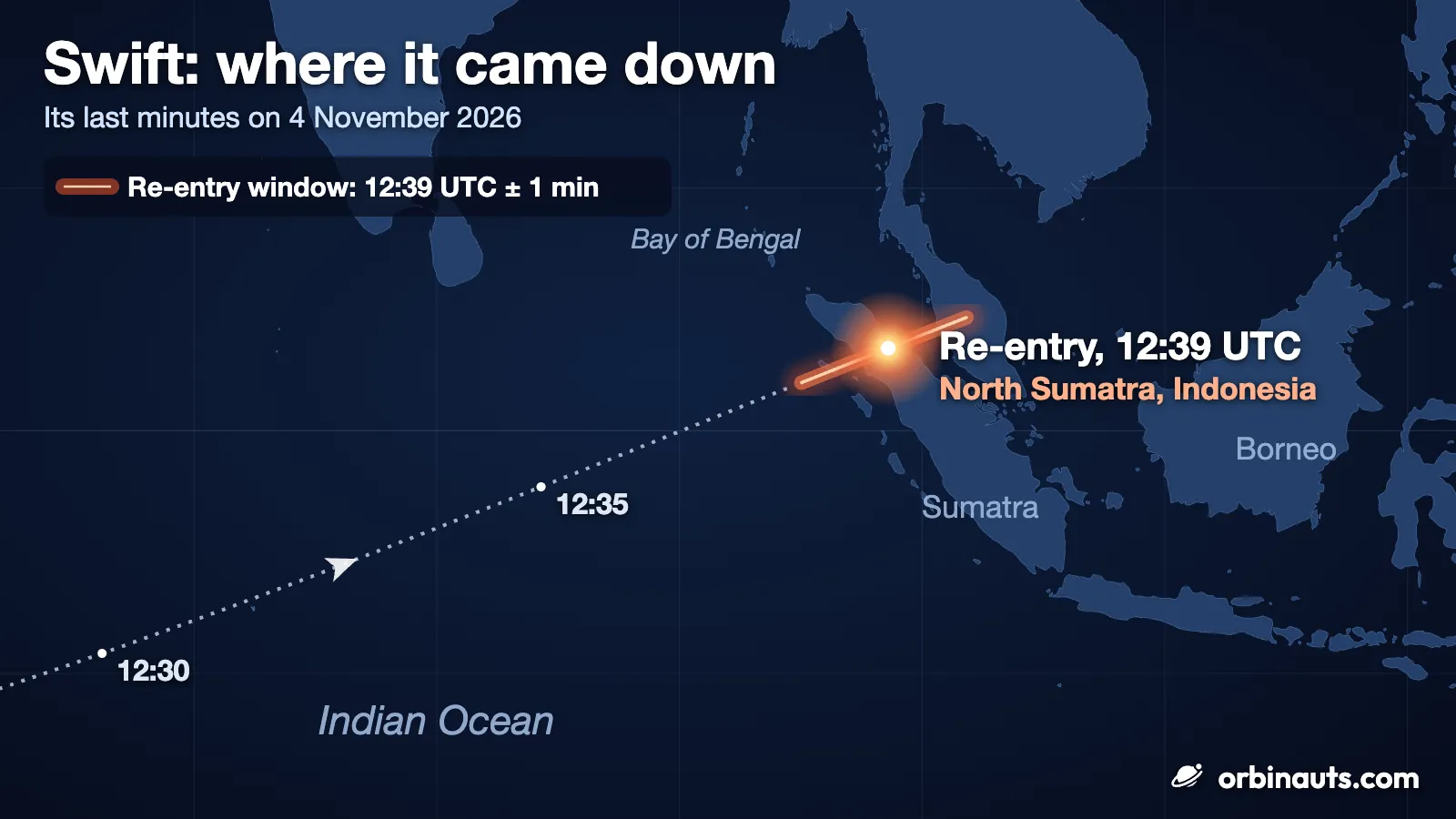
NASA’s Neil Gehrels Swift Observatory re-entered Earth’s atmosphere on Wednesday 4 November, almost 22 years after its launch. The US Space Force confirmed the re-entry at 12:39 UTC over the North Sumatra region of Indonesia, at about 3.4° north and 98.6° east, where it was 19:39 in the evening. NASA expected most of the spacecraft to burn up on the way down, but says some components may have survived re-entry. It has not said whether any have been found.
Swift came in from the Indian Ocean, heading north-east. Its last minutes took it across the sea west of Sumatra and over the north of the island, as the map at the top of this page shows.
A fast end
The fall sped up to the last. Early on 27 October the mean height of Swift’s orbit was about 255 km, and it was losing nearly 4 km a day. The last Elements published for it, late on 3 November, put it at about 184 km, more than 20 km lower than a day earlier.
The forecasts closed in with it. On 31 October, Space-Track’s re-entry prediction gave 09:25 UTC on 4 November, give or take 18 hours. On 3 November it gave 10:47 UTC, give or take five hours. From the early hours of 4 November it settled on 12:42 UTC, first give or take two hours, then one: three minutes from the time the Space Force confirmed after the event.
How Swift came to fall, from the robot sent to lift it to its last two months of science, is in our story from the week before:
 Read nextNASA's Swift observatory is predicted to re-enter on 4 November
Built for two years, it flew for almost 22
Swift launched on 20 November 2004 to catch gamma-ray bursts, the most powerful explosions in the cosmos, and was designed for a two-year mission. It worked for more than ten times as long and observed more than 2,000 of them. NASA announced the end of the mission on 23 October, after the growing drag of the upper atmosphere had pushed the spacecraft into safe mode.