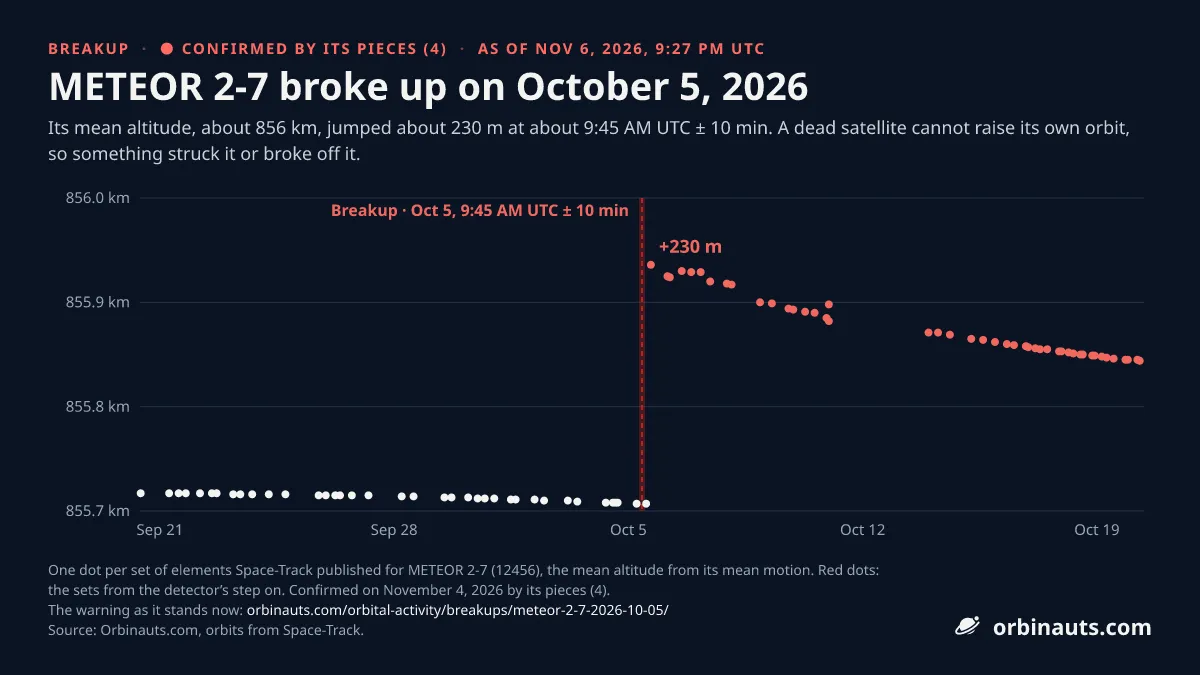
Meteor 2-7, a Soviet weather satellite silent since 1984, did break up in orbit on 5 October. On 4 November the US catalogue added four new pieces of debris from the satellite, all four in its own orbit, and our Breakup page marked the breakup Confirmed that morning. When we reported it on 9 October, it was still a suspected one: a small jump in the satellite’s orbit and LeoLabs’ radar pointed to it, but no piece had been catalogued.
In this Article
- Meteor 2-7
Satellite
- Meteor 2-7 piece 1981-043AC
Debris
- Meteor 2-7 piece 1981-043AD
Debris
- Meteor 2-7 piece 1981-043AE
Debris
- Meteor 2-7 piece 1981-043AF
Debris
The four pieces
The catalogue names all four “METEOR 2-7 DEB”. Each circles between about 820 and 890 km, in the same plane as the satellite, tilted 81° to the equator. The catalogue rates two of them as medium-sized radar targets and one as small, and gives no size for the fourth.
In a month they have spread far along the satellite’s path. The breakup threw them off at about a metre per second, enough for each to go round a few seconds quicker or slower than Meteor 2-7, and two are now thousands of kilometres ahead of it and two behind. Traced back, all four orbits meet the satellite on 5 October.
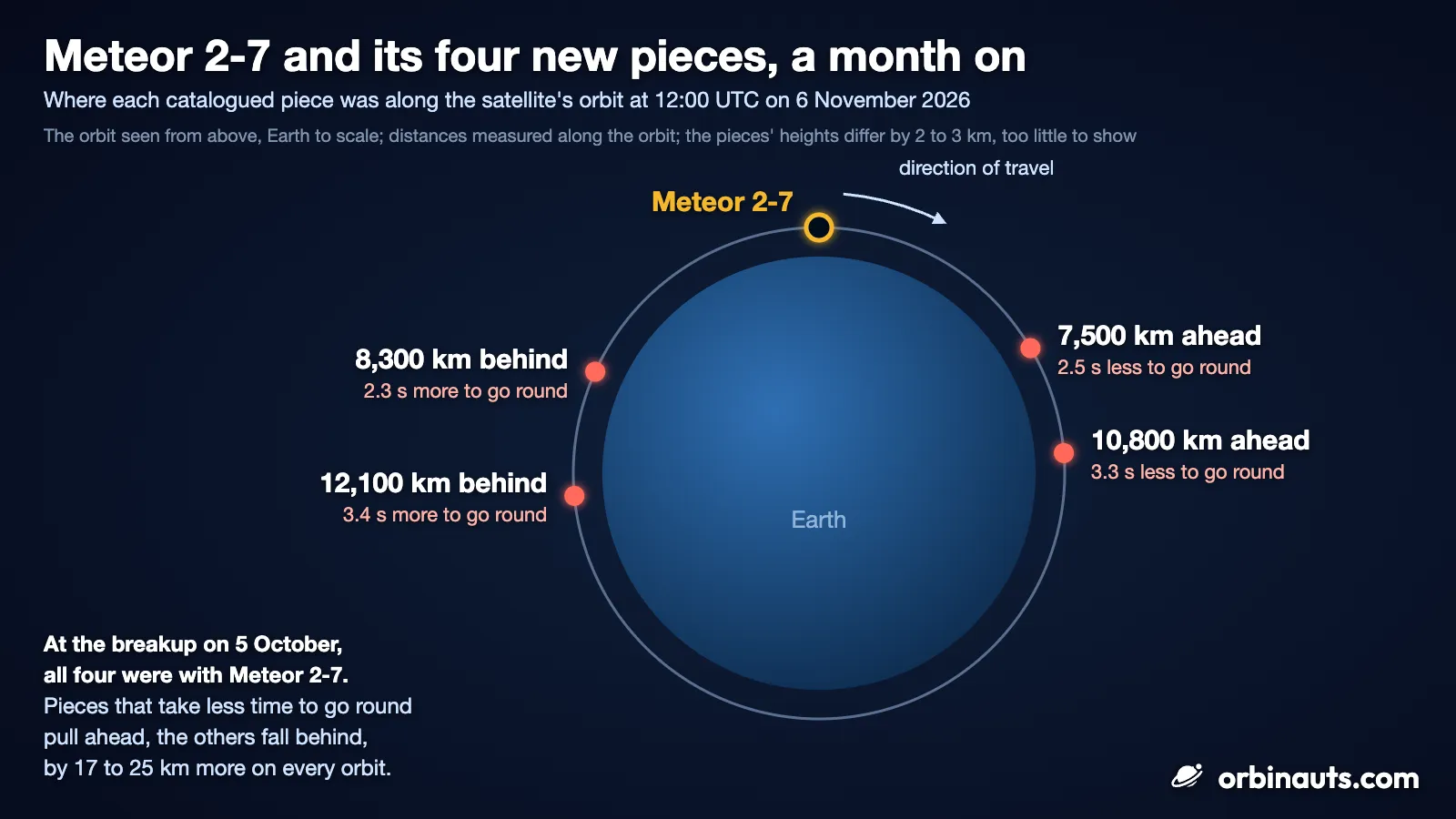
They are not the first pieces of Meteor 2-7. With these four, the catalogue names 26 pieces of debris after the satellite, the older ones shed in earlier events; 15 of the 26 are still in orbit. How this breakup first came to light, from LeoLabs’ radar and a jump in the satellite’s orbit, is in our first report.
 Read nextMeteor 2-7, a Soviet weather satellite dead since 1984, may have broken up
When and why it broke up
What caused it is not known: something either struck Meteor 2-7 or broke off it. Jim Shell, an orbital debris analyst, puts the breakup at 09:45 UTC on 5 October, give or take 10 minutes, when the satellite was near the farthest it gets from the equator, where debris is densest at its height. That makes him wonder whether one of the many pieces of debris nobody tracks hit it, though he expects the question will likely never be settled.
LeoLabs estimated tens of fragments when it confirmed the event on 7 October. A month later the catalogue holds four, so more may yet be added, and the Breakup page will list each new piece as it is catalogued. Meteor 2-7 itself can be followed on the live map.