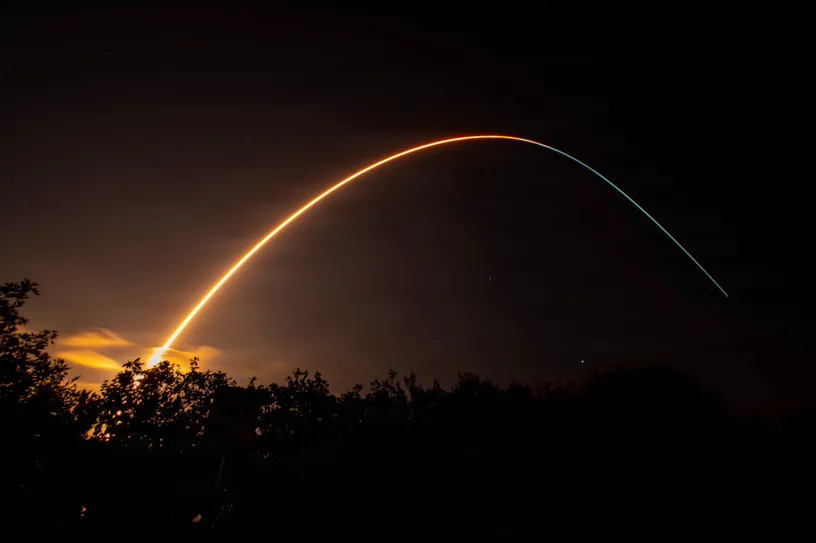
United Launch Alliance’s Vulcan rocket failed on Sunday on its first flight in nine months, and the 40 Amazon Leo internet satellites it carried were lost. It lifted off from Cape Canaveral, Florida, at 17:40 UTC on 15 November, 12:40 p.m. local time, at the very end of its window. Amazon says ULA “experienced an anomaly with the Vulcan rocket carrying Leo satellites, and the payload was lost”.
ULA said the rocket suffered an anomaly 10 minutes into the flight and failed to deliver the satellites to orbit. It has no specific data yet on what happened, and will work with Amazon and other organisations to find the cause and return Vulcan to flight as quickly as possible. It is the end of a record ULA is proud of: the company counts more than 150 consecutive launches since it was formed in 2006.
What the webcast showed
The first minutes went as planned. In ULA’s webcast, the six solid rocket boosters burned out and fell away less than two minutes after lift-off. The core stage then flew on alone on its two BE-4 engines, made by Blue Origin.
Six minutes in, ULA’s live updates confirmed that the core stage had shut down and separated, that the upper stage, the Centaur V, had lit its two engines and that the fairing had come away as planned. At 6 minutes 22 seconds the commentator said all systems continued to operate normally. The Centaur’s first burn was to last almost 12 minutes, into a parking orbit, so the anomaly ULA puts 10 minutes into the flight came during it.
The webcast then turned to a film and interviews about Amazon Leo and closed without saying how the flight ended. Nothing from the launch has been added to the public catalogue, which lists every object found in orbit.
A stronger Vulcan for Amazon
The flight was the first of 38 Vulcan launches Amazon has bought, meant to carry more than 1,500 of its satellites, close to half of its first-generation network. For this mission, Vulcan flew for the first time with six solid boosters and a new, shorter version of the Centaur V for low orbits, under a longer fairing. The 40 satellites, more than 22,700 kg, were to set a new record for ULA as its heaviest payload to orbit.
It was also Vulcan’s return after a fault in February. On that flight, pictured above, the nozzle of a solid booster failed, and the rocket still delivered its payload, as it had through booster trouble on its earlier flights. ULA changed the nozzle’s design and how it is built, and on Sunday the new boosters did their part.
What it means for Amazon Leo
Amazon has 392 Leo satellites in orbit and has launched none since an Atlas V flight on 2 July. Before Sunday, Amazon said it had built its 1,000th satellite and that a second Vulcan for it was being prepared to launch within weeks of the first, if that flight went as planned.
“There is risk with any launch, and that’s especially true for inaugural missions like LV-01,” Amazon said. “ULA has been a trusted partner for Amazon, and we believe they’ll learn from this mission and deliver on their long-term plans for Vulcan.”
Amazon’s next launch does not depend on Vulcan. An Ariane 6 is due to lift off from Kourou, French Guiana, with 36 more Leo satellites no earlier than Monday 23 November.
What comes next
ULA has not said when Vulcan might fly again, and has promised further updates when new information becomes available. The rocket also carries the US military’s satellites: the next 16 Vulcan flights on our Launches list are all for the Space Force, the National Reconnaissance Office or the Space Development Agency, and none has a firm date yet. Our page for this launch keeps its record, with every move of its date since September.