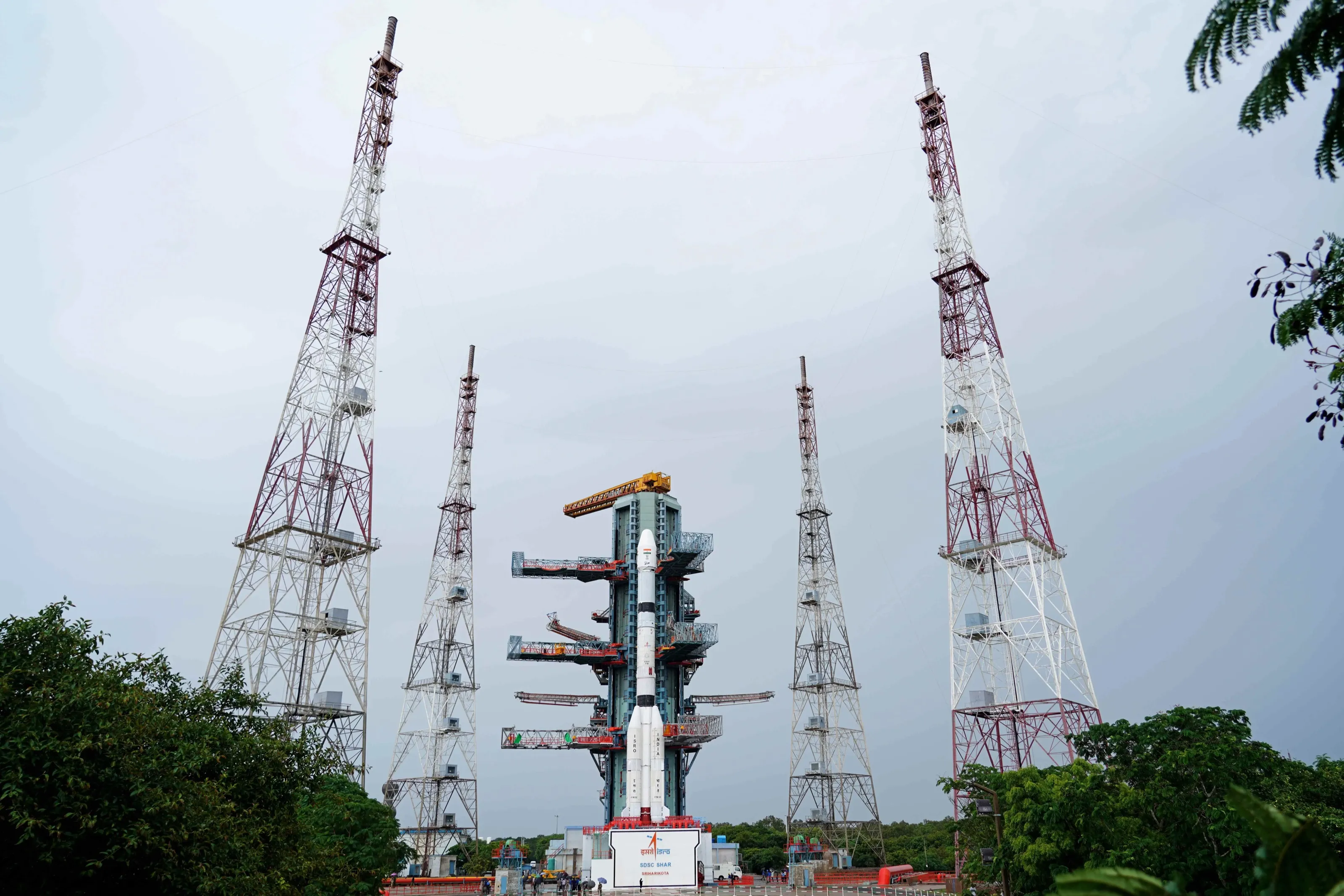
India is to launch NVS-03, a new satellite for its NavIC navigation system, on Friday 30 October. ISRO has scheduled the launch for 23:51 India time, which is 18:21 UTC, on the GSLV-F18 rocket from the Second Launch Pad of the Satish Dhawan Space Centre at Sriharikota. The rocket is to place NVS-03 in a geosynchronous transfer orbit, from which the satellite has to climb the rest of the way on its own.
In this Article
Much rides on this one satellite. NavIC, India’s own system for position, navigation and timing, needs at least four working satellites in orbit to provide a basic position. It has had three since the atomic clock on IRNSS-1F stopped working on 13 March, three days after the satellite completed its ten-year design life. On 29 July the government told Parliament that NavIC cannot provide a standalone positioning service, though its timing service works, and named the three satellites that still broadcast its navigation signals: IRNSS-1B, IRNSS-1I and NVS-01. It added that NavIC is used alongside other satellite navigation systems for most uses, so users are not left exposed.
Where NavIC stands
NavIC’s satellites come in two generations. ISRO launched the nine of the first, IRNSS-1A to IRNSS-1I, on PSLV rockets between July 2013 and April 2018; IRNSS-1H was lost in a failed launch in August 2017. The second generation, the NVS series, began with NVS-01 in 2023 and is meant to replace or reinforce the ageing first.
NavIC is designed to serve India and the region extending up to 1,500 km from its boundary, with an extended service area that reaches from 30° south to 50° north and from 30° to 130° east. Its satellites fly at geosynchronous height, about 35,786 km up, where an orbit lasts exactly one turn of the Earth, so each satellite keeps over the same region. A few circle close to the equator and barely move: on the map below, each draws a short north-south stroke. The others circle on orbits tilted well away from the equator, so every day they swing far north and back south, and most draw a figure of eight.
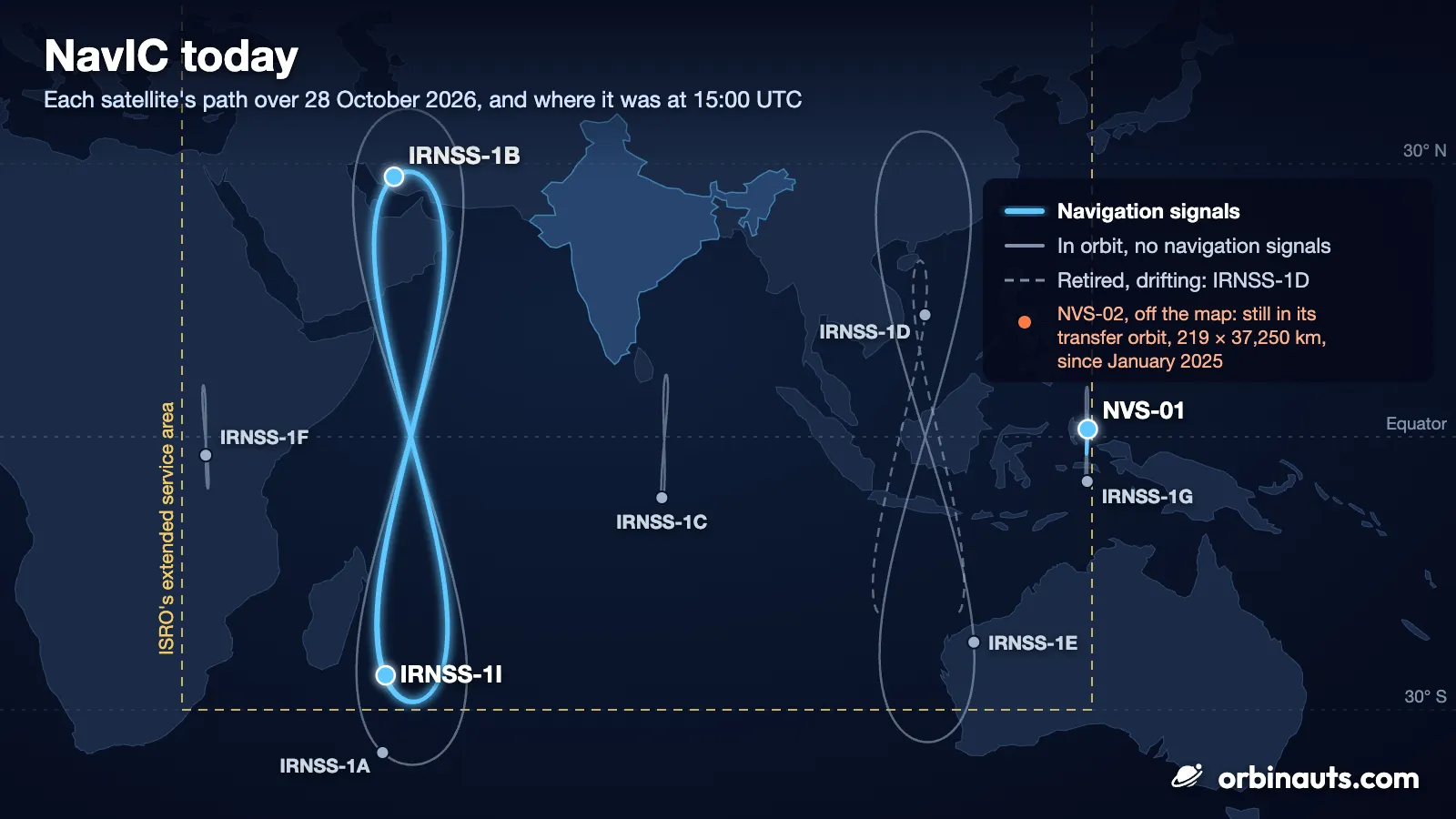
Our tracking shows where the three are. IRNSS-1B and IRNSS-1I share one figure of eight, centred on 55° east, one at each end of it: at 15:00 UTC on 28 October IRNSS-1B was over Iran, at 28.6° north, and IRNSS-1I over the Indian Ocean at 26.2° south. NVS-01 hangs over the equator at 129.5° east, north-west of New Guinea. The oldest, IRNSS-1B, launched in April 2014, is already past the ten years it was built for.
Of the first generation, only IRNSS-1B and IRNSS-1I still broadcast navigation signals. The six others still in orbit have stopped, and in March a committee of Parliament gave the reason for some of them: NavIC’s atomic clocks, imported from a foreign vendor, had malfunctioned. The same month the government counted five NavIC satellites that can broadcast one-way messages; ISRO says that is what IRNSS-1F now does, and IRNSS-1A too. IRNSS-1D is retired: at the end of its mission, ISRO raised it to a graveyard orbit nearly 600 km above the geostationary belt and made it inert, out of the way of working satellites. It now flies between 36,414 and 36,482 km up, so it no longer keeps its place: it drifts more than 8° west a day.
The flight
GSLV-F18 is the 20th flight of the GSLV, a three-stage rocket about 50 m tall that weighs about 420 tonnes at liftoff: a solid-fuelled core with four liquid-fuelled boosters strapped around it, a liquid-fuelled second stage, and a cryogenic upper stage that burns liquid hydrogen and liquid oxygen. NVS-03, about 2,250 kg, rides under a metal fairing 3.4 m across. ISRO’s target is a transfer orbit 170 km high at its lowest and 37,023 km at its highest, tilted 20.75° to the equator, reached on a launch azimuth of 106°, east-south-east over the Bay of Bengal.
ISRO’s list of GSLV launches counts 19 flights so far and marks four of them unsuccessful, the last in August 2021. The most recent, GSLV-F17, placed EOS-05 into its intended orbit in September.
The step NVS-02 never took
The rocket’s part ends in the transfer orbit. From there the satellite has to fire its own engine to raise itself to a circular orbit, and that is where the previous NavIC satellite failed.
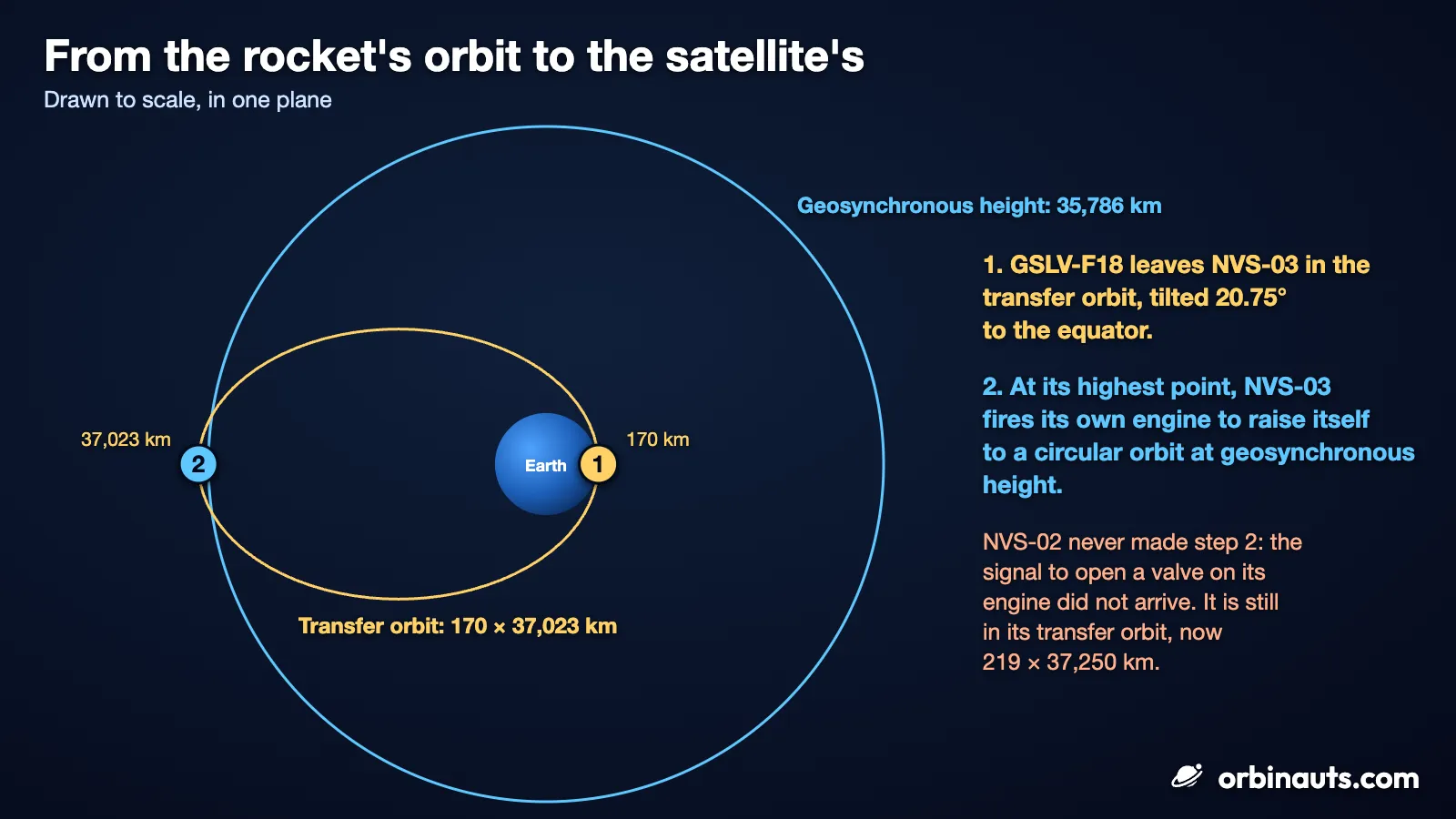
GSLV-F15 put NVS-02 in its transfer orbit on 29 January 2025, and its solar panels opened, but the operations to raise its orbit could not be carried out. ISRO’s Apex Committee found that the command to open a valve on the engine meant for raising the orbit (a pyro valve, which lets oxidiser in) had never reached it, most likely because at least one contact of a connector had come apart in both the main and the backup path. ISRO says its recommendations were applied to the CMS-03 satellite, launched on 2 November 2025, which reached its intended orbit, and will be followed on all future missions where they apply.
NVS-02 was meant to take the place of IRNSS-1E at 111.75° east. It is still close to where the rocket left it, 170 km up at its lowest and 37,785 km at its highest, tilted 20.8°: our latest tracking, from 25 October, puts it between 219 and 37,250 km up. ISRO’s annual report, published in April, says NVS-02 can still provide a limited service even so, and that its Indian-made atomic clock is performing better than specified.
What NVS-03 carries
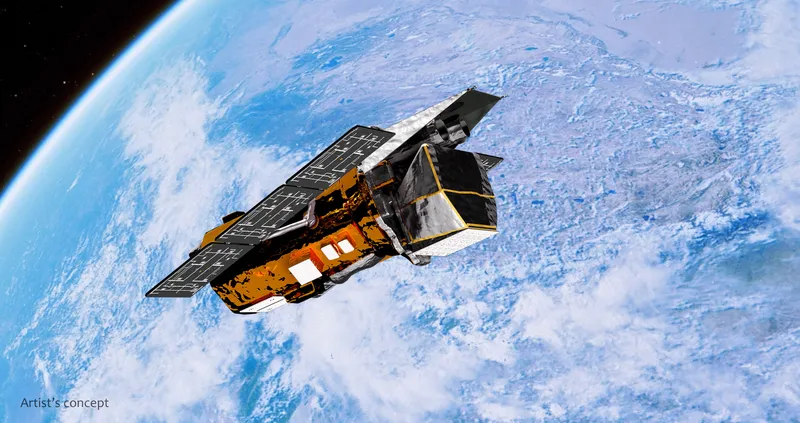
NVS-03 is the third of the second-generation NavIC satellites, a series of five meant to keep the service going. It carries an atomic clock made in India alongside procured ones; ISRO counts NVS-01 as the first satellite to fly an Indian-made atomic clock. Like NVS-01, it also broadcasts a third signal, L1, which ISRO says widens the service, alongside NavIC’s L5 and S. ISRO has not announced at which longitude NVS-03 will sit, nor when it would join the service. The government told Parliament that NVS-04 and NVS-05 are at an advanced stage of being built.
Watching it
ISRO’s live broadcast starts at 23:20 India time, 17:50 UTC. Until liftoff, NVS-03 is on our next launches, with its countdown. We will report on the launch once the rocket has flown.