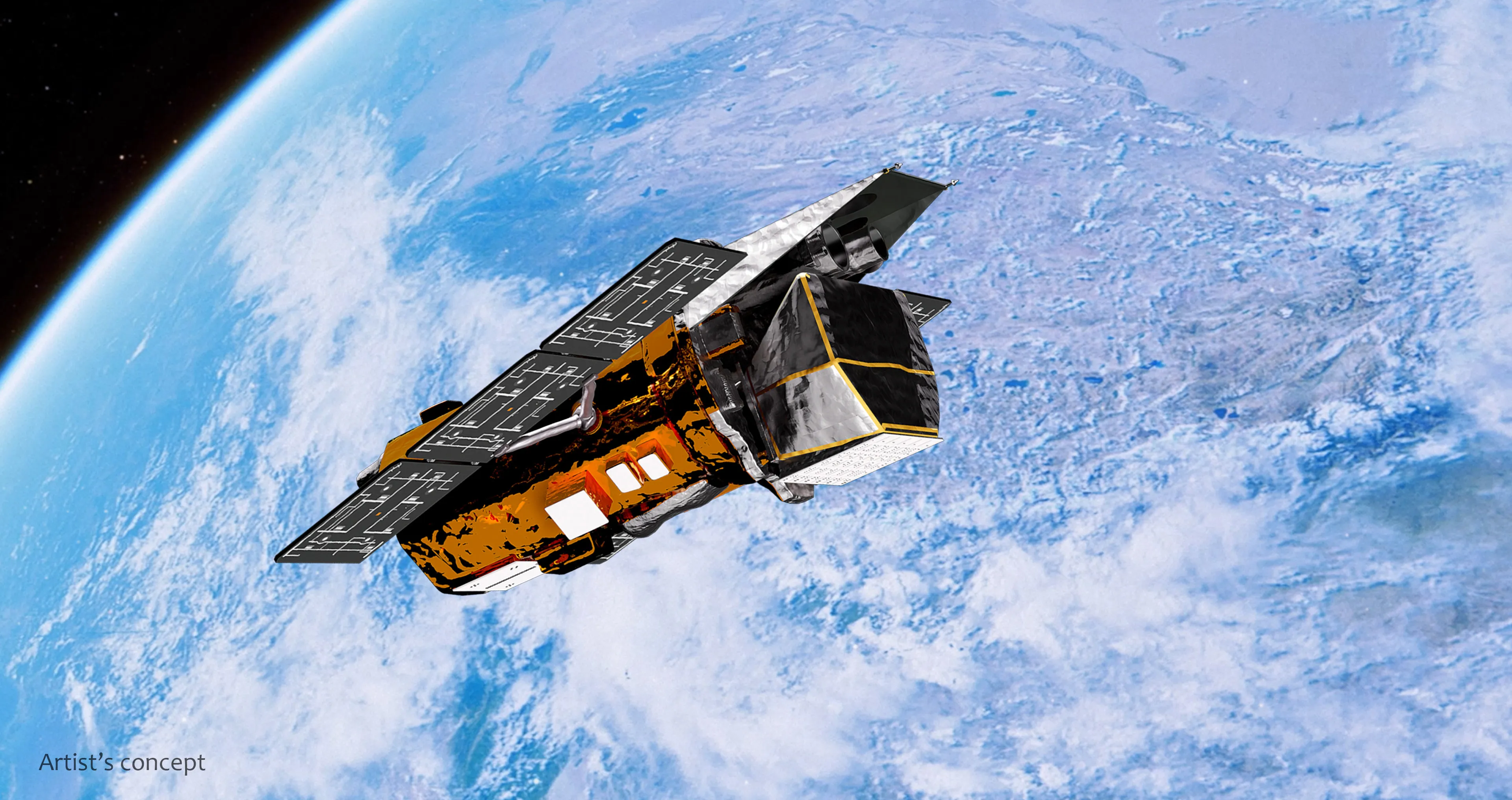
NASA’s Neil Gehrels Swift Observatory has made its last observation and is coming down. On 20 October, at 275 km, the spacecraft could no longer cope with the growing drag of the upper atmosphere and went into safe mode, and the team at Penn State that flies it sent the command that effectively ended its operations, to prepare it for re-entry. NASA announced the end of the mission on 23 October and expects Swift to re-enter the atmosphere in the next few weeks.
In this Article
- Swift
Satellite
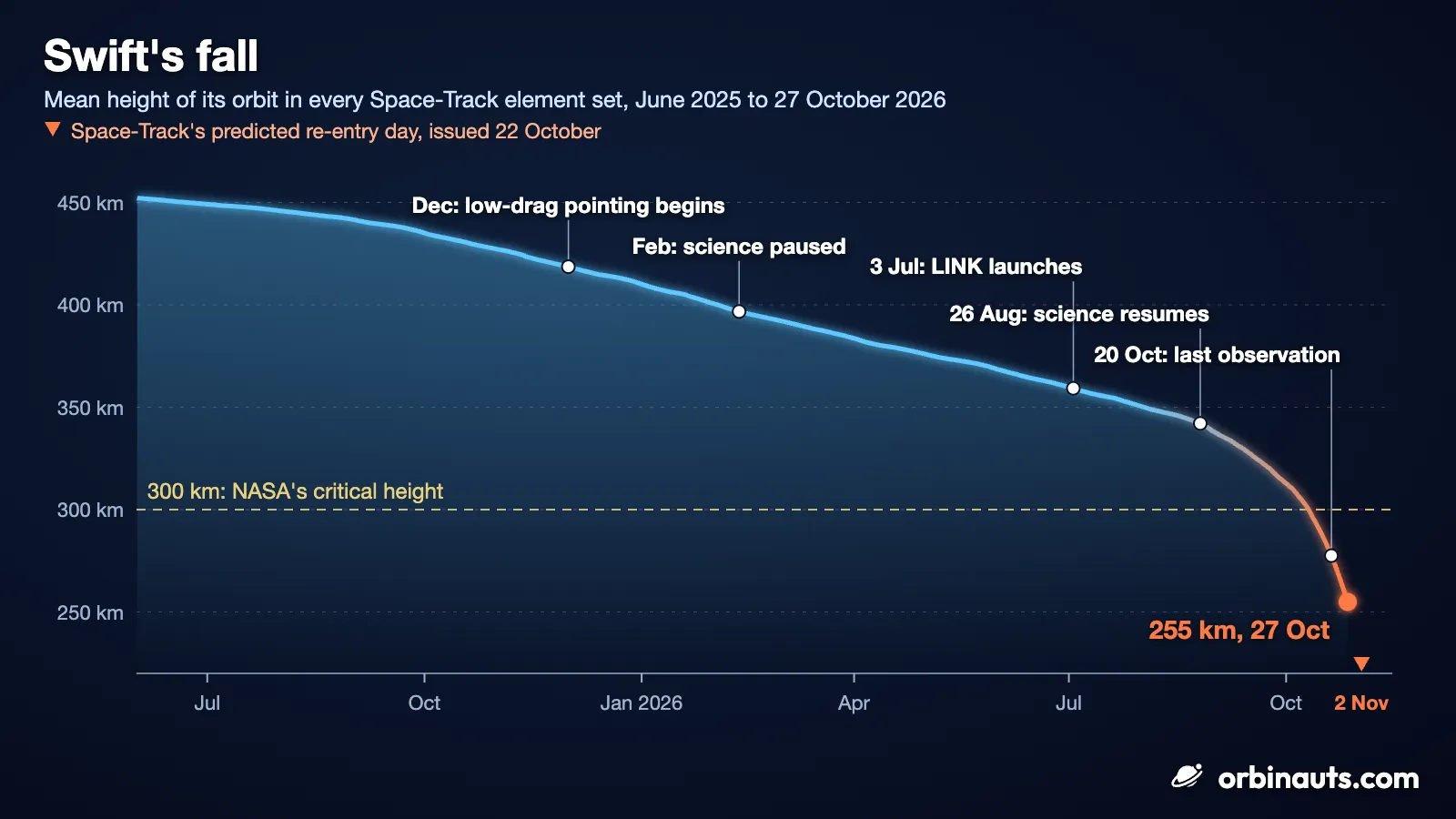
The fall is speeding up, as NASA had warned it would: below 300 km, the rate of descent quickly increases. The latest Elements we hold, dated 26 October at 11:48 UTC, put Swift between 255 and 260 km. A newer set on Space-Track, from early on 27 October, gives the mean height of its orbit as about 255 km, nearly 23 km lower than a week earlier: more than 3 km a day. In a week of August, before it returned to science, it lost under 3 km: it is now falling about eight times as fast. Space-Track’s long-range decay prediction, issued on 22 October, dates the re-entry to 2 November.
Why Swift is falling
Every satellite in low Earth orbit is slowed by the thin air at that height, and Swift has no engine to climb back. The Sun’s last maximum made matters worse: activity stronger than expected in 2024 swelled the atmosphere, and by early 2025 almost all of NASA’s models had Swift re-entering by the summer of 2026. Swift flew at about 452 km in June 2025, in Space-Track’s Elements.
To buy time for a rescue, the team at Penn State changed how Swift was flown. From December 2025 it swapped around a quarter of the planned targets for points on the sky that would minimise drag, and by February it had switched over to this way of pointing entirely, with no pointed science from mid-February to late August. The Burst Alert Telescope was stopped in April to save power, so the solar panels could be turned to cut drag further. It worked: the team kept Swift above its critical height, around 300 km, for several months.
The rescue that never got to try
In September 2025 NASA hired Katalyst Space to build, within a year, a satellite that would meet Swift, grab it and lift it. LINK, a $30 million mission, lifted off on 3 July on a Pegasus XL, but a power fault during commissioning took out two of its three reaction wheels, and steering with its thrusters instead burned the propellant it needed. On 19 August NASA and Katalyst announced that LINK would not capture or boost Swift. It came to within 12 to 15 km of Swift, tested its arms, and re-entered in September.
Two last months of science
With no rescue coming, the team switched Swift’s X-ray and Ultraviolet/Optical telescopes back on 26 August. The Burst Alert Telescope was detecting gamma rays again on 18 September, and from 21 September Swift was once more allowed to swing round on its own to look at new bursts. In those weeks it observed hundreds of targets, from the remains of exploded stars to active supermassive black holes in distant galaxies and comets in our own solar system.
The price was height. Pointing where the science was, rather than where drag was least, increased the drag, and Swift began to sink rapidly again. On 25 September NASA put it at around 325 km, and expected it to reach 300 km in early to mid-October. It did: its mean height dropped below 300 km on 10 October, in Space-Track’s Elements.
What Swift leaves behind
Swift launched on 20 November 2004 to catch gamma-ray bursts, the most powerful explosions in the cosmos, which flare and fade too fast for big telescopes to be aimed at them in time. It would spot a burst, pass its position to other observatories and turn its own telescopes to it, typically in about a minute. Designed for a two-year mission, it worked for more than ten times as long. NASA counts more than 2,000 gamma-ray bursts and more than 1,400 supernovae observed, stars shredded by black holes, an all-sky X-ray survey, asteroids and comets, and data in about 7,000 published papers.
In May 2005 it caught GRB 050509B, a burst that lasted 0.03 seconds, quickly enough to detect 11 X-ray photons from its afterglow. NASA counts it the first short burst with a detected afterglow, and the evidence that short bursts likely come from two neutron stars merging. The mission was renamed in 2018 after the death of Neil Gehrels, its first principal investigator. Its public archive, some 12 terabytes, holds nearly 22 years of observations. NASA says it will keep looking for new ways to react quickly to events in the sky, using its current missions to help fill the gap in the meantime.
Its hope of more years had rested on LINK, the robot sent to lift it, which came down before it.
 Read nextThe satellite that failed to save NASA's Swift has re-entered over the Pacific
When and where it will come down
Space-Track has issued a long-range prediction for Swift every week since mid-September, each giving a day: 31 October in the prediction of 16 September, then 3, 6 and 11 November in those of 23 and 30 September and 7 October, and 2 November in those of 14 and 22 October. NASA’s own forecasters say their predictions of Swift’s height change with space weather and with the spacecraft’s height and orientation, and Space-Track’s have moved too. Swift can come down only between 20.5° north and 20.5° south, the tilt of its orbit to the equator, but where along that band cannot be told until the end. NASA has not said whether any part of it is expected to reach the ground.
Swift can be followed on the live map. We will report its re-entry when it comes.