Two spacewalks are left in the International Space Station’s solar array upgrade, whose first new arrays went up in June 2021. NASA astronaut Anil Menon and the Canadian Space Agency’s Joshua Kutryk are to leave the station’s Quest airlock on Thursday 29 October and on Thursday 5 November to install and deploy the last two International Space Station Roll-Out Solar Arrays, iROSAs. The first is scheduled to start at 8 a.m. EDT, 12:00 UTC, the second at 8:10 a.m. EST, 13:10 UTC.
In this Article
- International Space Station
Space station
Two spacewalks, two arrays
On US spacewalk 100, the pair are to fit the seventh iROSA on the station’s 2A electrical power channel, on the port side of its truss. It will be Menon’s fourth spacewalk and Kutryk’s first, and NASA expects it to last 6 hours 45 minutes. On spacewalk 101 they are to fit the eighth and final one on the 3B channel, on the starboard side, which completes the upgrade. NASA counts them the 285th and 286th spacewalks in support of the station’s assembly, maintenance and upgrades.
| Spacewalk 100 | Spacewalk 101 | |
|---|---|---|
| Date | Thursday 29 October | Thursday 5 November |
| Start | 12:00 UTC | 13:10 UTC |
| NASA+ coverage from | 10:30 UTC | 11:45 UTC |
| Array | Seventh | Eighth and last |
| Power channel | 2A, port side | 3B, starboard side |
Times from NASA’s schedule as it stood on 21 October; NASA says it will share more details closer to each spacewalk.
Where the arrays are now
The two arrays arrived on SpaceX’s CRS-35 cargo Dragon, which docked at 10:27 a.m. EDT, 14:27 UTC, on 15 October to the space-facing port of the Harmony module. They ride in the Dragon’s unpressurised trunk: engineers on the ground are to command the Canadarm2 robotic arm to lift them out and stow them for the time being on logistics platforms on the station’s truss, from where Menon and Kutryk will finish the installation. NASA’s posts up to 23 October do not say whether the arm has done so.
The crew spent the past week getting ready. On Monday 19 October Menon cleaned the cooling loops of two spacesuits while Kutryk filled their water tanks. On 21 October the two organised tools, inspected tethers and fitted the suits with communications gear and medical monitors. With NASA’s Jessica Watkins and Luke Delaney, who will help them in and out of their suits, they studied how to move outside the station, retrieve the arrays and install them. On 22 October Kutryk tried on his spacesuit in Quest to check its fit, and Delaney trained to command Canadarm2, which he will use to assist the spacewalkers. On 23 October all four went through the spacewalk procedures with engineers on the ground, and Watkins and Delaney trained on the arm.
The power channels were readied this year
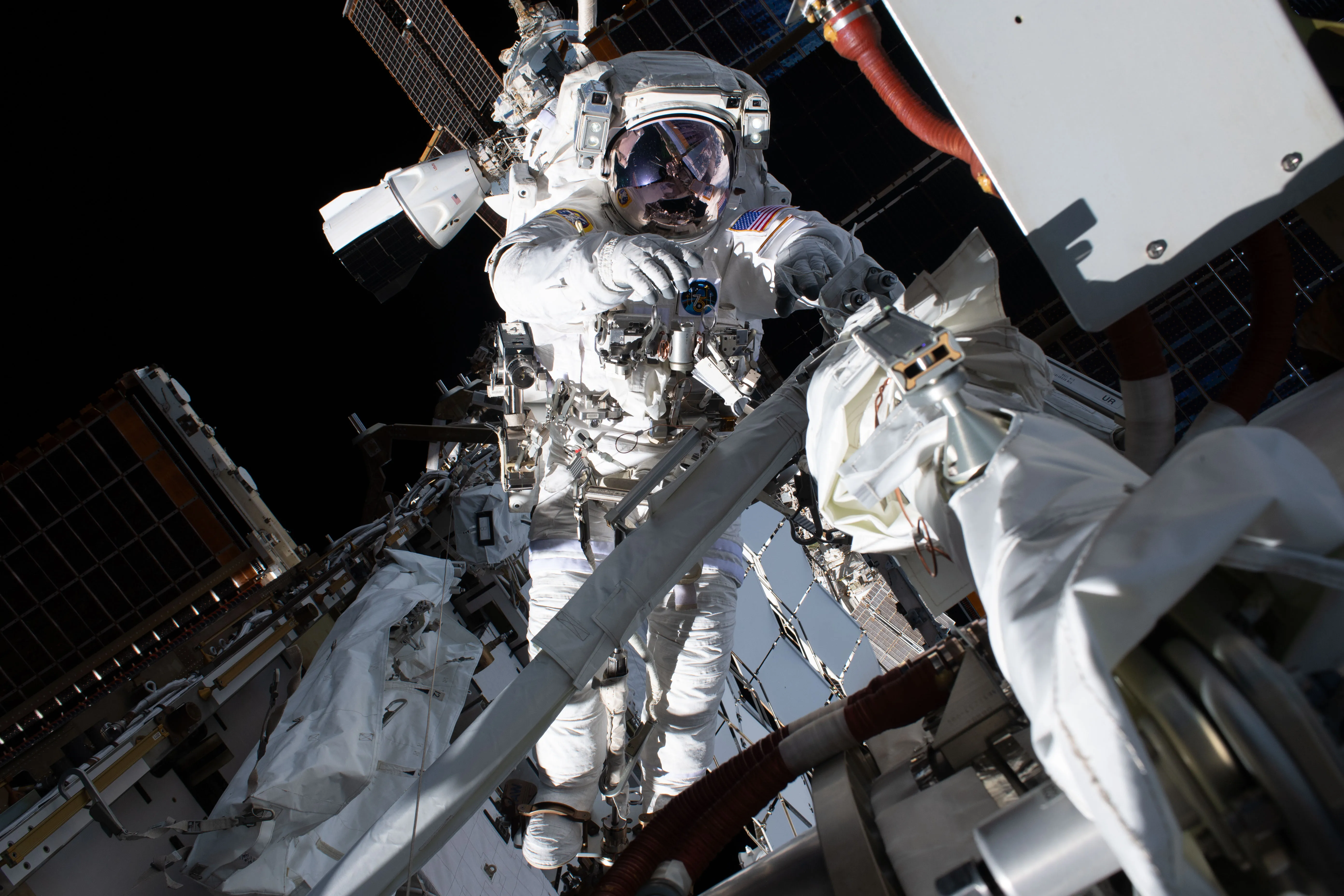
On 18 March, NASA’s Jessica Meir and Chris Williams prepared the 2A channel in a spacewalk of about seven hours. On 6 August, Meir and Menon prepared the 3B channel in 6 hours 27 minutes, Menon’s first spacewalk, building a modification kit on the Starboard 6 truss segment, where the last array will go. The picture at the head of this Article is of Menon on that spacewalk.
What the arrays add
An iROSA rolls out in front of one of the station’s original arrays and is about half its size, so the uncovered part of the old array keeps producing power. Six are already in place. With all eight, NASA says, the arrays raise the station’s available power by up to 30%, from 160 kW of generating capacity to about 215 kW. The seventh, NASA says, will provide additional power to support critical operations, including the station’s safe and controlled deorbit at the end of its life. At the preview news conference on 20 October, Gaurang Patel, who manages operations integration for NASA’s Low Earth Orbit Program, said the arrays “increase our power generation capability up to 30 percent”. NASA’s figures do not quite agree with each other: going from 160 to 215 kW is a rise of about a third, and its earlier account of the arrays put the station at more than 250 kW once six were in place.
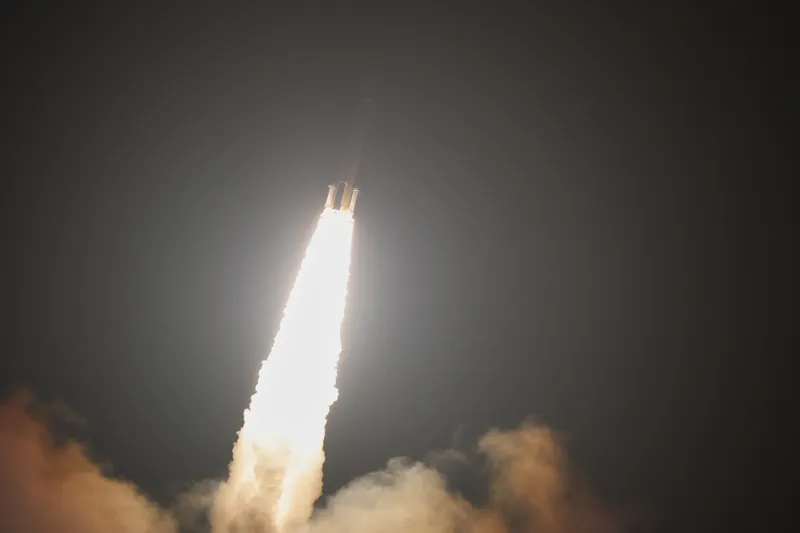
The two arrays left Florida on 13 October, on the launch we previewed the day before.
 Read nextSpaceX's CRS-35 is set to lift off on Tuesday with the final pair of new solar arrays, which complete the ISS's power upgrade
The station they will work on
When the Dragon arrived, NASA counted five spacecraft docked at the station: the CRS-35 and Crew-13 Dragons, the Soyuz MS-29 and the Progress 95 and 96 cargo ships. The CRS-35 Dragon is to stay until mid-November, after both spacewalks, and splash down off California.
The ISS itself orbits between 415 and 425 km above the Earth on 25 October, according to Orbinauts. Our tracking has seen no firing of its engines since it raised its orbit by about 2 km between 25 and 26 September, and by a further 109 m later on the 26th.