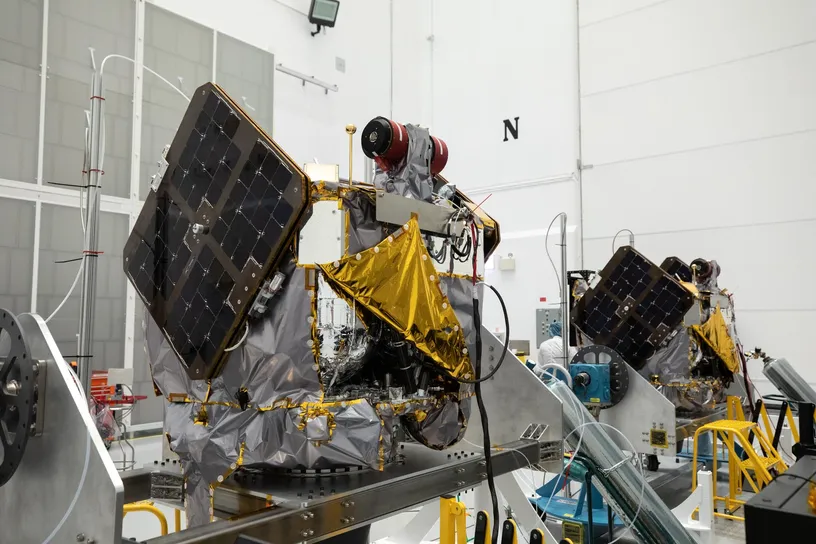
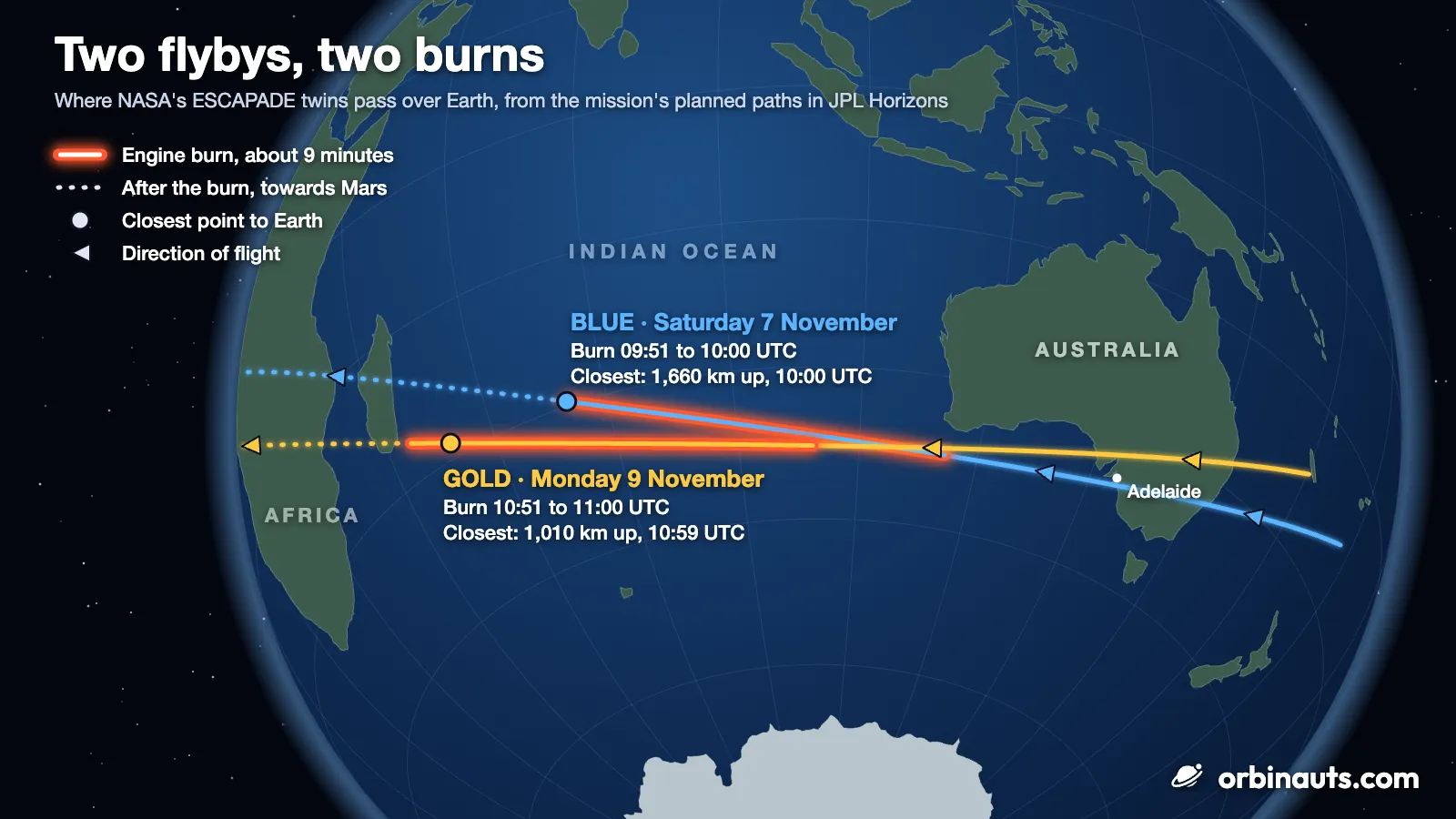
NASA’s ESCAPADE Gold, one of two identical probes built to study how the solar wind strips away the air of Mars, swings past Earth on Monday 9 November to leave for Mars. It begins an engine burn of about 9 minutes at 5:51 a.m. EST, 10:51 UTC, as it sweeps past the planet: Earth’s gravity speeds it up and turns it towards Mars, and the burn at the bottom of the swing adds more, taking it from about 10.1 to about 10.8 km/s, NASA says. The twins are due at Mars on 7 and 9 September 2027.
It is the twin that stumbled last winter. In December 2025 one twin’s course correction ran short of thrust while the other’s went as planned, and the one that fell short completed its correction on 6 January. NASA did not say which twin that was; Rocket Lab, which built them, logs Gold’s correction on that day, a 97.7-second burn, in its mission log. NASA has not said what caused the low thrust. On Monday, Gold’s engine has to fire for about nine minutes, more than five times as long.
Its twin, Blue, went first: its burn was due to begin at 09:51 UTC on Saturday 7 November, and NASA has not yet said how it went.
On the mission’s planned path, Gold is closest to Earth at about 10:59 UTC on Monday, some 1,010 km up over the southern Indian Ocean. That is higher than about four in five satellites, the space station and every Starlink among them, but far below the geostationary ones, some 36,000 km up.
NASA said on 2 November that a “powered” flyby of Earth, gravity and an engine burn together, was a manoeuvre none of its spacecraft had flown before, and that no spacecraft bound for Mars had done one successfully. One has tried. Japan’s Nozomi made a powered swing-by of Earth at about 1,000 km on 20 December 1998, on its way to Mars, but a defective thrust valve left it short of thrust, much as Gold was last December. The change of course used so much fuel that Nozomi needed two more swing-bys of Earth, in December 2002 and June 2003, and reached Mars four years late. By then a solar flare had damaged its power system and cut off its telemetry, and the systems it needed to brake into orbit around Mars could not be brought back. So Nozomi never stopped at Mars. On 9 December 2003 the team gave up on putting it into orbit and steered it away so it would not crash into the planet; it flew past and has circled the Sun ever since.
Why the long way round
Spacecraft usually leave for Mars when Earth and Mars line up, which happens every 26 months and makes for the shortest trip on the least fuel. ESCAPADE lifted off on 13 November 2025 on Blue Origin’s New Glenn, from Cape Canaveral, when the two planets were on opposite sides of the Sun. So instead of heading straight for Mars, the pair flew a kidney-bean-shaped loop around Lagrange point 2, a spot beyond Earth on the side away from the Sun, about 1.6 million km out, and then turned back to Earth to arrive just as the planets came into line again. The loop took them as far as about 2.5 million km from Earth in April, and back within about 550,000 km at the end of June, before a second, smaller swing brought them home for the flybys.
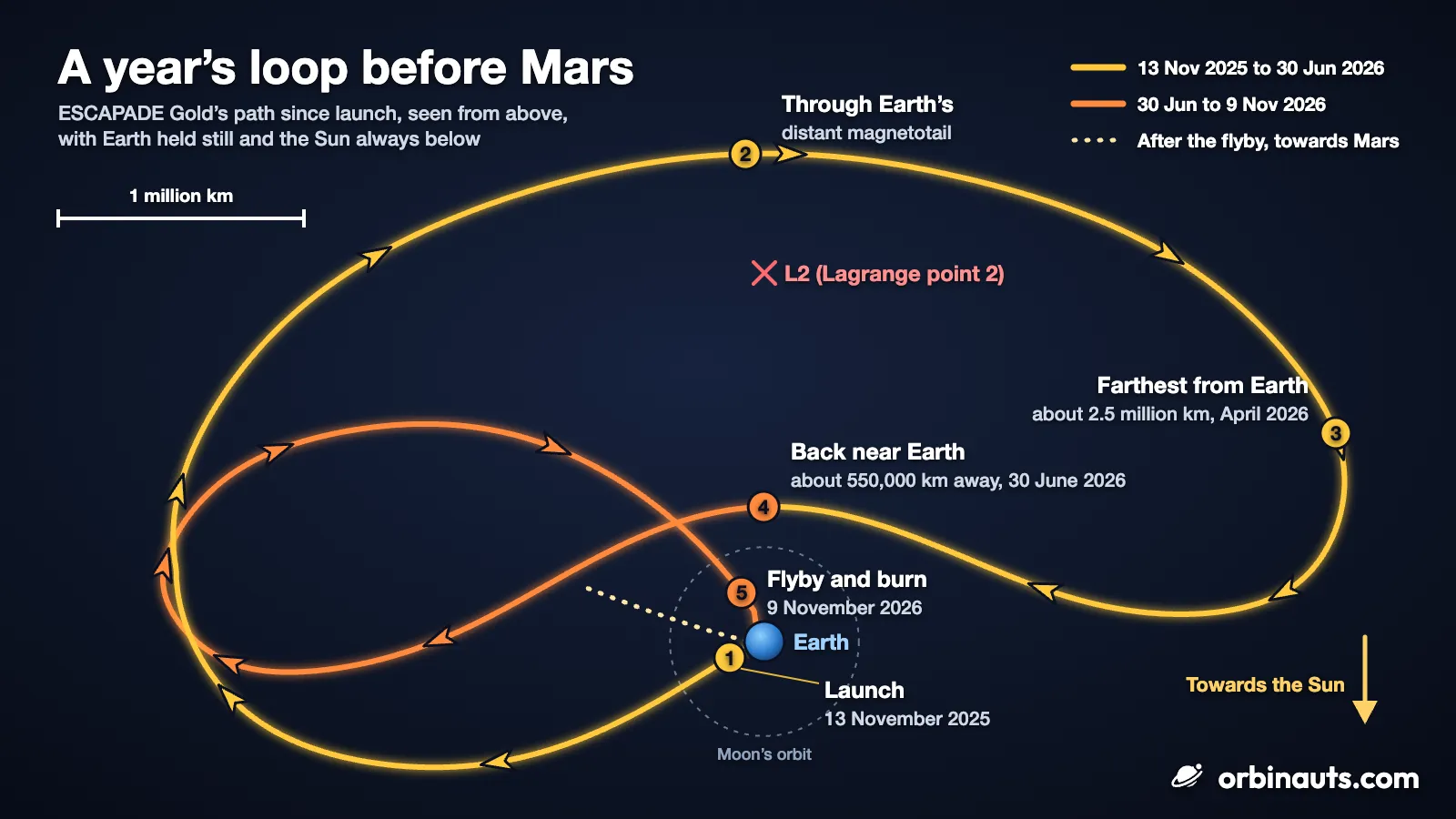
The loop was not idle. Along it the twins flew through a distant stretch of Earth’s magnetotail, the part of the planet’s magnetic field the solar wind draws out behind it, and the team plans to share what it found soon.
What comes next
It will take several days after each burn for the team to know how well the spacecraft are aimed, and several course corrections during the ten-month cruise will fine-tune the paths. We will report each flyby once NASA confirms it. At Mars, each spacecraft fires its engine for about 11 minutes to slow into a large capture orbit lasting about 60 hours, then shrinks it step by step. The science is to begin in 2028: first six months with the two following each other along the same orbit, like a string of pearls, then five months in different orbits, one out in the solar wind while the other is inside Mars’s magnetic environment, to watch how the planet responds to the Sun as it happens.
ESCAPADE will not be alone on the road. Japan’s MMX lifted off for Mars on 20 October, Japan time, and is already on its way.
 Read nextJapan's MMX spreads its solar wings and sets course for Mars
Who is behind ESCAPADE
ESCAPADE is led by the University of California, Berkeley’s Space Sciences Laboratory; Rocket Lab designed the spacecraft, and the mission belongs to NASA’s SIMPLEx programme of small planetary missions, funded by the agency’s Heliophysics Division.