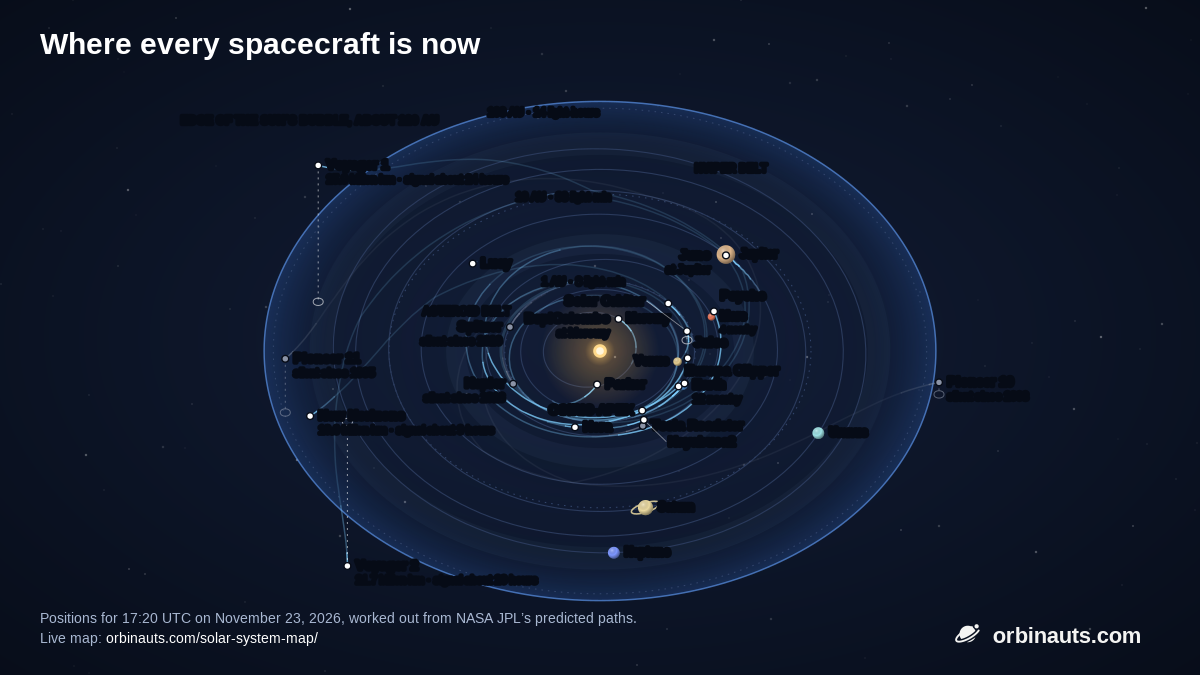
Live solar system map: where every spacecraft is now positions of this minute
38 spacecraft are on the map as of : 33 at work beyond Earth orbit and 5 silent. The nearest to the Sun is Parker Solar Probe, 53 million km from it; the farthest from Earth is Voyager 1, 25.9 billion km away, where a radio signal takes about 24 hours to arrive.
From Earth right now
4,562,661 km
A radio signal takes 15 s each way
- From the Sun
- 149,966,561 km
- Speed round the Sun
- 32.7 km/s
Seen from above and to one side, at true distances. A stalk shows how far a spacecraft is above or below the planets.
- journey since launch
- latest part of the journey
- working
- silent
- Earth
Positions for , worked out from NASA JPL’s predicted paths. How this is worked out
- From the Sun
- Speed round the Sun
Next
Above Mercury right now
Farthest point of this lap
Next close pass
One lap takes
How far from Earth, in signal time
Pick a spacecraft here or on the map.
How long a radio signal from Earth takes to reach each spacecraft, at the speed of light. The line is logarithmic: from 1 second to 10 s is as long as from 1 minute to 10 min.
What happens next
Every spacecraft, nearest first
| Spacecraft | Where it is | From Earth | A signal takes | From the Sun | Speed round the Sun |
|---|---|---|---|---|---|
| At Earth: 12 spacecraft | Around the Moon and at the L1 and L2 points | 0.4 to 1.7 million km | 1 s to 6 s | 146 to 149 million km | |
| Chandrayaan-2 | In orbit around the Moon | 0.4 million km | 1 s | 148 million km | 32.3 km/s |
| Danuri | In orbit around the Moon | 0.4 million km | 1 s | 148 million km | 30.3 km/s |
| Lunar Reconnaissance Orbiter | In orbit around the Moon | 0.4 million km | 1 s | 148 million km | 32.4 km/s |
| SOHO | At the L1 point, between Earth and the Sun | 1.2 million km | 4 s | 146 million km | 29.6 km/s |
| Nancy Grace Roman Space Telescope | Nearing the L2 point, 1.5 million km from Earth | 1.2 million km | 4 s | 149 million km | 30.7 km/s |
| Aditya-L1 | At the L1 point, between Earth and the Sun | 1.3 million km | 4 s | 146 million km | 29.7 km/s |
| DSCOVR | At the L1 point, between Earth and the Sun | 1.4 million km | 5 s | 146 million km | 29.8 km/s |
| IMAP | At the L1 point, between Earth and the Sun | 1.5 million km | 5 s | 146 million km | 29.8 km/s |
| ACE | At the L1 point, between Earth and the Sun | 1.5 million km | 5 s | 146 million km | 29.9 km/s |
| Euclid | At the L2 point, 1.5 million km from Earth | 1.6 million km | 5 s | 149 million km | 30.4 km/s |
| Wind | At the L1 point, between Earth and the Sun | 1.6 million km | 5 s | 146 million km | 30.1 km/s |
| James Webb Space Telescope | At the L2 point, 1.5 million km from Earth | 1.7 million km | 6 s | 149 million km | 30.2 km/s |
| ESCAPADE Gold | On its way to Mars | 4.1 million km | 14 s | 150 million km | 32.8 km/s |
| ESCAPADE Blue | On its way to Mars | 4.6 million km | 15 s | 150 million km | 32.7 km/s |
| Europa Clipper | On its way to Jupiter and its moon Europa | 10 million km | 34 s | 139 million km | 36.9 km/s |
| Juice | On its way to Jupiter | 57 million km | 3 min 11 s | 130 million km | 38.7 km/s |
| OSIRIS-APEX | On its way to the asteroid Apophis | 82 million km | 4 min 34 s | 136 million km | 33.4 km/s |
| Hayabusa2 | On its way to the asteroid 1998 KY26 | 91 million km | 5 min 5 s | 158 million km | 26.6 km/s |
| Solar Orbiter | Orbiting the Sun, climbing above its equator | 95 million km | 5 min 18 s | 133 million km | 22.7 km/s |
| Tesla RoadsterSilent | A car sent up as a test load, orbiting the Sun | 128 million km | 7 min 7 s | 205 million km | 25.0 km/s |
| Parker Solar Probe | Orbiting the Sun, passing 6.1 million km from its surface | 134 million km | 7 min 27 s | 53 million km | 52.4 km/s |
| BepiColombo | At Mercury | 160 million km | 8 min 53 s | 53 million km | 51.7 km/s |
| STEREO-A | Orbiting the Sun ahead of Earth | 172 million km | 9 min 34 s | 145 million km | 30.2 km/s |
| At Mars: 4 spacecraft | In orbit around Mars | 186 million km | 10 min 19 s | 242 million km | |
| Mars Odyssey | In orbit around Mars | 186 million km | 10 min 19 s | 242 million km | 19.5 km/s |
| Mars Reconnaissance Orbiter | In orbit around Mars | 186 million km | 10 min 19 s | 242 million km | 25.1 km/s |
| Mars Express | In orbit around Mars | 186 million km | 10 min 19 s | 242 million km | 22.4 km/s |
| ExoMars Trace Gas Orbiter | In orbit around Mars | 186 million km | 10 min 19 s | 242 million km | 23.2 km/s |
| Hera | At the asteroids Didymos and Dimorphos | 193 million km | 10 min 43 s | 166 million km | 32.5 km/s |
| Psyche | On its way to the asteroid Psyche | 234 million km | 13 min 1 s | 284 million km | 22.7 km/s |
| KeplerSilent since 2018 | Retired, orbiting the Sun | 268 million km | 14 min 55 s | 156 million km | 28.7 km/s |
| SpitzerSilent since 2020 | Retired, trailing Earth around the Sun | 299 million km | 16 min 37 s | 152 million km | 29.5 km/s |
| Juno | In orbit around Jupiter | 769 million km | 42 min 44 s | 795 million km | 13.0 km/s |
| Lucy | Among Jupiter's Trojan asteroids | 926 million km | 51 min 28 s | 783 million km | 8.6 km/s |
| New Horizons | Crossing the Kuiper Belt, beyond Pluto | 10.0 billion km | 9 h 15 min | 9.9 billion km | 13.6 km/s |
| Pioneer 11Silent since 1995 | Leaving the Solar System | 17.8 billion km | 16 h 29 min | 17.7 billion km | 11.1 km/s |
| Pioneer 10Silent since 2003 | Leaving the Solar System | 21.1 billion km | 19 h 35 min | 21.3 billion km | 11.8 km/s |
| Voyager 2 | In interstellar space, beyond the Sun's bubble | 21.7 billion km | 20 h 6 min | 21.6 billion km | 15.3 km/s |
| Voyager 1 | In interstellar space, beyond the Sun's bubble | 25.9 billion km | 24 h 0 min | 25.8 billion km | 16.9 km/s |
Figures for 17:27 UTC on November 23, 2026, worked out from NASA JPL’s predicted paths. The table as a CSV file
Questions people ask
How many spacecraft are beyond Earth orbit?
This map follows 38 spacecraft as of 17:27 UTC on November 23, 2026: 33 at work and 5 silent. They are the spacecraft beyond Earth orbit whose paths NASA JPL’s Horizons system holds; a spacecraft for which JPL holds no path is not on it. NASA JPL
Which spacecraft is the farthest from Earth?
Voyager 1, 25.9 billion km from Earth at 17:27 UTC on November 23, 2026. A radio signal from Earth takes about 24 hours to reach it. NASA JPL
Where are Voyager 1 and Voyager 2 now?
Both are in interstellar space, beyond the edge of the Sun’s bubble: Voyager 1 since August 2012 and Voyager 2 since 2018. At 17:27 UTC on November 23, 2026, Voyager 1 is 25.9 billion km from Earth and Voyager 2 is 21.7 billion km. NASA JPL NASA
Where is New Horizons now?
Speeding outward across the Kuiper Belt, 10.0 billion km from Earth at 17:27 UTC on November 23, 2026. A radio signal from Earth takes about 9 hours to reach it. Johns Hopkins APL NASA NASA JPL
Where is the James Webb Space Telescope now?
It orbits the Sun at the second Lagrange point, L2, 1.7 million km from Earth at 17:27 UTC on November 23, 2026. NASA NASA JPL
Which spacecraft is the closest to the Sun?
Parker Solar Probe, 53 million km from the Sun at 17:27 UTC on November 23, 2026. NASA JPL
Which spacecraft is the fastest right now?
Parker Solar Probe, moving at 52.4 km/s (about 189,000 km/h) relative to the Sun at 17:27 UTC on November 23, 2026. NASA JPL
Where do the positions come from?
From the paths NASA JPL’s Horizons system predicts for each spacecraft and for the planets. Orbinauts reads each path once a day and works out from it where each spacecraft is at the minute the page is sent, so every position is a prediction, not a measurement. NASA JPL
How this is worked out
Every place on the map comes from the path NASA JPL’s Horizons system predicts for each spacecraft and for the eight planets. Orbinauts reads each spacecraft’s path once a day and works out where it is for the minute the page is sent. The paths shown now were read between and .
These are predicted paths, so every figure is a prediction, not a measurement. Where JPL’s path for a spacecraft ends before the minute shown, the map draws it hollow at the last place the path gives, with the day the path ends, and leaves it out of the nearest and the farthest. Nothing is drawn past the end of a path.
Seen whole, as the map opens, the solar system is squeezed so that Mercury and Voyager 1 fit one picture: each ring is ten times farther from the Sun than the one inside it. Directions stay true, and so does the share of each distance that lies above or below the planets. Framed on the inner planets, the outer planets or interstellar space, the map shows true distances. The note on the map always says which you are looking at.
The map looks at the solar system from above and to one side. A spacecraft above or below the plane the planets orbit in stands on a stalk down to that plane: the longer the stalk, the farther above or below it is. The asteroid belt, the Kuiper Belt and the edge of the Sun’s bubble are drawn roughly where they lie, for scale.
The signal time is how long a radio signal from Earth, at the speed of light, takes to reach a spacecraft at the minute shown. A spacecraft is working or silent as its agency last said; the silent ones are grey.
Cite or embed this
Copy any form. The figures and their time are those of the minute this page was sent, so they stay true in a saved copy.
- In a sentence
- The solar system map showed 38 spacecraft beyond Earth orbit at 17:27 UTC on November 23, 2026; the farthest from Earth was Voyager 1, 25.9 billion km away, according to Orbinauts.com, from NASA JPL’s predicted paths.
- As a footnote
- Orbinauts.com, Solar system map, orbinauts.com/solar-system-map, from NASA JPL Horizons, retrieved November 23, 2026.
- Under a chart or a table
- Source: Orbinauts.com, from NASA JPL Horizons
Free to reuse with the credit (CC BY 4.0).
Data: every spacecraft as CSV, the map as SVG, the live positions as JSON. API reference.