Where is Voyager 1 now?
updates every secondVoyager 1 is 25.906 billion km from Earth (16.098 billion miles, 173 times the distance from Earth to the Sun), in interstellar space, in the direction of the constellation Ophiuchus, as of . It is just over one light-day away: a radio signal needs a little more than 24 hours each way.
A live tracker of Voyager 1’s location, worked out for this second from NASA JPL’s predicted path for the spacecraft. How this is worked out
- Distance from Earth 25,906,487,543 km 16,097,545,000 miles · 173.174 AU Growing 25 km every second. Computed, not measured: the last digits show the motion.
- A signal sent now 24 h 0 min 20 s to reach Voyager 1, at the speed of light The reply is back after 48 h 0 min 43 s
- Distance from the Sun 172.409 AU 25.792 billion km · 16.026 billion miles Outside the Sun’s bubble since August 25, 2012
- Speed, relative to the Sun 16.92 km/s 60,900 km/h · 37,840 mph In flight 49 years, 2 months, 15 days
If you sent it a command now
- Sent
- Reaches Voyager 1
- Its answer reaches Earth
Voyager 1: key figures
| Distance from Earth | 25.906 billion km · 16.098 billion miles · 173.174 AU |
|---|---|
| A signal sent now arrives in | 24 h 0 min 20 s |
| A signal arriving now left | 24 h 0 min 10 s ago |
| A command and its reply | 48 h 0 min 43 s |
| Distance from the Sun | 172.409 AU · 25.792 billion km · 16.026 billion miles |
| Speed, relative to the Sun | 16.92 km/s · 60,900 km/h · 37,840 mph |
| Direction from Earth | Ophiuchus · RA 17 h 15 min · Dec +12° 03′ |
| Beyond one light-day by | 4,419,171 km |
| As of | · JPL Horizons |
On this page: Where it is · How far that is · One light-day · How fast it is · Since 1977 · Is it still working? · Questions people ask · Cite or embed this
Voyager 1’s location: a map
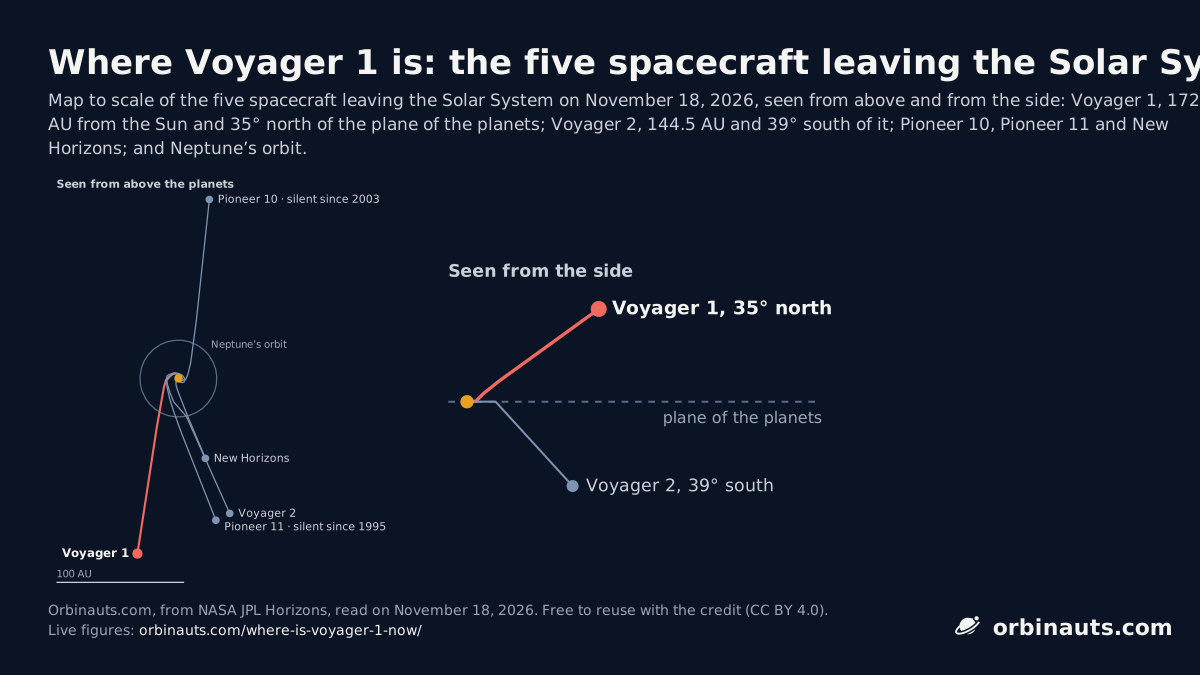
Voyager 1 left the plane the planets move in at Saturn in 1980 and has climbed north of it ever since. It is now 35° above that plane. It is on the far side of the Sun from where Pioneer 10 went. The map is to scale; Neptune’s orbit is the small circle.
From Earth it lies in Ophiuchus, at right ascension 17 h 15 min, declination +12° 03′ (sky coordinates).
NASA’s Deep Space Network listens for it from California, Spain and Australia; only its 70-metre dish near Canberra has the power to send commands to the Voyagers, NASA says.
What the map shows
- Neptune, the outermost planet: 30 AU from the Sun.
- Voyager 1: 172.4 AU from the Sun, 35° north of the plane of the planets.
- Voyager 2: 144.5 AU from the Sun, 39° south of the plane of the planets. Seen from above, its direction is 34° from Voyager 1’s.
- Pioneer 10: 142.3 AU from the Sun, 3° north of the plane of the planets. Seen from above, its direction is 177° from Voyager 1’s. Silent since 2003.
- Pioneer 11: 118.3 AU from the Sun, 14° north of the plane of the planets. Seen from above, its direction is 28° from Voyager 1’s. Silent since 1995.
- New Horizons: 66.1 AU from the Sun, 2° north of the plane of the planets. Seen from above, its direction is 32° from Voyager 1’s.
The map is also an image file: map of Voyager 1 and the four other spacecraft leaving the Solar System (SVG).
How far is Voyager 1 from Earth?
About 173 times as far as the Sun. Light from the Moon reaches us in 1.3 seconds and from the Sun in 8 minutes 19 seconds; from Voyager 1 it takes just over a day. It is the most distant object people have made. The ruler is to scale and shows distance only.
Distance from Earth only: the five are flying in different directions. Neptune is 30 AU from the Sun, Voyager 1 left the Sun’s bubble at 122 AU, and one light-day is 173.1 AU.
| Spacecraft | From Earth | Light time | From the Sun | Launched | State |
|---|---|---|---|---|---|
| Voyager 1 | 173.2 AU | 24 h 0 min | 172.4 AU | Sep 5, 1977 | Working, 2 instruments |
| Voyager 2 | 145.0 AU | 20 h 6 min | 144.5 AU | Aug 20, 1977 | Working, 3 instruments |
| Pioneer 10 | 141.4 AU | 19 h 36 min | 142.3 AU | Mar 3, 1972 | Silent since Jan 23, 2003 |
| Pioneer 11 | 118.9 AU | 16 h 29 min | 118.3 AU | Apr 6, 1973 | Silent since Sep 30, 1995 |
| New Horizons | 66.7 AU | 9 h 15 min | 66.1 AU | Jan 19, 2006 | Working |
Voyager 1 is one light-day from Earth
Voyager 1 passed one light-day from Earth on ; NASA gives the moment as 10:16:07 UTC, 49 years, 2 months and 13 days after launch. One light-day is the distance light covers in 24 hours: 25,902,068,371 km (16.095 billion miles). No other spacecraft has been this far. It is now 4,419,171 km beyond that mark and gains about 2.1 million km a day. NASA: What is a light-day?
Why some reports said November 17 or November 19
- From then on, a command sent from Earth needed more than 24 hours to catch the spacecraft, which kept moving away while the signal travelled.
- The spacecraft itself was one light-day away. This is NASA’s moment and the one this page uses.
- From then on, a signal arriving at Earth had spent more than 24 hours on the way.
Will it drop back under one light-day?
No. Each year, from about January 20 to April 24, Earth’s own orbit carries us towards Voyager 1 faster than it flies away, and the distance shrinks. At the 2027 low point, on April 24, it is still about 27 million km beyond one light-day.
What comes next
- Reaches one light-day from the Sun
- Completes 50 years in flight
- Reaches 200 AU from the Sun
- Voyager 2 reaches one light-day from Earth NASA
- Reaches two light-days from Earth
How fast is Voyager 1 travelling?
Voyager 1 is moving at 16.92 km/s relative to the Sun: 60,900 km/h or 37,840 mph. That is 3.57 AU a year, about 534 million km. NASA rounds it to nearly 38,000 mph (61,000 km/h). It is the fastest of the five spacecraft leaving the Solar System; Voyager 2 travels at 15.3 km/s.
It is still slowing a little, as the Sun’s gravity pulls on it: from 17.04 km/s in 2012 to 16.92 km/s now, settling near 16.6 km/s. It will never stop or turn back. Seen from Earth the gap grows by 25 km every second today, because Earth is moving too; from about January 20 to April 24 each year it shrinks instead.
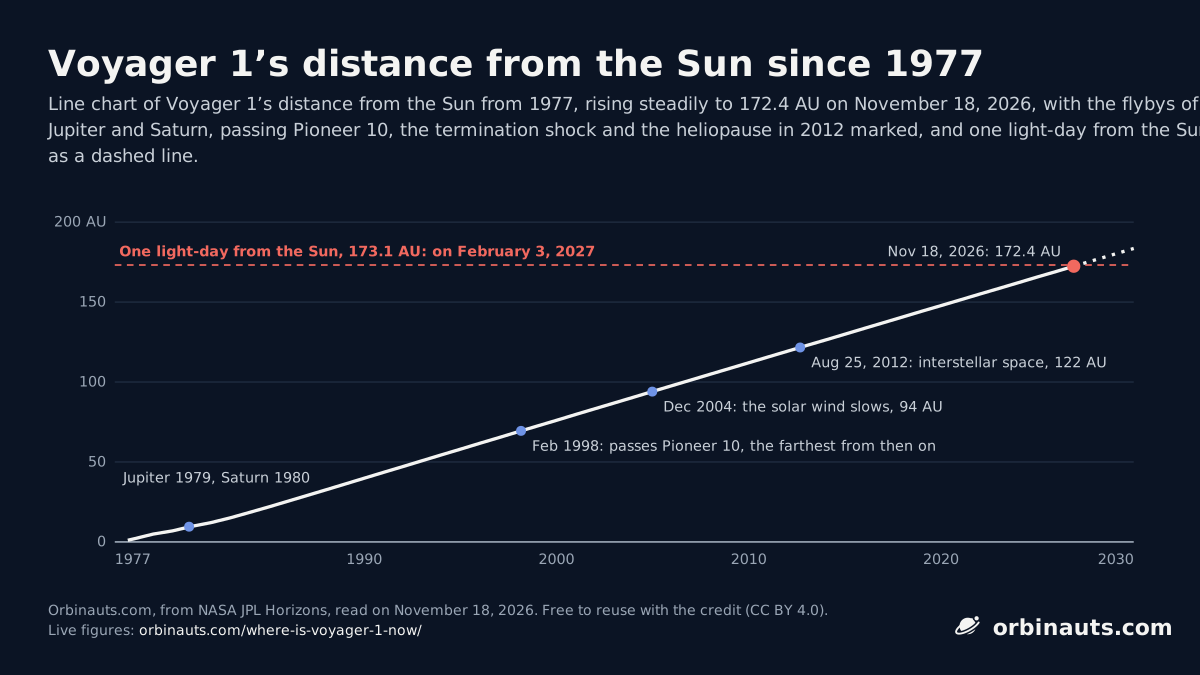
How far Voyager 1 has travelled since 1977
Its distance from the Sun, year by year. Since its flyby of Saturn in 1980, no planet has changed its course.
Marked on the chart
- Closest to Jupiter on March 5, 1979 and to Saturn on November 12, 1980.
- February 17, 1998: passes Pioneer 10, 69.4 AU from the Sun, and is the farthest spacecraft from then on.
- December 16, 2004: crosses the termination shock, where the solar wind slows, 94 AU from the Sun.
- August 25, 2012: leaves the Sun’s bubble for interstellar space, 122 AU from the Sun.
- : 172.409 AU from the Sun.
- February 3, 2027: one light-day from the Sun, 173.1 AU.
The yearly ripple seen from Earth
Seen from Earth the line has a yearly ripple of about 0.8 AU each way, because Earth circles the Sun. In 2027 the distance from Earth shrinks from January 20 to April 24, by about 41 million km, then grows again.
The figures as a table: the distance on January 1 of each year
| Date (UTC) | From the Sun (AU) | From Earth (AU) | Speed relative to the Sun (km/s) |
|---|---|---|---|
| 1.008 | 0.000 | 40.56 | |
| 1.920 | 1.099 | 27.31 | |
| 4.883 | 4.005 | 13.69 | |
| 6.898 | 6.502 | 21.74 | |
| 9.745 | 9.695 | 21.45 | |
| 12.061 | 12.284 | 20.58 | |
| 15.067 | 15.453 | 19.85 | |
| 18.394 | 18.878 | 19.30 | |
| 21.883 | 22.417 | 18.89 | |
| 25.438 | 26.016 | 18.58 | |
| 29.034 | 29.642 | 18.34 | |
| 32.650 | 33.282 | 18.16 | |
| 36.288 | 36.928 | 18.01 | |
| 39.921 | 40.577 | 17.90 | |
| 43.556 | 44.224 | 17.80 | |
| 47.190 | 47.869 | 17.71 | |
| 50.832 | 51.512 | 17.63 | |
| 54.461 | 55.149 | 17.56 | |
| 58.086 | 58.781 | 17.50 | |
| 61.707 | 62.407 | 17.45 | |
| 65.333 | 66.032 | 17.40 | |
| 68.945 | 69.649 | 17.35 | |
| 72.553 | 73.263 | 17.31 | |
| 76.160 | 76.873 | 17.28 | |
| 79.773 | 80.484 | 17.26 | |
| 83.376 | 84.091 | 17.24 | |
| 86.976 | 87.695 | 17.22 | |
| 90.575 | 91.297 | 17.19 | |
| 94.181 | 94.899 | 17.17 | |
| 97.774 | 98.496 | 17.15 | |
| 101.364 | 102.089 | 17.13 | |
| 104.950 | 105.678 | 17.11 | |
| 108.544 | 109.268 | 17.08 | |
| 112.125 | 112.852 | 17.07 | |
| 115.703 | 116.433 | 17.05 | |
| 119.280 | 120.013 | 17.04 | |
| 122.866 | 123.595 | 17.03 | |
| 126.442 | 127.173 | 17.03 | |
| 130.017 | 130.750 | 17.02 | |
| 133.591 | 134.326 | 17.01 | |
| 137.172 | 137.904 | 17.00 | |
| 140.743 | 141.477 | 16.99 | |
| 144.310 | 145.047 | 16.97 | |
| 147.876 | 148.614 | 16.96 | |
| 151.448 | 152.183 | 16.94 | |
| 155.009 | 155.746 | 16.93 | |
| 158.569 | 159.307 | 16.93 | |
| 162.128 | 162.868 | 16.92 | |
| 165.696 | 166.433 | 16.92 | |
| 169.255 | 169.994 | 16.92 | |
| 172.394 | 173.152 | 16.92 |
The same figures as a file: Voyager 1’s distance by year (CSV).The chart is also an image file: Voyager 1’s distance from the Sun since 1977 (SVG).
Where is Voyager 1 going?
It is leaving the Solar System for good, towards the constellation Ophiuchus. What lies ahead:
- In about 300 years
- The inner edge of the Oort Cloud, the Sun’s far shell of comets. NASA
- In about 18,000 years
- One light-year from the Sun, worked out from JPL’s path.
- In about 30,000 years
- Out of the Oort Cloud. NASA
- In about 40,000 years
- Within about 1.7 light-years of the star Gliese 445 (AC +79 3888), today in the constellation Ursa Minor. NASA
Is Voyager 1 still working?
Yes. Two of its ten instruments are still on, the magnetometer and the plasma wave instrument, and it reports to Earth through NASA’s Deep Space Network. NASA
NASA’s engineers believe it could keep at least one instrument running into the 2030s. NASA
- No signal for two days, then back. One group of thrusters had gone offline and their backups had turned on; what caused the silence is still being investigated. NASA
- Three devices swapped for lower-power ones at once, which put off an instrument shutdown that could have come as early as summer 2027. NASA
- The low-energy charged particle instrument is switched off to save power. NASA
Its power falls by about 4 watts a year. From NASA’s post of October 29, 2026; checked .
| Instrument | State | Source |
|---|---|---|
| Magnetometer (MAG) | On | NASA |
| Plasma Wave Subsystem (PWS) | On | NASA |
| Low-Energy Charged Particles (LECP) | Off since , to save power | NASA |
| Cosmic Ray Subsystem (CRS) | Off since , to save power | NASA |
| Ultraviolet Spectrometer (UVS) | Off since , to save power | NASA |
| Planetary Radio Astronomy (PRA) | Off since , to save power | NASA |
| Plasma Science (PLS) | Off since , as its performance had degraded | NASA |
| Infrared Interferometer Spectrometer and Radiometer (IRIS) | Off since , to save power | NASA |
| Imaging Science Subsystem (ISS): the wide-angle and narrow-angle cameras | Off since , to save power | NASA |
| Photopolarimeter Subsystem (PPS) | Off since , as its performance had degraded | NASA |
Questions people ask
How far is Voyager 1 from Earth right now?
25.906 billion km (16.098 billion miles, 173.174 AU) at 11:22 UTC on November 20, 2026.
Where is Voyager 1 now?
In interstellar space, 172.4 AU from the Sun and 35° north of the plane of the planets. From Earth it lies in the direction of the constellation Ophiuchus. JPL
How long does a signal take to reach Voyager 1?
A signal sent now arrives in 24 h 0 min 20 s. The reply is back after 48 h 0 min 43 s.
What is one light-day?
The distance light travels in 24 hours: 25,902,068,371 km, or 16.09 billion miles.
Has Voyager 1 left the Solar System?
Not by the scientific definition, NASA says: for that it must pass beyond the Oort Cloud, whose inner edge it reaches in about 300 years. It left the Sun’s bubble, the heliosphere, for interstellar space on August 25, 2012. NASA JPL
How fast is Voyager 1 going?
16.92 km/s relative to the Sun: 60,900 km/h and 37,840 mph, about 3.6 AU a year.
How long would it take to get to Voyager 1?
Light needs 24 h 0 min 15 s. An airliner at 900 km/h would need about 3,300 years. A spacecraft as fast as Voyager 1 would need about 49 years to get to where it is now, and would never catch it up.
How many light-years away is Voyager 1?
About 0.0027 light-years. It will be one light-year from the Sun in about 18,000 years.
Why does its distance from Earth sometimes shrink?
From about January 20 to April 24 each year, Earth, on its way round the Sun, moves towards Voyager 1 faster than Voyager 1 flies away, so the gap closes for a while. NASA
Do we still have contact with Voyager 1?
Yes. NASA’s Deep Space Network still hears it: it sends its data at 160 bits a second. Only the network’s 70-metre dish near Canberra has the power to send commands to the Voyagers, NASA says. NASA
How long will Voyager 1 last?
NASA’s engineers believe it could keep at least one instrument running into the 2030s. Its power falls by about 4 watts a year. NASA
How is Voyager 1 powered?
By three radioisotope thermoelectric generators, which turn the heat of decaying plutonium-238 into electricity. NASA
Will Voyager 1 ever stop or come back?
No. It is still slowing a little, from 17.04 km/s in 2012 to 16.92 km/s now, but it is faster than the Sun’s gravity can hold: its speed settles near 16.6 km/s.
When was Voyager 1 launched?
On September 5, 1977, from Cape Canaveral, 16 days after Voyager 2. NASA
Is Voyager 1 farther than Voyager 2?
Yes, by about 28 AU. On November 18, 2026, Voyager 2 was 145.0 AU from Earth, 20 h 5 min 37 s at the speed of light.
Which is faster, Voyager 1 or Voyager 2?
Voyager 1: 16.92 km/s against 15.3 km/s for Voyager 2, both relative to the Sun.
Where will Voyager 1 be in 300 years?
At the inner edge of the Oort Cloud, the Sun’s far shell of comets, about 1,200 AU from the Sun. NASA
When will Voyager 1 reach the nearest star?
The nearest star, Proxima Centauri, is about 4.24 light-years away, and Voyager 1 is headed elsewhere: in the direction of the star Gliese 445, which it should pass within about 1.7 light-years of in about 40,000 years. NASA
What has Voyager 1 discovered?
At Jupiter, a thin ring and two new moons, Thebe and Metis; at Saturn, five new moons and a new ring, the G ring. It was then the first spacecraft to leave the Sun’s bubble for interstellar space. NASA
How this is worked out
The path comes from NASA JPL Horizons. We read it once a day and work out, for the second the page is sent, the straight-line distance between the centre of the Earth and the spacecraft. The digits then count on from that second; a wrong clock on your device does not change them.
How exact it is. JPL’s path is a prediction, fitted in 2022 to tracking from 1981 to 1992, when two-way tracking of the spacecraft ended; no new tracking data has been possible since, although Voyager 1 still sends its own. JPL’s record for the spacecraft gives the formal uncertainty of its predicted direction from Earth for January 1, 2030 as 1.7 arcseconds in right ascension and 1.5 in declination: at this distance, about 210,000 km sideways. It gives none for the distance itself. So the sentence is rounded to a million km, and the last digits of the tile show the motion, not a measurement.
Path read at , JPL’s solution Voyager_1_ST+refit2022_m. If JPL refits the path, every figure here shifts a little, and this line says so.
Cite or embed this
Copy any form. The figure and its time are those of the second this page was sent, so they stay true in a saved copy.
- In a sentence
- Voyager 1 was 25.906 billion km from Earth at 11:22 UTC on November 20, 2026, according to Orbinauts.com, from NASA JPL’s predicted path.
- As a footnote
- Orbinauts.com, Where is Voyager 1 now, orbinauts.com/where-is-voyager-1-now, from NASA JPL Horizons, retrieved November 20, 2026.
- Under a chart or a table
- Source: Orbinauts.com, from NASA JPL Horizons
Free to reuse with the credit (CC BY 4.0).
Data: the live figures as JSON, the distance by year as CSV, and the map and the distance chart as SVG. API reference.
- How many satellites are in orbit?
- How many Starlink satellites are in orbit?
- How much space debris is there?
- How many people have been to space?
- How many people are in space right now?
- How many space stations are there?
- Where is Voyager 2 now? (page to come)
- Where is the ISS now?
- Space in numbers: every count
- For reporters: press and reuse