How many space stations are there?
There are 2 space stations in orbit as of , both crewed: the International Space Station and China’s Tiangong. 10 people are aboard them.
15 space stations have been launched since 1971. The other 13 are gone.
- 2Space stations in orbitBoth crewed. See which ones.
- 10People aboard them7 on the ISS, 3 on Tiangong. How many people are in space right now?
- 15Launched since 197112 of them had a crew. The full list.
Figures as of UTC. How this count is made
On this page: the stations in orbit, seeing them, the list of every space station, other numbers you may read, the ones coming next, questions.
Which space stations are in orbit right now?
- ISS: up to 51.6° north and south of the equator, 7 aboard
- Tiangong: up to 41.5° north and south of the equator, 3 aboard
International Space Station
About 420 km up
ISS tracker: live map and passes over you
7 aboard, Expedition 75: Pyotr Dubrov (commander), Anna Kikina, Anil Menon, Jessica Watkins, Luke Delaney, Joshua Kutryk, Sergey Teteryatnikov
- First module launched
- Days in orbit
- 10,227
- Mass
- about 420 t
- Run by
- NASA, Roscosmos, ESA, JAXA and CSA
Tiangong Space Station
About 390 km up
Tiangong tracker: live map and passes over you
3 aboard, Shenzhou 23: Zhu Yangzhu (commander), Lai Ka-ying, Zhang Zhiyuan
- First module launched
- Days in orbit
- 2,031
- Mass
- about 100 t
- Run by
- China Manned Space Agency
The ISS is about 4 times as heavy as Tiangong.
Can you see the space stations from Earth?
Yes, both, without a telescope: each looks like a bright star crossing the sky in a few minutes, after dusk or before dawn. The ISS climbs high over most of the inhabited world. Tiangong keeps closer to the equator. From London or Berlin it stays low in the south. North of about 53° of latitude it climbs less than 10° above the horizon, too low for our pass lists, and north of about 60° it does not rise at all. The same limits hold in the south.
How many space stations have there been?
15 space stations have been launched since Salyut 1 in April 1971. 14 reached orbit, 12 had a crew and 2 are still in orbit. The Soviet Union and Russia launched 10, China 3, and the United States 1. The ISS is shared by 15 countries.
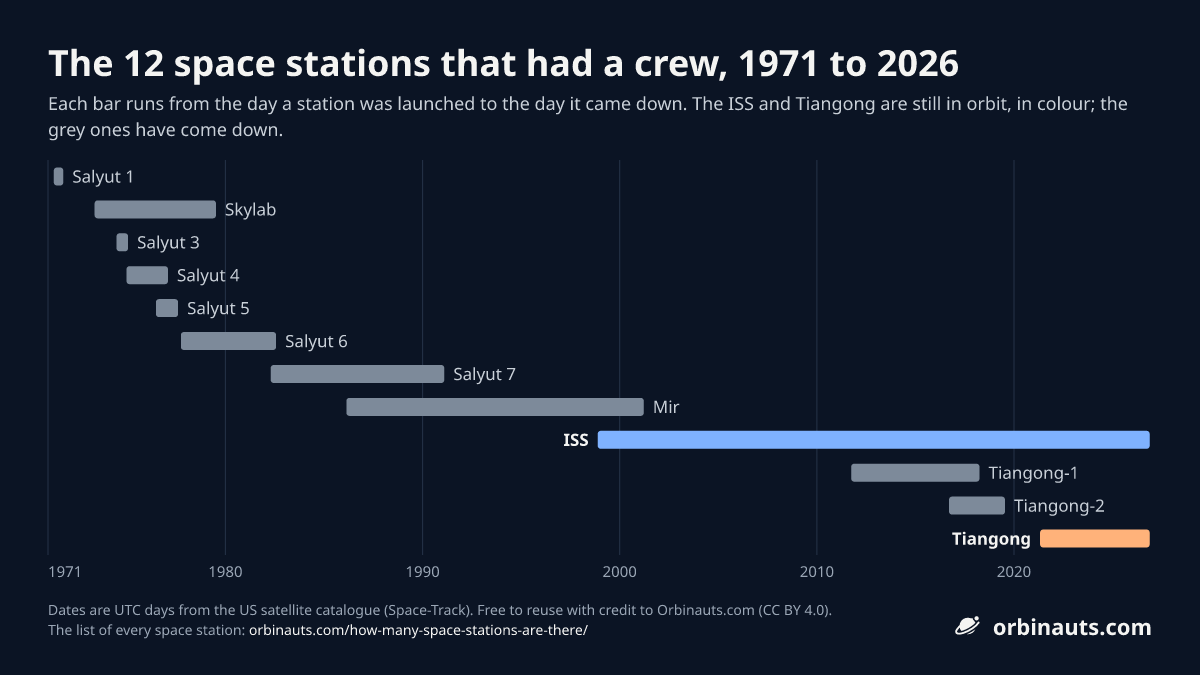
List of space stations: all 15, with names and dates
| Station | Country | Launched | Came down | Days in orbit | Crew |
|---|---|---|---|---|---|
| Salyut 1 | Soviet Union | 175 | Yes | ||
| DOS-2 | Soviet Union | Did not reach orbit | No | ||
| Salyut 2 | Soviet Union | , failed in orbit | 55 | No | |
| Kosmos 557 | Soviet Union | , failed in orbit | 11 | No | |
| Skylab | United States | 2,249 | Yes | ||
| Salyut 3 | Soviet Union | 214 | Yes | ||
| Salyut 4 | Soviet Union | 769 | Yes | ||
| Salyut 5 | Soviet Union | 412 | Yes | ||
| Salyut 6 | Soviet Union | 1,764 | Yes | ||
| Salyut 7 | Soviet Union | 3,216 | Yes | ||
| Mir | Soviet Union, Russia | 5,511 | Yes | ||
| International Space Station | 15 countries | In orbit | 10,227 | 7 now | |
| Tiangong-1 | China | 2,377 | Yes | ||
| Tiangong-2 | China | 1,037 | Yes | ||
| Tiangong Space Station | China | In orbit | 2,031 | 3 now |
Dates are UTC days, as the US satellite catalogue gives them. The day of DOS-2 is the one NASA gives, without a time zone. Salyut 2, Salyut 3, and Salyut 5 were military stations flown under the Salyut name. China called Tiangong-1 and Tiangong-2 space labs.
The list as CSV, free to reuse with credit to Orbinauts.com (CC BY 4.0).
- The first space station was Salyut 1, launched by the Soviet Union on April 19, 1971.
- The largest is the ISS, about 420 t.
- Since April 1973 there has always been at least one space station in orbit.
Why you may read a different number
Because the answer depends on what is counted, and on when the page was written. Every figure here is counted from the list on this page.
- 1
- True from , the day Tiangong-2 came down, to , the day Tiangong was launched. A page written between those days is right to say it.
- 2
- The space stations in orbit today. This is the number on this page.
- 10
- The stations that had a crew, counted without Tiangong-1 and Tiangong-2, which China called space labs.
- 12
- The stations that have had a crew aboard.
- 14
- The stations that reached orbit, with or without a crew.
- 15
- Every station launched. Did not reach orbit: DOS-2.
- More than 2 in orbit
- A list with more counts test craft, or planned stations that have not been launched.
What counts here: a spacecraft built for people to live in that stays in orbit while crews come and go in other craft. A capsule that carries its crew up and down is not a station. A station counts from the day its first module reaches orbit, with or without a crew, until it comes down.
Test craft flown without a crew and never visited are left out:
- The US Air Force’s mock-up of its Manned Orbiting Laboratory (OPS 0855): launched in 1966, down in 1967.
- Genesis I: launched in 2006, down in 2025.
- Genesis II: launched in 2007, down in 2025.
- Haven Demo, Vast’s testbed for the technologies of its Haven-1 space station: launched in 2025, down in February 2026.
Which space stations are coming next?
None of the planned space stations is in orbit yet. NASA plans to operate the International Space Station through 2030 and then to steer it into a remote part of the ocean with a deorbit vehicle that SpaceX is building. Unless another station reaches orbit first, the count on this page will then fall from 2 to 1.
Planned space stations, as their builders state them. Checked .
| Station | Who | First launch | Source |
|---|---|---|---|
| Haven-1 | Vast, United States | 2027 | Vast |
| Axiom Station | Axiom Space, United States | 2028, first module | Axiom Space |
| Haven-2 | Vast, United States | 2028, first module | Vast |
| Bharatiya Antariksh Station | ISRO, India | 2028, first module | Government of India |
| Starlab | Starlab Space (Voyager Technologies and Airbus), United States and Europe | 2029 | Airbus |
Only stations for Earth orbit with a named builder and a published plan are listed, each as its builder’s own page states it.
Axiom Space says the first module of Axiom Station berths to the International Space Station before it leaves to fly on its own, so its launch adds no station to this count.
Questions people ask
Is there a space station still in space?
Yes. There are 2 space stations in orbit as of November 20, 2026, both crewed: the International Space Station and China’s Tiangong. Which space stations are in orbit right now?
How many people are on the space stations right now?
10 people are on the space stations as of November 20, 2026: 7 on the ISS, 3 on Tiangong. The figure is higher while a new crew is aboard beside the one it relieves. How many people are in space right now?
Does China have its own space station?
Yes. Tiangong has been in orbit since April 2021 and crewed without a break since June 2022. Tiangong tracker: live map and passes over you
Why is China not on the ISS?
China is not a partner in the ISS: since 2011 each US spending law has barred NASA from working with China bilaterally unless it first certifies the work to Congress. The full answer on the Tiangong page
How many countries have a space station?
China has a space station of its own, Tiangong. The ISS is shared by 15 countries.
Is there more than one International Space Station?
No. There is one International Space Station. The other space station in orbit is China’s Tiangong, which is not part of it.
Does NASA have its own space station?
Not today. The only space station the United States has launched alone was Skylab, in orbit from 1973 to 1979. NASA is one of the 5 space agencies that operate the International Space Station.
Does Russia have its own space station?
Not today. Russia’s last space station of its own was Mir, launched by the Soviet Union in 1986 and in orbit until 2001. Russia’s space agency Roscosmos is one of the 5 space agencies that operate the International Space Station.
What was the first space station?
The first space station was Salyut 1, launched by the Soviet Union on April 19, 1971. It stayed in orbit for 175 days. The full list
When will the ISS come down?
NASA plans to operate the International Space Station through 2030 and then to steer it into a remote part of the ocean with a deorbit vehicle that SpaceX is building. NASA has named no day. Which space stations are coming next?
How this count is made
A space station counts from the day its first module reaches orbit, with or without a crew, until it comes down. The count is made again every 4 hours, with each refresh of the public catalogue of Space-Track, and each station’s height is worked out from its newest orbit there. The launch day, the mass and who runs a station are those on its own page. The people aboard are those Launch Library lists on each station’s expedition or mission, read every 6 hours. While a new crew overlaps the one it relieves, both are counted.
The stations that came down are a list kept by hand. Each launch day and each day a station came down is the one in Space-Track’s satellite catalogue, read on November 18, 2026; DOS-2, which never reached orbit, has the day NASA’s history of the Soviet stations gives. Whether a station had a crew is taken from NASA and the China Manned Space Agency. Days in orbit are worked out from those days.
The planned stations are kept by hand from their builders’ own pages, last read on November 18, 2026. What is said of the end of the International Space Station is what NASA states.
How to cite this count
Copy any form. The date is the date of the figures above, so it stays true in a saved copy.
- In a sentence
- There were 2 space stations in orbit on November 20, 2026, with 10 people aboard, according to Orbinauts.com.
- As a footnote
- Orbinauts.com, How many space stations are there, orbinauts.com/how-many-space-stations-are-there, orbits from Space-Track, crews from Launch Library, retrieved November 20, 2026.
- Under a chart or a table
- Source: Orbinauts.com
Figures are free to reuse with credit, under CC BY 4.0.
- How many satellites are in orbit?
- How many Starlink satellites are in orbit?
- How much space debris is there?
- How many people have been to space?
- Where is Voyager 1 now?
- How many people are in space right now?
- Space in numbers: every count
- The same figures as JSON: the Census in the API reference
- For reporters: press and reuse