How many people have been to space?
As of , 746 people have been to space by the 100 km line, or 787 by the 50-mile (80 km) line that US agencies use. 651 of them reached orbit.
That is every astronaut, cosmonaut and private flier since Yuri Gagarin on . The newest are Joshua Kutryk, Luke Delaney, and Sergey Teteryatnikov, who flew on Crew-13 on .
- 746Above 100 kmThe Kármán line, used for world records
- 787Above 80 km50 miles, used by US agencies
- 651Reached orbitFlew a mission around the Earth
Seen 781? That figure dates from spring 2026 and counts by the 50-mile line, though it is often quoted as “above 100 km”. Why the numbers differ
Counted from the flight record, one person once. Last changed (Crew-13, 3 new people). Checked UTC. How we count
On this page: why the numbers differ, newest in space, by country, since 1961, the Moon, in space right now, how we count, questions people ask, how to cite.
Why you see different numbers
No law says where space begins, so the count depends on the line you choose. A flight to 85 km earns astronaut wings in the United States and is not a spaceflight in the world record books.
| The line | People | Who it adds |
|---|---|---|
| Reached orbit | 651 | Everyone who flew a mission around the Earth, from Gagarin to today’s station crews |
| Above 100 kmThe Kármán line, used by the FAI, the world air sports federation | 746 | 95 more who went up and came straight down without ever orbiting: one X-15 pilot, the two SpaceShipOne pilots and 92 Blue Origin passengers |
| Above 80 km50 miles, the height at which US agencies award astronaut wings | 787 | 41 more who passed 80 km and not 100 km: six X-15 pilots and 35 Virgin Galactic fliers |
Do space tourists count? Yes. Anyone who crosses the line has been to space, whoever paid for the seat. 125 of the 746 flew as private fliers, 31 of them to orbit.
Other figures you will meet
| 781 | Quoted since spring 2026, on Wikipedia and elsewhere, often as “above 100 km”. It matches that season’s 50-mile count: those above 100 km plus the 41 who passed 80 km only. |
|---|---|
| 743 | The 100 km count of July 2026 on German Wikipedia, before the flights since. |
| 655 to 668 | Counts last updated in April 2025 that do not include passengers of commercial suborbital flights. |
Newest in space
The ten people who most recently flew to space for the first time. 15 people have joined the count in 2026.
| No. | Name | Country | Flight | First flew |
|---|---|---|---|---|
| 746 | Sergey Teteryatnikov | Russia | Crew-13 | |
| 745 | Luke Delaney | United States | Crew-13 | |
| 744 | Joshua Kutryk | Canada | Crew-13 | |
| 743 | Anil Menon | United States | Soyuz MS-29 | |
| 742 | Lai Ka-ying | China | Shenzhou 23 | |
| 741 | Zhang Zhiyuan | China | Shenzhou 23 | |
| 740 | Jeremy Hansen | Canada | Artemis II | |
| 739 | Sophie Adenot | France | Crew-12 | |
| 738 | Jack Hathaway | United States | Crew-12 | |
| 737 | Laura Stiles | United States | NS-38 |
Numbered by the 100 km line; people on one flight share the day. Facts of the flight only: a name, a country, the flight and its date.
By country
People from 49 countries have been to space. The United States has sent the most, 439, ahead of Russia with the Soviet Union, 141. Each person is counted under the citizenship of their first flight; the Soviet Union and Russia are one row, as are East, West and today’s Germany.
| Country | People | Share of all | First |
|---|---|---|---|
| United States | 439 | 59% | Alan Shepard, 1961 |
| Russia and the Soviet Union | 141 | 19% | Yuri Gagarin, 1961 |
| China | 31 | 4% | Yang Liwei, 2003 |
| Canada | 16 | 2% | Marc Garneau, 1984 |
| Germany | 14 | 2% | Sigmund Jähn, 1978 |
| Japan | 14 | 2% | Toyohiro Akiyama, 1990 |
| France | 13 | 2% | Jean-Loup Chrétien, 1982 |
| Italy | 8 | 1% | Franco Malerba, 1992 |
| United Kingdom | 6 | 0.8% | Helen Sharman, 1991 |
| India | 4 | 0.5% | Rakesh Sharma, 1984 |
The other 39 countries
| Country | People | First |
|---|---|---|
| Hungary | 3 | Bertalan Farkas, 1980 |
| Netherlands | 3 | Wubbo Ockels, 1985 |
| Saudi Arabia | 3 | Sultan bin Salman Al Saud, 1985 |
| Spain | 3 | Pedro Duque, 1998 |
| Australia | 3 | Chris Boshuizen, 2021 |
| Poland | 2 | Mirosław Hermaszewski, 1978 |
| Bulgaria | 2 | Georgi Ivanov, 1979 |
| Mexico | 2 | Rodolfo Neri Vela, 1985 |
| Belgium | 2 | Dirk Frimout, 1992 |
| Ukraine | 2 | Leonid Kadeniuk, 1997 |
| Israel | 2 | Ilan Ramon, 2003 |
| Brazil | 2 | Marcos Pontes, 2006 |
| Sweden | 2 | Christer Fuglesang, 2006 |
| Kazakhstan | 2 | Aidyn Aimbetov, 2015 |
| United Arab Emirates | 2 | Hazza Al Mansouri, 2019 |
| Türkiye | 2 | Alper Gezeravci, 2024 |
| Czechia | 1 | Vladimír Remek, 1978 |
| Cuba | 1 | Arnaldo Tamayo Méndez, 1980 |
| Vietnam | 1 | Phạm Tuân, 1980 |
| Mongolia | 1 | Jügderdemidiin Gürragchaa, 1981 |
| Romania | 1 | Dumitru Prunariu, 1981 |
| Syria | 1 | Muhammed Faris, 1987 |
| Afghanistan | 1 | Abdul Ahad Mohmand, 1988 |
| Austria | 1 | Franz Viehböck, 1991 |
| Switzerland | 1 | Claude Nicollier, 1992 |
| Slovakia | 1 | Ivan Bella, 1999 |
| South Africa | 1 | Mark Shuttleworth, 2002 |
| Iran | 1 | Anousheh Ansari, 2006 |
| Malaysia | 1 | Sheikh Muszaphar Shukor, 2007 |
| South Korea | 1 | Yi So-yeon, 2008 |
| Denmark | 1 | Andreas Mogensen, 2015 |
| Egypt | 1 | Sara Sabry, 2022 |
| Portugal | 1 | Mário Ferreira, 2022 |
| Belarus | 1 | Marina Vasilevskaya, 2024 |
| Malta | 1 | Chun Wang, 2025 |
| Norway | 1 | Jannicke Mikkelsen, 2025 |
| New Zealand | 1 | Mark Rocket, 2025 |
| Panama | 1 | Jaime Alemán, 2025 |
| Singapore | 1 | Elaine Chia Hyde, 2025 |
Other lists say 43 to 55 countries. They differ on dual citizens, on people counted by birthplace, and on whether the two Germanys or the Soviet republics are separate rows.
Since 1961
The first 100 people flew to space between 1961 and 1980, the latest 100 between 2024 and 2026. The Space Shuttle carried up to eight at a time from 1981. Short suborbital flights with paying passengers have added 92 people since 2021.
Chart as an image, free to reuse with credit to Orbinauts.com.
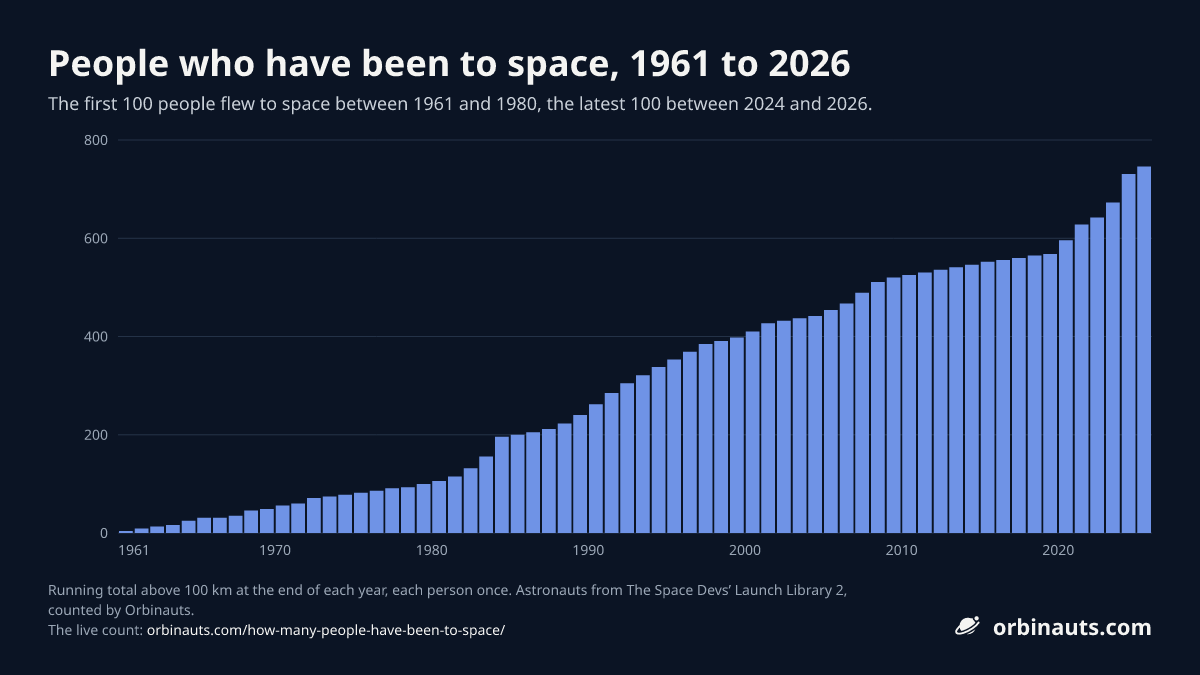
The figures by year
| Year | First flew | Running total |
|---|---|---|
| 2026, to | 15 | 746 |
| 2025 | 58 | 731 |
| 2024 | 31 | 673 |
| 2023 | 14 | 642 |
| 2022 | 32 | 628 |
| 2021 | 28 | 596 |
| 2020 | 3 | 568 |
| 2019 | 5 | 565 |
| 2018 | 4 | 560 |
| 2017 | 4 | 556 |
Earlier years, 1961 to 2016
| Year | First flew | Running total |
|---|---|---|
| 2016 | 6 | 552 |
| 2015 | 5 | 546 |
| 2014 | 5 | 541 |
| 2013 | 6 | 536 |
| 2012 | 5 | 530 |
| 2011 | 5 | 525 |
| 2010 | 9 | 520 |
| 2009 | 22 | 511 |
| 2008 | 22 | 489 |
| 2007 | 13 | 467 |
| 2006 | 12 | 454 |
| 2005 | 5 | 442 |
| 2004 | 5 | 437 |
| 2003 | 5 | 432 |
| 2002 | 17 | 427 |
| 2001 | 12 | 410 |
| 2000 | 7 | 398 |
| 1999 | 6 | 391 |
| 1998 | 16 | 385 |
| 1997 | 16 | 369 |
| 1996 | 15 | 353 |
| 1995 | 17 | 338 |
| 1994 | 16 | 321 |
| 1993 | 20 | 305 |
| 1992 | 23 | 285 |
| 1991 | 22 | 262 |
| 1990 | 17 | 240 |
| 1989 | 11 | 223 |
| 1988 | 7 | 212 |
| 1987 | 5 | 205 |
| 1986 | 4 | 200 |
| 1985 | 40 | 196 |
| 1984 | 24 | 156 |
| 1983 | 17 | 132 |
| 1982 | 9 | 115 |
| 1981 | 6 | 106 |
| 1980 | 7 | 100 |
| 1979 | 2 | 93 |
| 1978 | 5 | 91 |
| 1977 | 4 | 86 |
| 1976 | 4 | 82 |
| 1975 | 4 | 78 |
| 1974 | 3 | 74 |
| 1973 | 11 | 71 |
| 1972 | 4 | 60 |
| 1971 | 7 | 56 |
| 1970 | 3 | 49 |
| 1969 | 11 | 46 |
| 1968 | 4 | 35 |
| 1967 | 0 | 31 |
| 1966 | 6 | 31 |
| 1965 | 9 | 25 |
| 1964 | 3 | 16 |
| 1963 | 4 | 13 |
| 1962 | 5 | 9 |
| 1961 | 4 | 4 |
How many went to the Moon?
28 people have flown to the Moon: 24 on Apollo between 1968 and 1972, and the 4 of Artemis II in April 2026. 12 of them walked on it, the last in December 1972. Everyone else who has been to space stayed in low Earth orbit or below.
In space right now
As of , 10 people are aboard the two space stations: 7 on the International Space Station and 3 on Tiangong, China’s space station. The most people in orbit at one time was 19, in September 2024.
How we count
- A person counts once, on their first flight above the line, however many times they flew after.
- The height is the highest point of the flight above the Earth’s surface.
- Reached orbit means the flight was an orbital mission that got to orbit: a launch aborted on the way up does not count as reaching it.
- Three of the Challenger crew of 1986 had not flown before and did not reach either line. They are not in the count.
- A country is the citizenship a person held on their first flight. A dual citizen is counted once, under the flag they flew for. The Soviet Union and Russia are one country, as are East, West and today’s Germany.
- A private flier is someone who has never been in a government's astronaut corps and flew as a company's employee or as a paying or sponsored passenger.
- Source: the list of astronauts and their flights in The Space Devs’ Launch Library 2, read every day, with our own record of which suborbital flights passed which line and a few corrections, each with its source. The figure changes when someone flies above a line for the first time.
Questions people ask
How many astronauts have been to space?
746 people of any profession had flown above 100 km as of November 19, 2026. 621 of them belonged to a government astronaut corps or flew for a government; the other 125 were private fliers, who flew for a company or as paying or sponsored passengers.
How many people have been to space in 2026?
24 people flew above 100 km in 2026 up to November 19, and 15 of them had never flown before.
How many Americans have been to space?
439 US citizens had flown above 100 km as of November 19, 2026, the first of them Alan Shepard in 1961.
Where does space begin?
There is no legal border. The FAI, which keeps flight records, uses 100 km, the Kármán line. US agencies award astronaut wings from 50 miles, about 80 km.
Who was the first person in space?
Yuri Gagarin of the Soviet Union, who flew one orbit of the Earth aboard Vostok 1 on April 12, 1961.
How many people have died in space?
3 people have died above 100 km: the crew of Soyuz 11 in June 1971. 16 more died during a launch or a return to Earth: Vladimir Komarov on Soyuz 1 in 1967, Michael Adams on the X-15 in 1967, the 7 aboard Challenger in 1986 and the 7 aboard Columbia in 2003.
Who has spent the longest in space?
Oleg Kononenko, with 1,111 days over 5 flights as of November 18, 2026.
Has anyone been to Mars?
No. Nobody has landed anywhere but the Moon, and nobody has flown farther than its far side. The greatest distance from Earth is 406,771 km (252,756 miles), reached by Artemis II in April 2026.
How to cite this count
Copy any form. The date is the day the count was read, so it stays true in a saved copy.
- In a sentence
- As of November 19, 2026, 746 people have been to space (above 100 km), according to Orbinauts.com.
- As a footnote
- Orbinauts.com, How many people have been to space, orbinauts.com/how-many-people-have-been-to-space, retrieved November 19, 2026.
- Under a chart or a table
- Source: Orbinauts.com
The figures are free to reuse under CC BY 4.0. Astronauts from The Space Devs’ Launch Library 2.
- How many satellites are in orbit?
- How many Starlink satellites are in orbit?
- How much space debris is there?
- Where is Voyager 1 now?
- How many people are in space right now?
- How many space stations are there?
- Space in numbers: every count
- The same figures as JSON: the People count in the API reference
- For reporters: press and reuse