How much space debris is there?
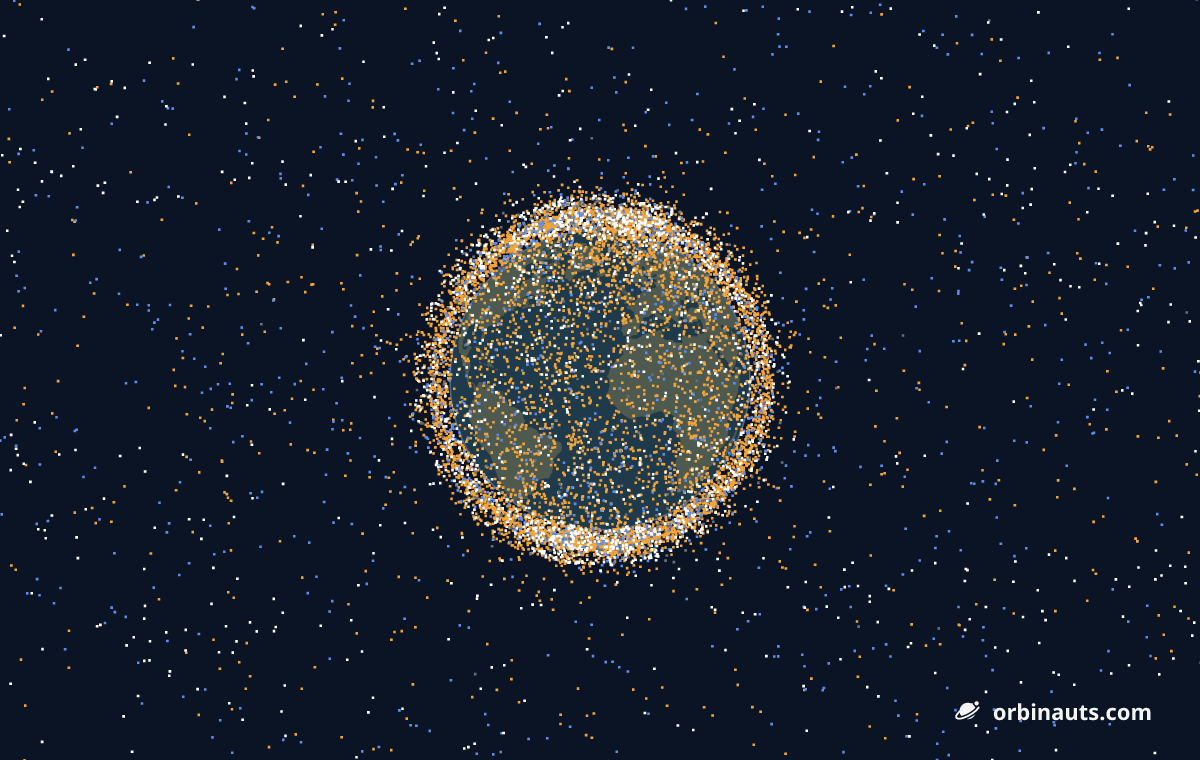
There are 16,478 tracked pieces of space debris, or space junk, in Earth orbit as of . ESA estimates another 1.5 million pieces of 1 to 10 cm, too small to track.
- 16,478Tracked pieces of debrisEverything left in orbit that no longer works and is large enough to follow, about 10 cm and up.
- 16,448Active satellitesFor comparison. How many satellites are in orbit
- 1.5 millionPieces of 1 to 10 cmToo small to track. An estimate by ESA, not a count.
The 32,926 objects tracked in orbit: half are debris
- Fragments
- Dead satellites
- Rocket bodies
- Unidentified
Counted daily. Updated UTC. How this count is made
On this page: what it is, where it is, what is too small to track, where it came from, how old it is, whether it is increasing, questions. Or see the debris on the live map.
What is space debris?
Space debris, also called space junk or space trash, is everything people left in orbit that no longer works. Fragments are the largest group: 10,390 pieces, 63% of all tracked debris. Most come from satellites and rocket bodies that exploded or were hit.
| Kind of debris | Share | Tracked |
|---|---|---|
| FragmentsPieces of something that broke up, and parts shed during a launch or a mission. | 63% | 10,390 |
| Dead satellitesWhole satellites that no longer work and were left in orbit. | 20% | 3,291 |
| Rocket bodiesThe upper stage of the rocket that carried a satellite up. | 13% | 2,222 |
| UnidentifiedTracked, but not yet matched to a launch. | 3% | 575 |
| All tracked debris | 100% | 16,478 |
Key facts
- Half of the 32,926 objects tracked in Earth orbit are debris: 16,478 against 16,448 active satellites.
- Dead satellites and rocket bodies are few but large. One of them breaking up can add hundreds of fragments in a day.
- The oldest piece of debris still in orbit is Vanguard 1, launched in March 1958.
Where is space debris?
12,704 pieces, 77% of all tracked debris, are in low Earth orbit, below 2,000 km, the same region as most active satellites.
| Orbit | Fragments | Dead satellites | Rocket bodies | Unidentified | All debris |
|---|---|---|---|---|---|
| Low Earth orbitBelow 2,000 km. | 9,121 | 2,066 | 995 | 522 | 12,704 |
| Highly elliptical orbitA long oval. Many rocket bodies are left there on the way to higher orbits. | 791 | 160 | 729 | 18 | 1,698 |
| Medium Earth orbitBetween 2,000 and 35,786 km. | 430 | 319 | 229 | 33 | 1,011 |
| Inclined geosynchronousGeostationary height, tilted. Mostly retired satellites. | 37 | 709 | 260 | 2 | 1,008 |
| Geostationary35,786 km above the equator. | 11 | 37 | 9 | 0 | 57 |
| All orbits | 10,390 | 3,291 | 2,222 | 575 | 16,478 |
How long does space debris stay in orbit?
It depends on the height. Low down, the thin upper air slows a piece until it falls and burns up. Higher up there is almost no air, and debris stays for centuries.
| Height in low Earth orbit | How long debris stays | Tracked debris |
|---|---|---|
| Below 600 km | Falls back within several years | 1,033 |
| 600 to 800 km | Longer the higher it is | 3,846 |
| 800 to 1,000 km | Often centuries | 4,339 |
| Above 1,000 km | 1,000 years or more | 3,486 |
| Low Earth orbit | 12,704 |
Lifetimes as given by NASA’s Orbital Debris Program Office for 600, 800 and 1,000 km. Height is the average height of the orbit.
Key facts
- The most crowded band is 800 to 1,000 km, with 4,339 pieces, where debris stays for centuries.
- Only 1,033 pieces, 8% of the debris in low Earth orbit, fly below 600 km, where the air clears them within a few years. Starlink and the Space Station fly there.
- Geostationary orbit holds only 57 pieces because retired satellites drift off the equator into inclined orbits, where 709 dead satellites are tracked.
How much space debris is too small to track?
Far more than is tracked. Radars follow pieces from about 10 cm, the size of a softball. For anything smaller there are only estimates, made with models. These are the European Space Agency’s.
| Size | How it is known | Pieces |
|---|---|---|
| Larger than 10 cm | Tracked one by one, counted here daily | 16,478 |
| 1 cm to 10 cm | Estimated by ESA, February 2026 | about 1.5 million |
| 1 mm to 1 cm | Estimated by ESA, February 2026 | about 230 million |
Estimates from ESA’s Space Environment Statistics, MASTER-8 model, read .
Key facts
- For every tracked piece of debris there are about ninety pieces of 1 to 10 cm that nobody can follow.
- Small does not mean harmless: in low Earth orbit debris moves at about 28,000 km/h, and a piece of 1 cm can disable a satellite.
Where does space debris come from?
Six events left 4,570 of the 10,390 fragments still in orbit, 44%. The largest is a Chinese weapon test on January 11, 2007 that destroyed the weather satellite Fengyun-1C.
| Event | Date | Fragments still in orbit |
|---|---|---|
| Fengyun-1CChinese weather satellite, destroyed by a missile in a weapon test | Jan 11, 2007 | 1,989 |
| Cosmos 2251 and Iridium 33A retired Russian satellite and an active American one collided | Feb 10, 2009 | 689 |
| Long March 6A upper stageBroke up shortly after releasing the weather satellite Yunhai-3 | Nov 12, 2022 | 611 |
| Long March 6A upper stageBroke up after releasing the first 18 Qianfan satellites | Aug 6, 2024 | 571 |
| Cosmos 1275Soviet navigation satellite, exploded 50 days after launch, probably a battery failure | Jul 24, 1981 | 365 |
| NOAA 16American weather satellite, retired in 2014, broke up in orbit | Nov 25, 2015 | 345 |
Who is responsible for space debris?
Russia, with the former Soviet Union, has the most space debris of any country: 5,461 tracked pieces. With the United States and China it accounts for 87% of the total.
| Launched by | Fragments | Dead satellites | Rocket bodies | All debris |
|---|---|---|---|---|
| Russia and the former Soviet Union | 3,086 | 1,346 | 1,029 | 5,461 |
| United States | 3,170 | 849 | 614 | 4,633 |
| China | 3,779 | 227 | 284 | 4,290 |
| France | 220 | 54 | 159 | 433 |
| Japan | 28 | 104 | 43 | 175 |
| India | 30 | 46 | 41 | 117 |
| Every other country and organisation | 77 | 665 | 52 | 794 |
| Unidentified | 575 | |||
| All tracked debris | 10,390 | 3,291 | 2,222 | 16,478 |
Key facts
- China has the most fragments, 3,779, and more than half of them, 1,989, come from the single test of 2007.
- Russia has the most dead satellites and rocket bodies, 2,375 together, left by decades of Soviet launches.
- Fragments still in orbit come from 740 different launches.
How old is space debris?
Most tracked debris is old. 11,154 pieces, 68%, come from launches before the year 2000.
Debris in orbit today, by the decade of the launch it came from. The 575 unidentified objects have no launch and are left out. The 1990s stand out because Fengyun-1C was launched in 1999, though it was destroyed in 2007.
Is space debris increasing?
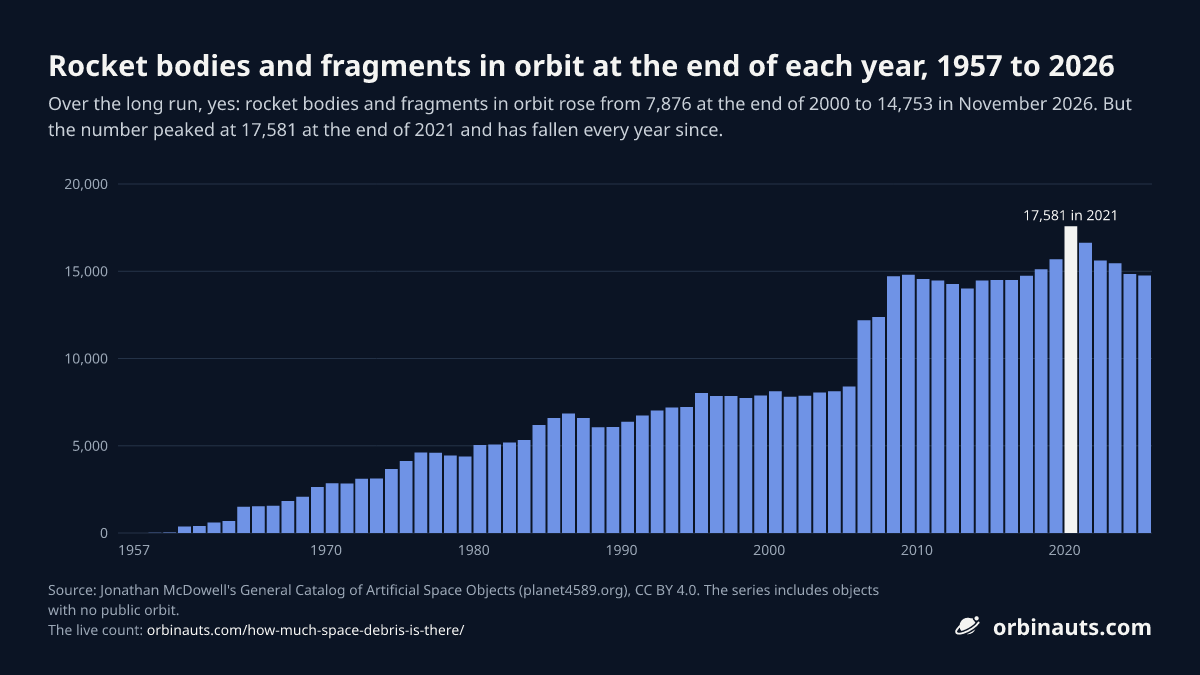
Over the long run, yes: rocket bodies and fragments in orbit rose from 7,876 at the end of 2000 to 14,753 in November 2026. But the number peaked at 17,581 at the end of 2021 and has fallen every year since.
Chart as an image, free to reuse with credit to Orbinauts.com.
| Year | New | Came down | In orbit |
|---|---|---|---|
| 2026, to | 282 | 372 | 14,753 |
| 2025 | 174 | 783 | 14,845 |
| 2024 | 966 | 1,114 | 15,460 |
| 2023 | 377 | 1,394 | 15,613 |
| 2022 | 1,182 | 2,122 | 16,637 |
| 2021 | 2,263 | 365 | 17,581 |
| 2020 | 890 | 311 | 15,692 |
| 2019 | 621 | 247 | 15,120 |
| 2018 | 391 | 134 | 14,747 |
| 2017 | 139 | 148 | 14,498 |
Rocket bodies and fragments only: when each satellite stopped working is not known far enough back to chart dead satellites. “In orbit” is the figure at the end of each year. The series holds 14,753 objects against the 12,612 rocket bodies and fragments in the count at the top, which keeps only objects with a current public orbit. Fragments are often catalogued months or years after the event that made them, so the latest years can still rise.
Key facts
- Two events made the two largest jumps: the Fengyun-1C test added about 3,800 pieces in 2007, and the collision of 2009 about 2,300.
- 2,122 pieces came down in 2022, more than in any year of the table. ESA puts the spike down to the Kosmos 1408 anti-satellite missile test at the end of 2021.
- Debris also comes down every day. What came down, and what is coming down next
How this count is made
Orbinauts counts every object for which Space-Track, the United States catalogue, publishes an orbit less than 30 days old. An object is debris when it is a fragment, a rocket body, unidentified, or a satellite that Jonathan McDowell’s General Catalog no longer lists as working. The count is made again every day.
Other counts are higher because they include more than debris, or objects with no public orbit. Each of them counts active satellites too, so compare the totals.
| Count | What it counts | Tracked objects |
|---|---|---|
| Orbinauts, daily | Objects with a public orbit: 16,478 debris and 16,448 active satellites | 32,926 |
| NASA, | Everything in the United States catalogue: 19,154 satellites, working or not, and 14,900 rocket bodies and fragments | 34,054 |
| ESA, | The United States catalogue plus Russian tracking data, including 10,873 unidentified objects found by other networks, nearly all outside low Earth orbit | 47,268 |
Questions people ask
How much space junk is orbiting Earth?
16,478 tracked pieces as of November 16, 2026, and an estimated 1.5 million pieces of 1 to 10 cm that are too small to track.
How much trash is in space?
16,478 tracked pieces as of November 16, 2026. Space trash, space garbage and space rubbish are everyday names for space debris, from whole dead satellites to fragments the size of a fist.
How much does space debris weigh?
ESA puts everything in Earth orbit at more than 17,600 tonnes in November 2026. That figure includes active satellites. ESA’s figures
How many dead satellites are in orbit?
3,291 satellites in orbit no longer work, beside 16,448 that do. How many satellites are in orbit
How fast does space debris travel?
About 28,000 km/h (17,500 mph) in low Earth orbit, the speed anything needs to stay in orbit at that height.
How long will space debris last?
Several years below 600 km, often centuries at 800 km, and 1,000 years or more above 1,000 km, by NASA’s figures. Debris by height
Does space debris fall to Earth?
Yes, every day. Most of it burns up in the atmosphere. What came down, and what is coming down next
What is the 25-year rule in space?
A guideline NASA proposed in the 1990s: a satellite in low Earth orbit should come down no more than 25 years after its mission ends. Since 2022 the United States regulator, the FCC, asks for five years from the satellites it licenses.
Why is space debris a problem?
Because of its speed. At about 28,000 km/h a piece larger than 1 cm can disable an active satellite, and above 800 km debris stays in orbit for centuries.
Can space junk be cleaned up?
Not so far. ESA calls its ClearSpace-1, planned for 2029, the first mission to remove a piece of space debris from orbit. Test missions have captured a target they brought with them (2021) and flown to within 15 m of an old rocket stage (2024).
Has space debris ever hurt anyone?
No one is known to have been injured by debris re-entering from orbit: ESA said in 2024 that there has never been a confirmed report of a human injury. Most debris burns up, and what survives most likely falls into an ocean or a thinly populated area. What came down, and what is coming down next
What is Kessler syndrome?
A chain reaction in which collisions between pieces of debris make more debris, which causes more collisions, until an orbit is too crowded to use. The NASA scientist Donald Kessler described it in 1978.
Is there a map of space debris?
Yes. The live map shows every tracked piece of debris, by kind and by the breakup it came from.
Why do other websites give a different number?
Some count every tracked object, active satellites included, and some add objects that have no public orbit. How this count is made
How to cite this count
Copy any form. The date is the date of the figures above, so it stays true in a saved copy.
- In a sentence
- As of November 16, 2026, there are 16,478 tracked pieces of space debris in Earth orbit, according to Orbinauts.com.
- As a footnote
- Orbinauts.com, How much space debris is there, orbinauts.com/how-much-space-debris-is-there, retrieved November 16, 2026.
- Under a chart or a table
- Source: Orbinauts.com
Figures are free to reuse under CC BY 4.0.