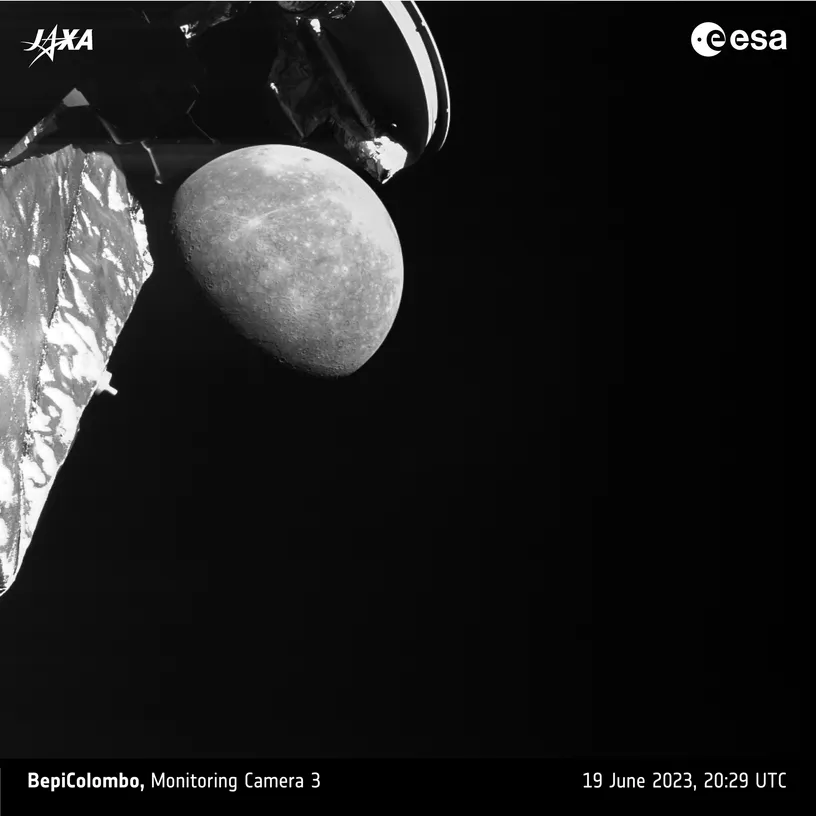
BepiColombo, the joint mission of the European and Japanese space agencies, is in orbit around Mercury. ESA confirmed it on 22 November, once the spacecraft’s signal came back after its orbit insertion burn. Mercury’s gravity had already caught it in a long, loose orbit, 674 to 178,000 km above the surface; the burn was to tighten that into the orbit the mission can work from. The four chemical thrusters of ESA’s Mercury Planetary Orbiter (MPO) were due to fire for 37 minutes, through the spacecraft’s closest approach, planned at 635 km above the surface; on ESA’s plan, from about 18:25 to 19:00 UTC. The two science orbiters are still stacked together, with JAXA’s Mercury Magnetospheric Orbiter, called Mio, on top of MPO.
Only one spacecraft had orbited Mercury before: NASA’s MESSENGER, from 2011 until it crashed into the surface in 2015. BepiColombo is the second mission to orbit the planet, and once Mio is released it will be the first to place two spacecraft there. Because of the Sun’s pull, entering a stable orbit around Mercury takes more energy than sending a mission to Pluto.
On ESA’s planned path, the new orbit runs from about 620 to 53,000 km above the surface, once every two and a half days. ESA has not yet said which orbit the spacecraft actually reached.
Five burns before the eclipses
This first burn only begins the arrival. ESA plans 16 burns between 21 November and March 2027. In ESA’s broadcast on 3 September, its spacecraft operations manager, Ignacio Clerigo, set out what comes next: a first block of five burns, one every three days or so, is to shrink the still very elongated orbit until Mio can be released. Those five have to be done by early December, before Mercury’s long eclipse season, when the spacecraft would otherwise risk draining its batteries.
The steps after that, on dates that may change for operational reasons:
- 9 and 10 December: MPO releases Mio onto its own polar orbit, 590 to 11,640 km above the surface, once every 9.3 hours.
- 16 December: MPO drops the sunshield that has sheltered Mio since launch, and starts lowering its own orbit.
- 10 March 2027: MPO reaches its own polar orbit, 480 to 1,500 km up, once every 2.3 hours.
- April 2027: the science phase begins.
What it will study
Mercury’s surface reaches 450°C, yet craters at its poles seem to hold water ice, which MPO’s instruments aim to measure directly. Besides Earth, it is the only rocky planet with a global magnetic field, though it seems too small to have one, and MPO and Mio will measure it together. It is also dotted with “hollows”, dents that look recent: if BepiColombo finds them changed since MESSENGER’s visit, Mercury is still an active world.
Our preview drew these orbits to scale, from Mercury’s first loose hold to MPO’s final one, and explained why Mercury is so hard to stop at.
 Read nextAfter eight years and nine flybys, BepiColombo is due to enter Mercury orbit on 21 November, only the second mission ever to orbit the planet
Eight years on the way
BepiColombo left Earth on 20 October 2018 and flew past planets nine times to shed speed: Earth once, Venus twice and Mercury six times. By September it had covered 9.9 billion km. On 3 September the Mercury Transfer Module, which had carried the two orbiters all that way, separated, leaving MPO’s thrusters to steer the stack the rest of the way in.