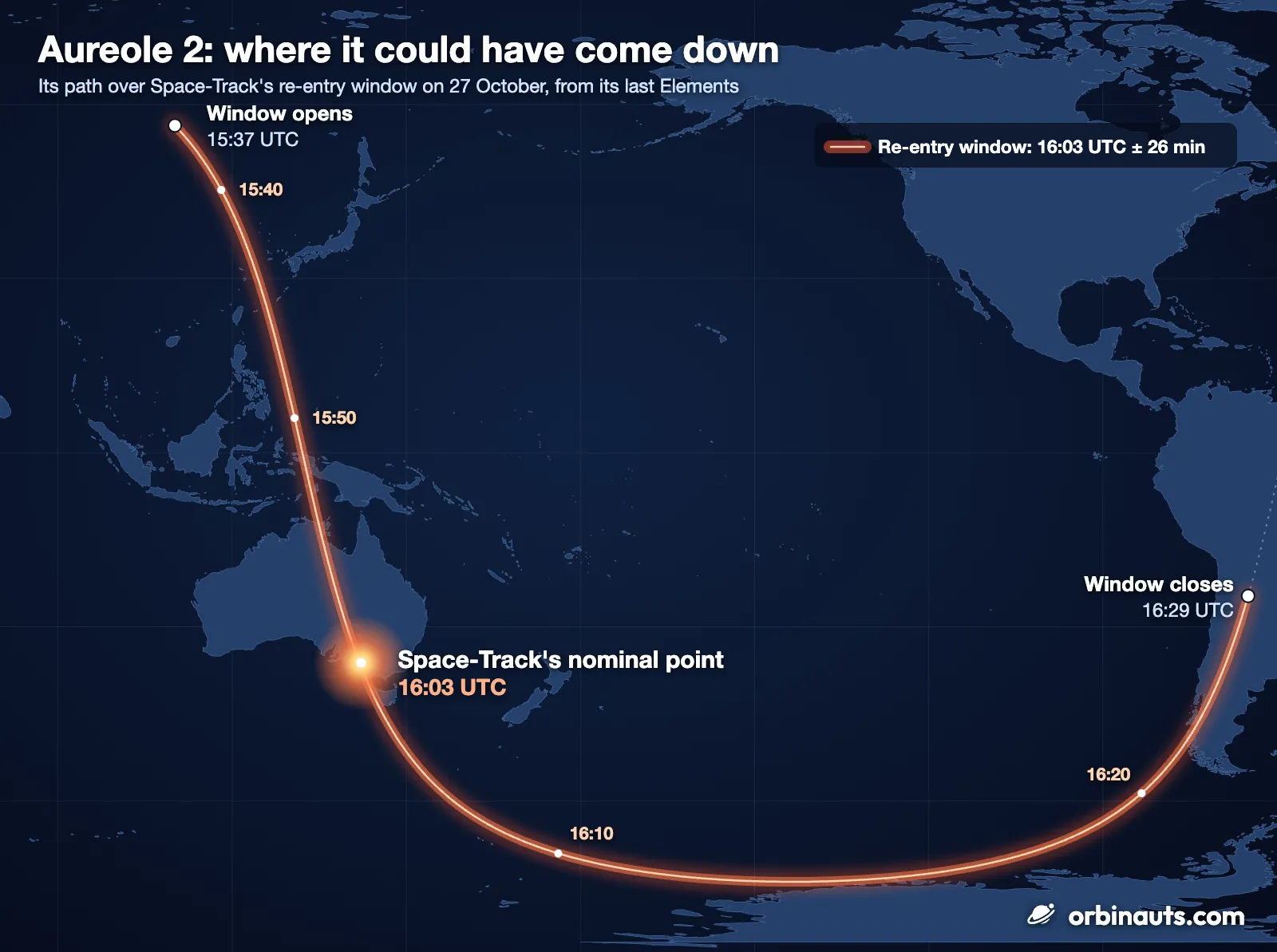
Aureole 2, a Soviet satellite that carried a French instrument to study the aurora, re-entered the atmosphere on 27 October, almost 53 years after its launch. Space-Track’s final prediction puts the re-entry at 16:03 UTC, give or take 26 minutes, on a southbound pass whose nominal point is over western Victoria, Australia, where the local time was just after 3 a.m. on 28 October. A window that wide covers more than half an orbit: on its last Elements, the satellite’s path in those 52 minutes ran from Siberia over China, the western Pacific and Australia, past Antarctica, to Chile and Argentina. Those Elements, from 09:17 UTC that morning, put it 147 to 159 km up.
In this Article
A French instrument on a Soviet satellite
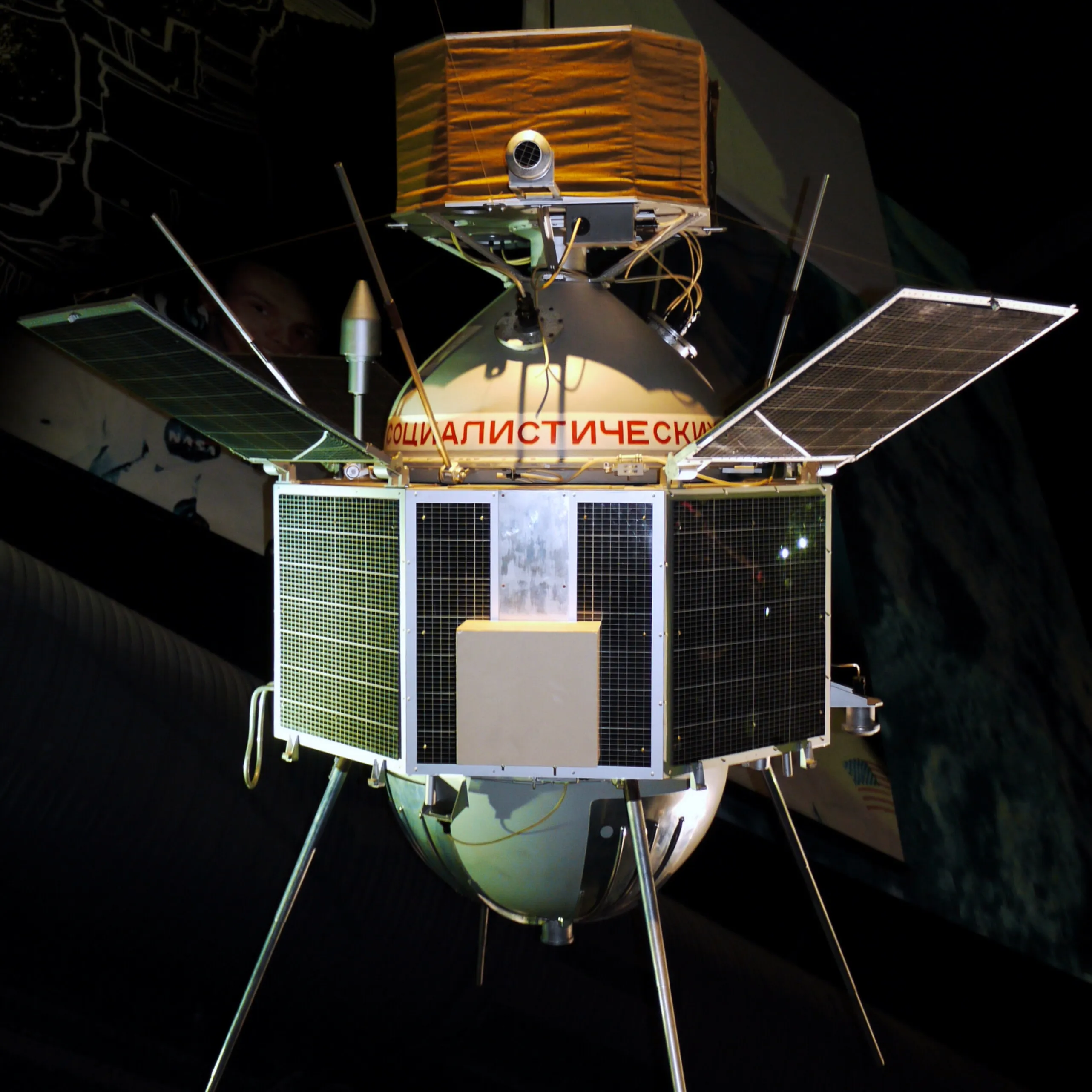
Aureole 2 lifted off from Plesetsk, in northern Russia, on 26 December 1973; the rocket stage that put it in orbit came down on 24 July 2021. Yuzhnoye built it on its DS-U2 platform, and it weighed 348 kg. It carried Arcad, a French instrument made to measure the protons and electrons of the aurora, which flew three times on Soviet satellites, in December 1971, December 1973 and September 1981. ESA’s history of the French space programme places the instrument in the space cooperation France and the Soviet Union opened with an agreement of 30 June 1966. The model at the head of this page, photographed in 2009 in the Air and Space Museum at Le Bourget, near Paris, is of its twin, Aureole 1.
Down in steps
Aureole 2’s orbit was an oval: at its lowest point (the perigee) it passed 399 km above the ground, and at its highest (the apogee) 1,972 km. For half a century the lowest point barely moved: it was still 364 km up in January 2022. What came down was the highest point, and not at a steady pace.
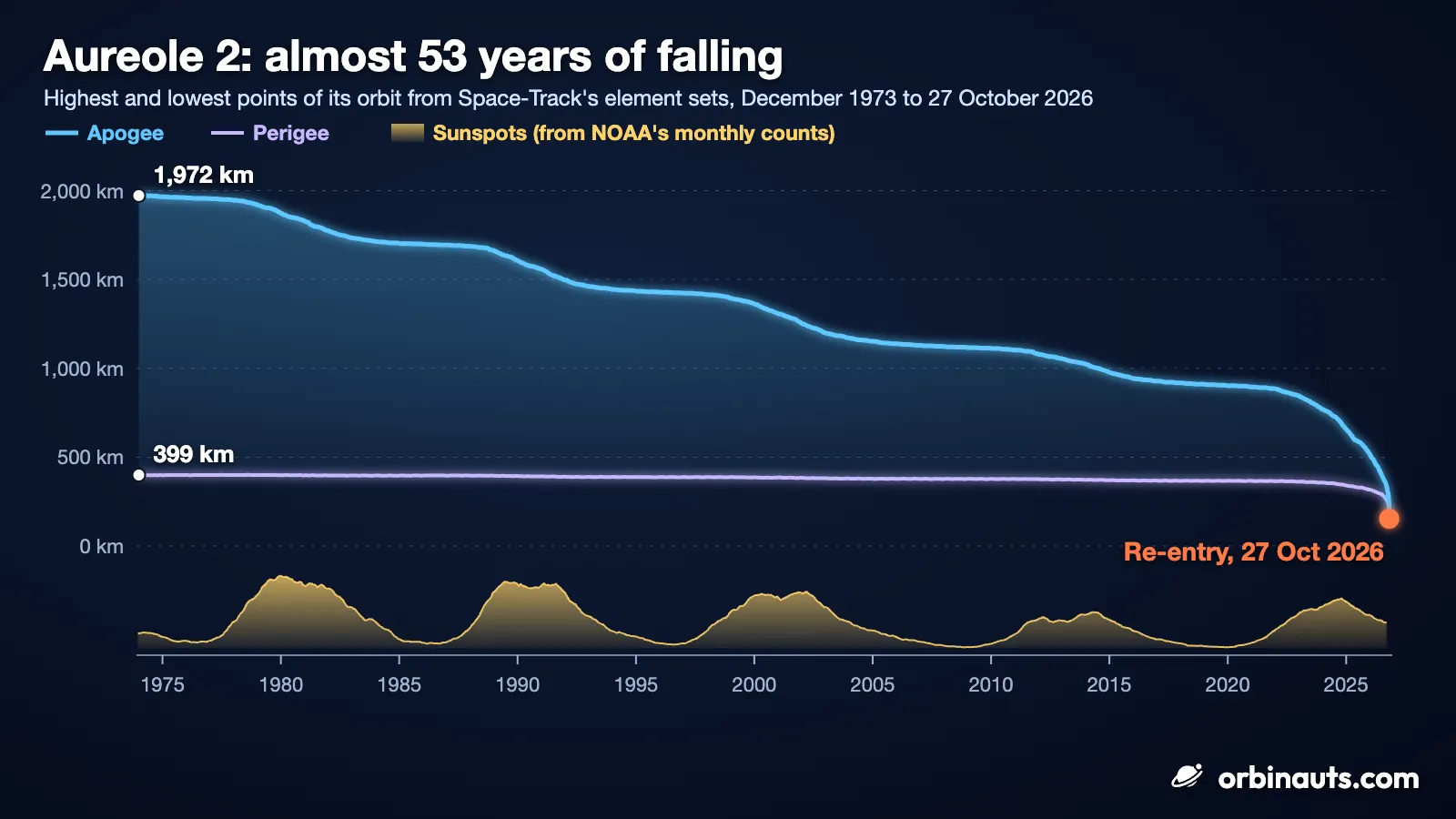
In the four years from January 1979, its apogee fell 187 km. In the four years from January 1984, it fell 27 km. The fast years line up with the peaks of the Sun’s 11-year cycle in NOAA’s sunspot record. When the Sun adds energy to the upper atmosphere, NOAA explains, denser layers of air rise to the heights where low satellites fly, and the drag on them grows.
The end came fast. The apogee took 48 years, to January 2022, to come down from 1,972 km to 884 km, and under five more to lose the last 725 km. In its final year, from 27 October 2025, it fell from 551 km to 159 km.
Another veteran of science is on the same road down:
 Read nextNASA's Swift observatory is losing more than 3 km of height a day and is predicted to re-enter on 2 November
Its sisters are still up
Aureole 1, its twin, went up two years earlier into a higher orbit, reaching 2,474 km. It is still in orbit, 382 km to 1,400 km up in its latest Elements, from 28 October. So is Aureole 3, the third Arcad flight, 370 km to 1,012 km up.