On 16 October Cosmos 2612, a Russian satellite, came up beside ICEYE-X36, a radar imaging satellite of a company that has supported Ukraine since 2022, and over the next two days came within a kilometre of it. In the week after, an analysis spread widely on X that went a step further: it claimed SpaceX had made the approach possible.
In this Article
- Cosmos 2612
Satellite
- ICEYE-X36
Satellite
- Starlink-35856
Satellite
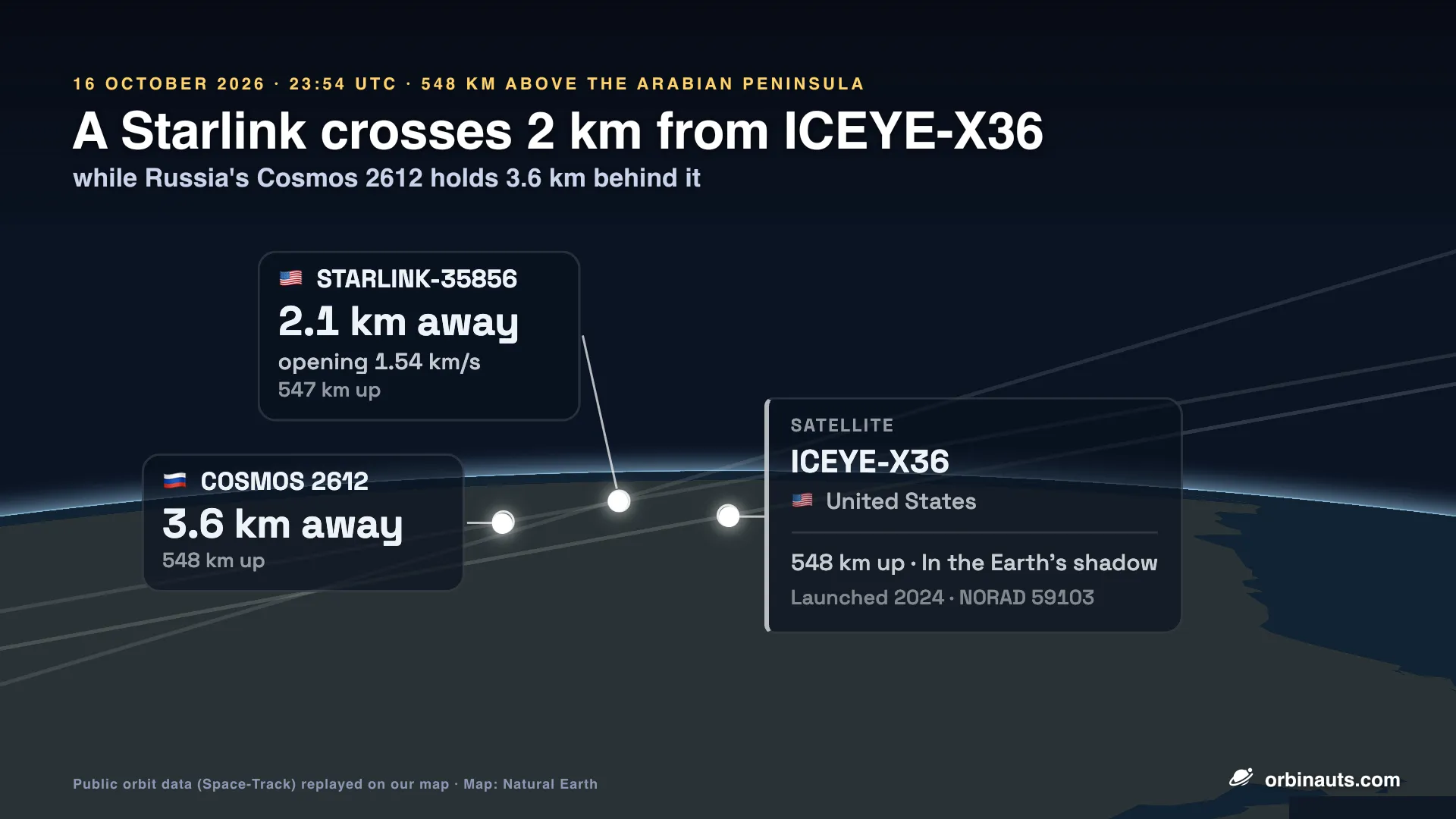
The orbits of both, and of the Starlink at the centre of the claim, are published openly by the US military, so what they did can be checked. We did, with every orbit record published for Cosmos 2612 and ICEYE-X36 from April to 30 October, and for the Starlink in the days around its pass. The video shows the moment at the heart of it.
The chain of claims
The viral analysis makes its case in five links. Written out plainly:
- On the night of 16 October, a Starlink satellite was about to pass within a kilometre of ICEYE-X36, just as Cosmos 2612 closed in.
- SpaceX’s collision alert for that pass “fixed ICEYE-X36 in place”: the satellite could not manoeuvre while the alert stood.
- Otherwise it would have dodged, as it had in June, when, the analysis says, it manoeuvred to evade Cosmos 2612.
- SpaceX’s own data put the pass at 2 km, five times farther than the alert said, so the alert overstated the danger on purpose.
- Therefore SpaceX helped Russia, with 99.9 per cent certainty.
The public orbit data can bear on the first four. We take them one at a time.
1. Did a Starlink really come close, and when?
Yes, a Starlink did cross close to ICEYE-X36 that night, and the data is clear about when. At 23:54 UTC on 16 October, Starlink-35856, launched in December 2025, crossed ICEYE-X36’s path. One flies an orbit tilted 70° to the equator, the other 97.9°, and the two paths happened to meet where the satellites were running nearly opposite each other, so they met almost head-on, at 15.1 km/s relative to each other. At that speed the whole encounter lasts a fraction of a second.
How close is harder to say than it sounds. A kilometre of miss distance at 15 km/s is 0.07 seconds of timing along the track, and the public records are not that precise. A 2009 study by ESA’s debris office found that a fresh record places a satellite in low orbit about 0.5 km off along its path, on average. The older a record gets, the larger that error grows.
So the answer depends on when you ask. Each satellite had several orbit records published over those days, and the prediction anyone could make at a given moment is the newest record of each, run forward to the crossing. Done hour by hour, that prediction swung on 15 October between 0.4 km and 5 km as the Starlink’s records changed. On the morning of 15 October it read about 0.4 km and by the early hours of 16 October 0.7 km, the two figures the analysis cites. From the morning of 16 October it settled: 1.4 km, then 1.75 km, then 1.9 km by 20:00 UTC, four hours before the crossing. The records published after the crossing, with hindsight, say 1.8 to 1.9 km. Across every combination of those days’ records, 180 in all, the pass comes out anywhere from 0.44 km to 5.2 km; the sub-kilometre figures are real outputs of the public data, but they are the early ones.
No alert has been made public. Warnings for a pass like this come from the US Space Force, which screens satellites’ predicted paths up to a week ahead and posts the results to operators through Space-Track, and SpaceX publishes its own Starlink predictions. The analysis’s 0.4 km is a figure the public records themselves gave, not the known content of any warning, and a warning is judged on the probability of collision it carries, not on distance alone.
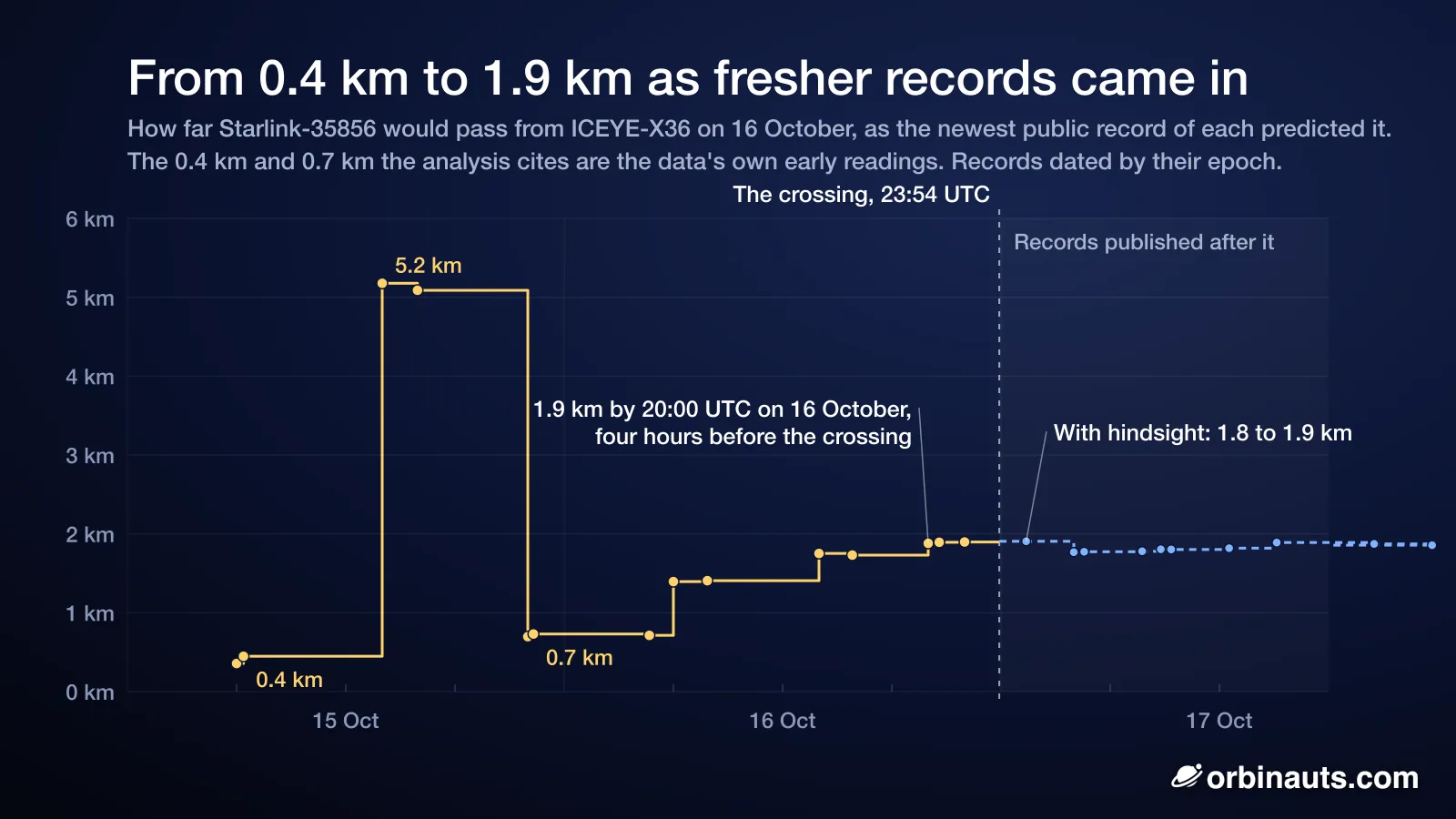
Verdict: a real crossing, about 2 km by the public data’s own last word before it, and under a kilometre only in its earliest guesses.
2. Does a collision alert freeze a satellite?
The analysis’s mechanism is that ICEYE-X36 was “pinned” and “stayed fixed” on 15 and 16 October, its height changing by 17 metres in all, as the analysis has it, because the alert boxed it in.
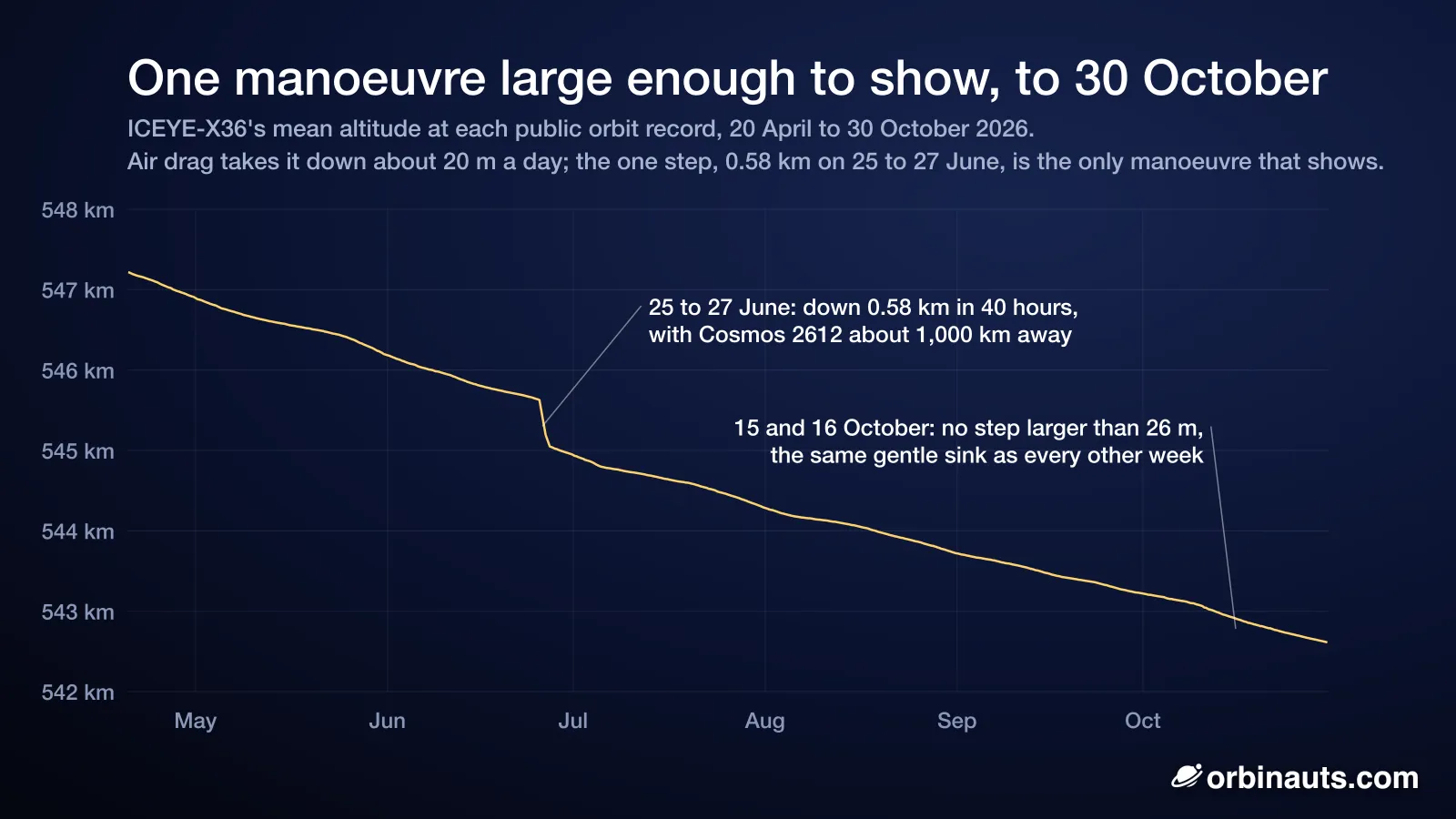
The records agree that it was still. Through October ICEYE-X36’s orbit sank by about 20 metres a day, as the thin air at its height slowly drags it down, and from one record to the next its height never changed by more than 26 metres. That is its normal state. Across all 1,159 records published for it in 2026, the change from one to the next is typically 5 metres, and in 99 of every 100 cases under 50. A radar satellite that goes days without manoeuvring is a radar satellite doing its job. Those two days look like any other two days of its year, with one exception, in June, which is the next link.
An alert can hold a satellite still, for a while. A warning names a time of closest approach, up to a week ahead, and is refreshed as new screenings run, and an operator may well hold off manoeuvring until that moment. With a Starlink, the dodging falls the other way: SpaceX says its satellites take responsibility for avoiding every conjunction by default, and its published guidance does not ask the other operator to stay put. Its 2021 agreement with NASA does have NASA hold still unless told otherwise, but nothing public shows such a deal with ICEYE. So stillness on 15 and 16 October proves little either way. What a warning cannot do is bind anything after the pass. The Starlink passed at 23:54 UTC on 16 October. Cosmos 2612 stayed beside ICEYE-X36 until about midday on 18 October, and by the public records their closest moment came early that day, more than a day after the pass. The records show no manoeuvre by ICEYE-X36 then either.
Verdict: ICEYE-X36’s stillness those days is what it shows almost every day, and it stayed just as still in the days after the pass, when a warning about it no longer applied.
3. Would it have dodged? The June precedent
The analysis says that in June, with Cosmos 2612 closing in, ICEYE-X36 lowered its orbit by half a kilometre and slipped away from it.
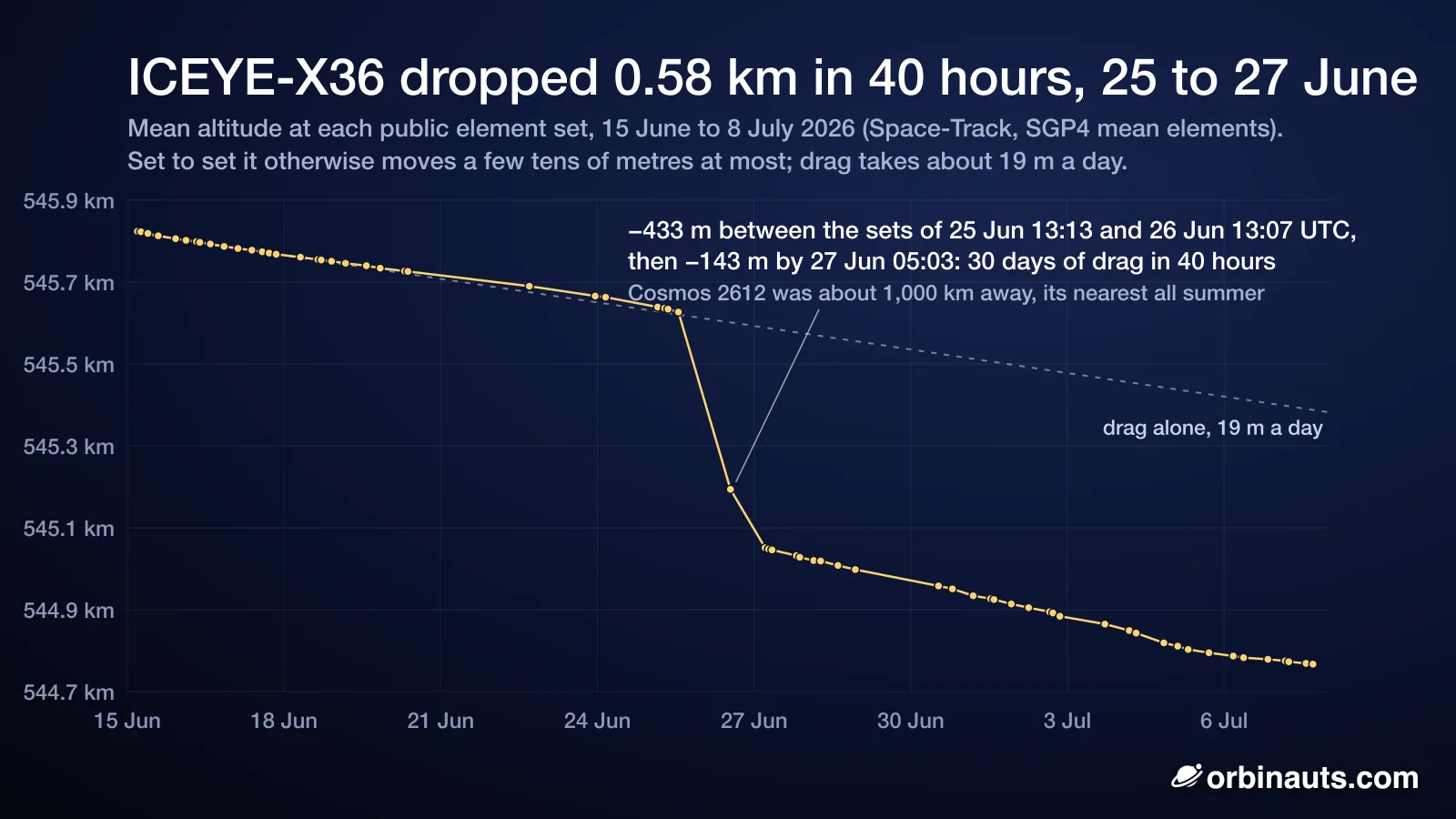
The records confirm the manoeuvre. Between the record of 13:13 UTC on 25 June and the record of 13:07 UTC on 26 June, ICEYE-X36’s average height dropped by 433 metres, and by another 143 metres by the record of 05:03 UTC on 27 June: 576 metres in 40 hours, against the 19 metres a day that air drag was taking. ICEYE-X36’s records otherwise scatter by a few metres, and nothing else in its year comes within a fifth of that. It is the satellite’s one manoeuvre of 2026 large enough to show in the public records, to those of 30 October; whether it was one burn or two, the records cannot tell.
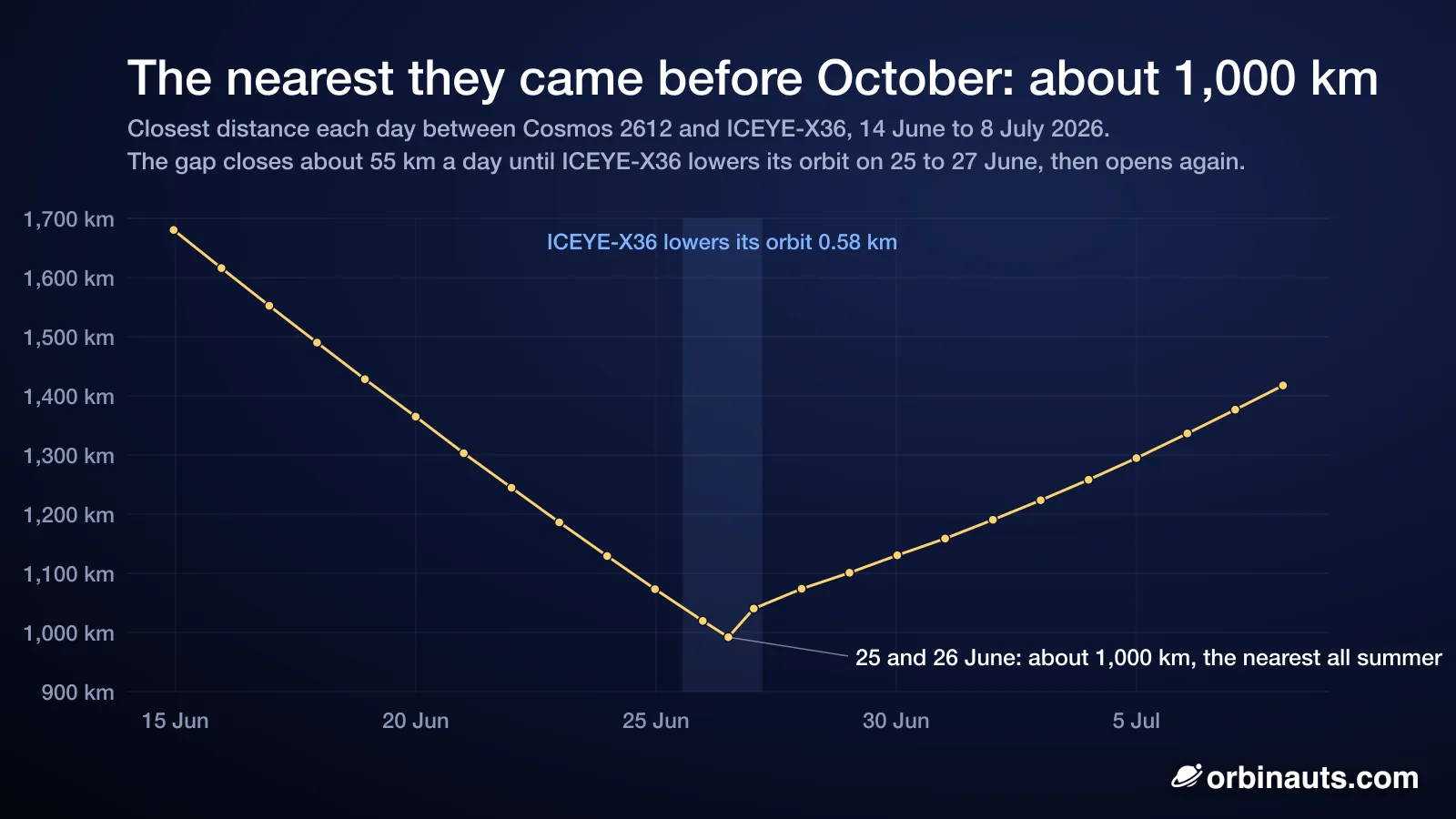
But Cosmos 2612 was nowhere near. That week it was in the same orbital plane, a few hundred metres lower, and closing along the orbit by about 55 km a day: 1,303 km away on 20 June, about 1,000 km on 25 and 26 June, the days of the burn, and pulling away again afterwards, 1,130 km by 30 June. That was the nearest the two came in all of 2026 before October. 1,000 km is a long way to dodge from.
The records do not say why ICEYE lowered its satellite’s orbit that week. Reuters reported on 9 October that Russian satellites came close to an ICEYE satellite in May, and that ICEYE’s chief executive said the company “later moved its satellite, prompting further Russian manoeuvres”. Reuters does not say why the company moved it, when, or which satellite it was. The June burn is the only move large enough to show in ICEYE-X36’s records in 2026, so it may be the one he meant. In May itself, Cosmos 2609 and Cosmos 2613, launched with Cosmos 2612, came within about 4 km of ICEYE-X36, and its records show no manoeuvre.
Before the burn Cosmos 2612 and ICEYE-X36 were getting closer by about 55 km a day; after it they were drawing apart, so the burn did change that. But operators also lower an orbit for reasons of their own: a lower orbit is a slightly faster one, which changes when the satellite passes over each place and exactly which ground it covers. The data settles the distance and leaves the reason open.
Verdict: the June burn is real and may be the move ICEYE’s chief executive described, but with the nearest Russian satellite from that launch about 1,000 km away it says little about what ICEYE-X36 would do with one closing in.
4. Did SpaceX’s own data expose an inflated alert?
The analysis’s strongest-sounding point is that SpaceX’s own ephemerides, the operator’s precise predictions, put the pass at 1.9 to 2.0 km, five times farther than the alert, and it reads the difference as an alert inflated on purpose.
But the 0.4 km has never been shown to be an alert. It is what the public records gave at one stage, and SpaceX’s own predictions are a separate product, built from its satellites’ own navigation data. SpaceX itself warns that outside tracking of a Starlink can differ from them, and a public figure and SpaceX’s can disagree at any moment. A figure from the public records also moves a long way as they are updated, as the chart above shows: they had reached 1.9 km by 20:00 UTC on 16 October. The analysis says SpaceX held its 2 km forecasts while the 0.4 km stood. We have not seen those files, so we cannot say when they read 2 km. But a gap between a public figure and an operator’s own is no evidence that anyone misstated anything.
Verdict: the 0.4 km is an early public figure, not a known alert, and a gap to the 2 km the analysis attributes to SpaceX would show no inflated alert.
5. So did SpaceX help Russia?
The public orbit data gives it no support. Three of the four links the conclusion rests on do not stand up: ICEYE-X36’s stillness is what it shows every week; the June “dodge” was a burn made with the other satellite about 1,000 km away, for a reason the records do not show; and the “inflated alert” rests on an alert no one has made public. The analysis’s 99.9 per cent is not a measurement of anything; it is the confidence it places in a chain with three of its four links unsupported.
That does not prove the opposite. Orbit records say where satellites were, not who was told what or why anyone acted. They cannot show what warning ICEYE received or why ICEYE-X36 stayed put, nor what Russia intended. But the claim was built on the orbits, and the orbits do not carry it.
What Cosmos 2612 did
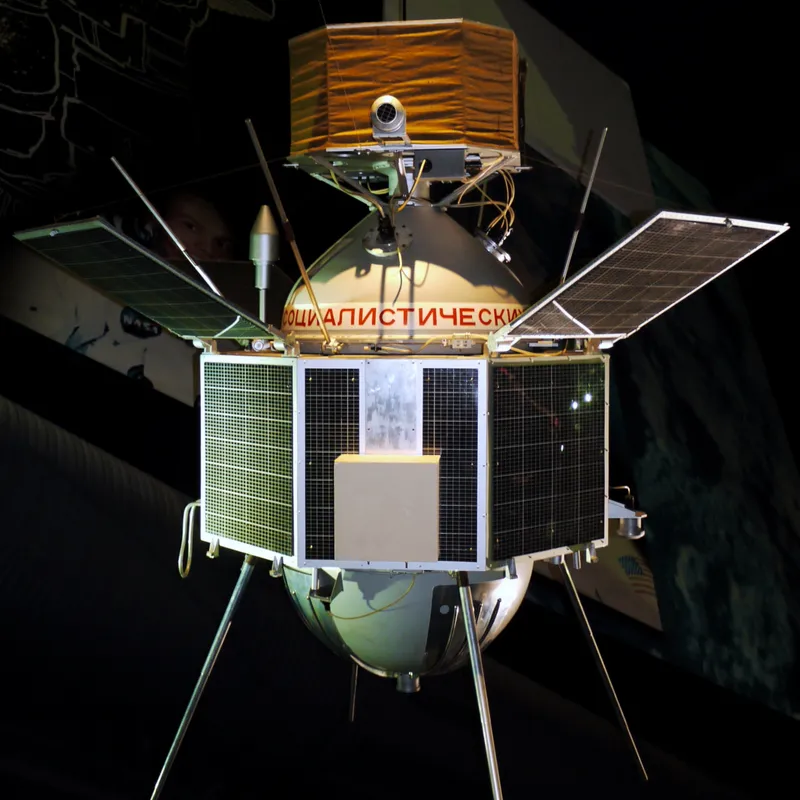
None of this changes the part of the story that was never in dispute. Cosmos 2612, launched on 16 April with five other Russian satellites, reached ICEYE-X36 by its own manoeuvres, a sequence we traced record by record in our Article on its departure: its tilt matched in May, its plane and height matched between 30 September and 12 October, and two burns on 15 and 16 October closed the last few hundred kilometres. Our rendezvous detector, which reads every record Space-Track publishes, raised the pair as beside each other from 14:14 UTC on 16 October, put the nearest pass under a kilometre early on 18 October and marked the pair as parted at 04:21 UTC on 19 October, some hours after Cosmos 2612 had left. LeoLabs, a company that tracks objects in orbit, reported Cosmos 2612 coming within roughly 500 metres, while noting that exact estimates may be uncertain.
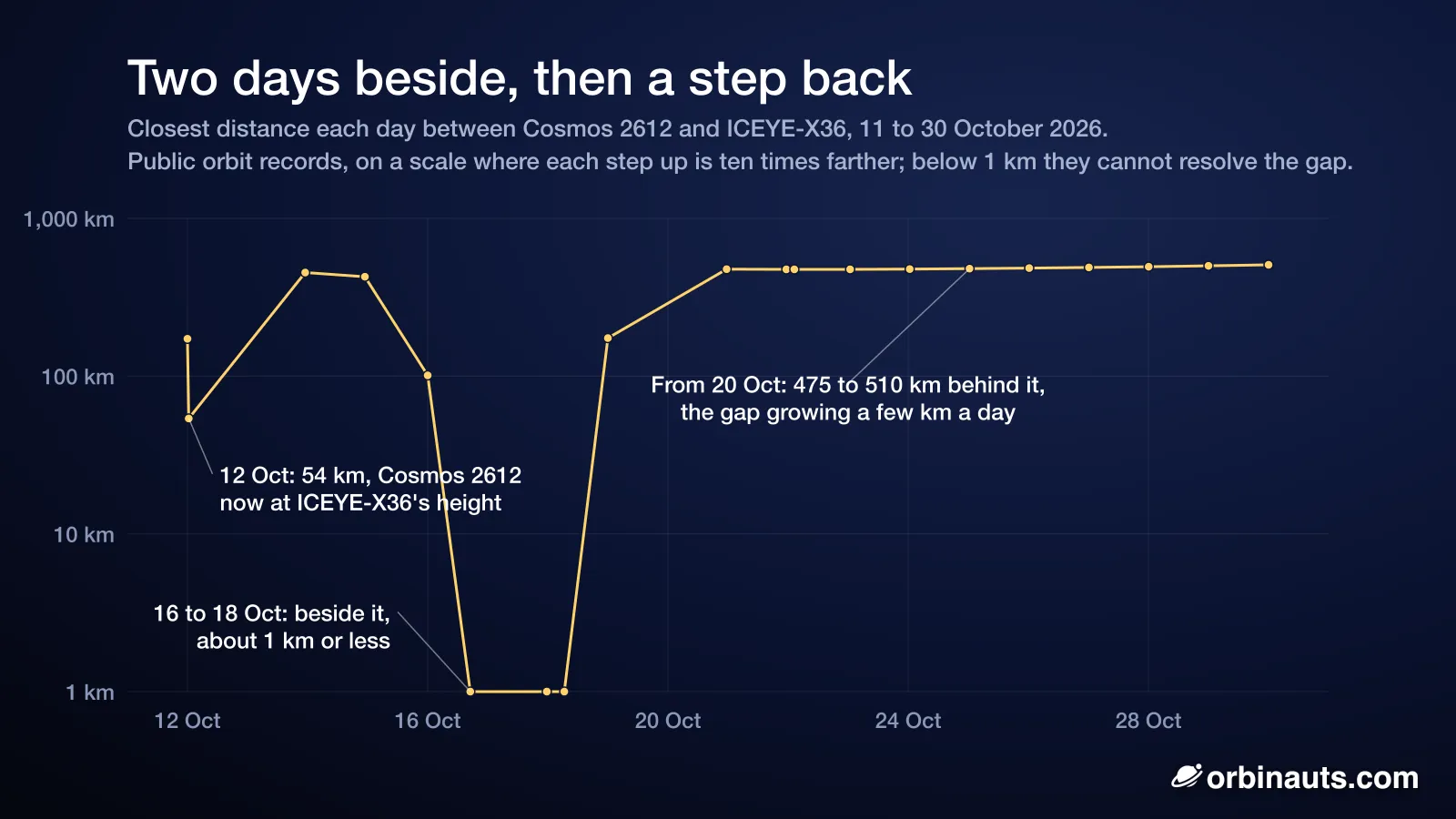
The records also show who did the moving: Cosmos 2612. Its records show the approach and the braking that stopped it beside ICEYE-X36 on 16 October; without that braking it would have flown past. ICEYE-X36’s records over the same days show the slow sink of air drag and nothing else.
And it is not over. On 18 October Cosmos 2612 climbed 2.3 km and, since a higher orbit is a slower one, dropped behind ICEYE-X36. By 20 October it was back at ICEYE-X36’s height, about 480 km behind, and it has stayed in the same orbital plane ever since, 475 to 510 km behind as of 30 October.
LeoLabs, in its report on the approach, said its observations do not establish hostile intent, while showing capabilities that could support inspection, intelligence collection, coercive signalling, interference or preparation for future counterspace operations. What the records show is a Russian satellite that spent six months lining up its orbit with another country’s radar satellite, flew beside it for about two days, stepped back and sits about 500 km behind it; and, by a COMSPOC analysis the same report cites, several of the satellites launched with it made close approaches to ICEYE satellites already in May. That is the story the data supports, and it needs no help from SpaceX to be a story.
 Read nextThe Russian satellite that flew 5 km behind an ICEYE radar satellite has manoeuvred away from it
How we checked
Every figure of ours comes from the orbit records Space-Track publishes, the US Space Force’s public catalogue, run through SGP4, the standard model made for them; launch dates come from CelesTrak. A record appears some hours after the moment it describes, so the hour-by-hour forecast is close to, not exactly, what was known at each moment. Distances worked out from these records carry roughly a kilometre of uncertainty: they are what the records give, not measurements. The video replays the same records on our map.